What is Form SSA-1724?
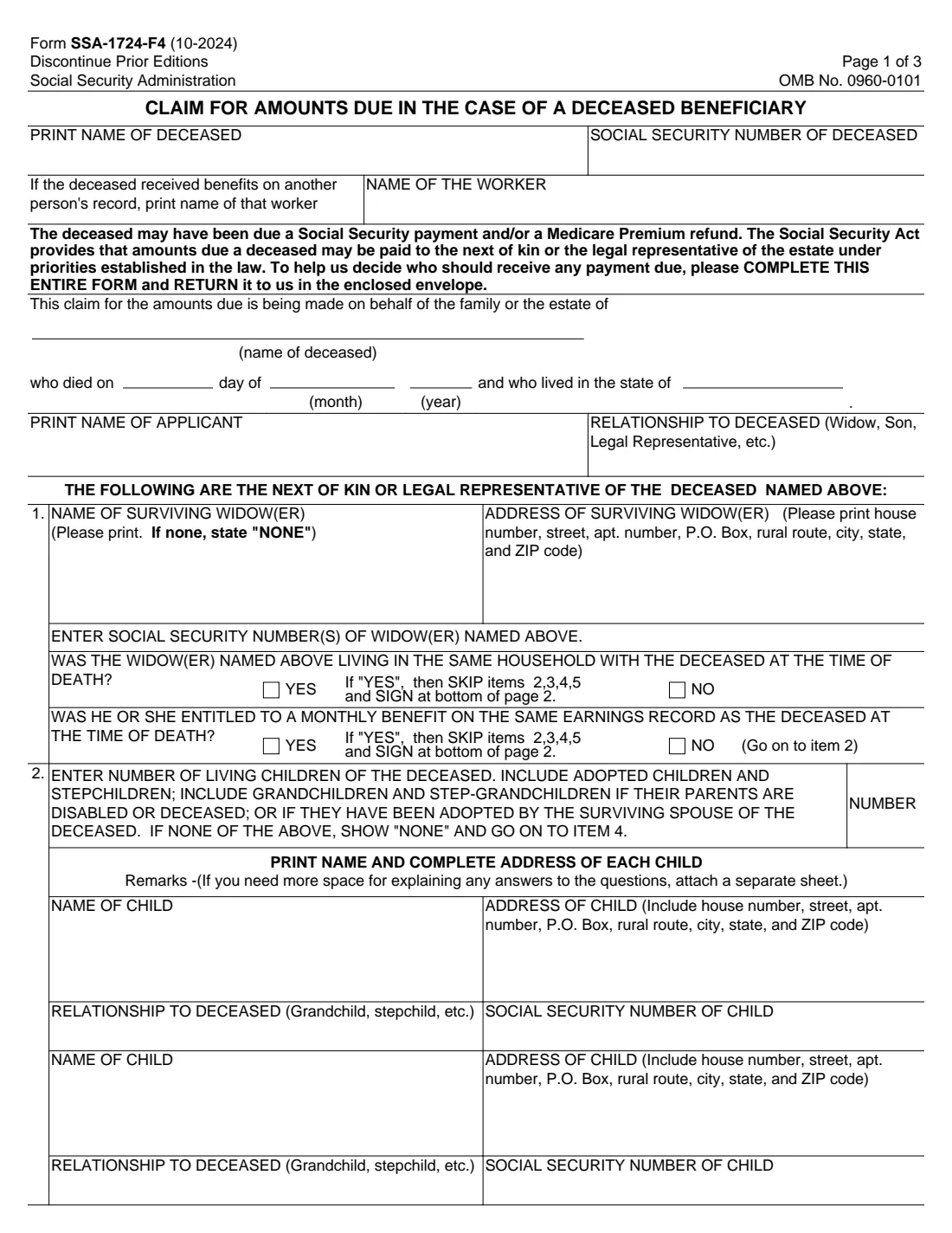
When someone who received Social Security dies, they may still have been due a payment, a Medicare premium refund, or both. Form SSA-1724 is the claim for those amounts, made on behalf of the family or the estate of the person who died.
The Social Security Act says amounts due to a deceased person may be paid to the next of kin or the legal representative of the estate, in an order set by law. So the form asks about the surviving widow(er) first, then living children, then living parents, then the estate's legal representative, and tells you which items to skip.
FileIt pre-fills the deceased's name from your vault, prints the date of death the way the form words it, follows the form's skip rules, and checks that every address fits its box. Your answers are printed on SSA's own PDF (10-2024 edition), accented names included, and saved in the vault folder.
- Who files it
- A family member (next of kin) or the legal representative of the deceased's estate.
- Pages
- 3: the deceased and next of kin, then parents, estate, signature and direct deposit, then the Privacy Act notice.
- Signature
- By hand: SSA's PDF says a wet signature is required. Two witnesses sign only if you sign by mark (X).
- Return it
- To Social Security, in the envelope SSA sent with the form.
- Edition
- Form SSA-1724-F4 (10-2024), OMB No. 0960-0101
Who needs to fill out Form SSA-1724?
- A surviving spouse, child or parent of someone who was getting Social Security benefits.
- The executor or administrator of the estate, when no relatives are listed.
- Anyone Social Security has sent this form to after a beneficiary's death.
When to use Form SSA-1724
- After a Social Security beneficiary dies and SSA says a payment or Medicare premium refund may be due.
- When SSA asks the family or the estate to tell it who the next of kin are.
- A legal representative also sends a certified copy of the letters of appointment.
What you need before you start
- The deceased's name, Social Security number, date of death and state of residence.
- Names, addresses and Social Security numbers of the surviving widow(er), children and parents, as they apply.
- If you're the estate's legal representative, a certified copy of your letters of appointment.
- Your mailing address and phone, and bank routing and account numbers if you want direct deposit.
What’s on Form SSA-1724
The 2024 edition has 3 pages. FileIt asks for it in 8 parts:
- The deceased and youApplicant
- 1. Surviving widow(er)Applicant
- 2. Living childrenApplicant
- 4. Living parentsApplicant
- 5. Legal representative of the estateApplicant
- Signature and contact detailsApplicant
- Direct deposit (financial institution)Applicant
- Witnesses (only if signed by mark)Applicant
How to fill out Form SSA-1724, step by step
1 The deceased and you
Name and SSN of the deceased, the worker's name if benefits were on someone else's record, the date of death and state, and your name and relationship.
2 1. Widow(er)
The surviving widow(er), or NONE. If they lived with the deceased or were entitled on the same record, skip to the signature.
3 2, 4 and 5. Children, parents, estate
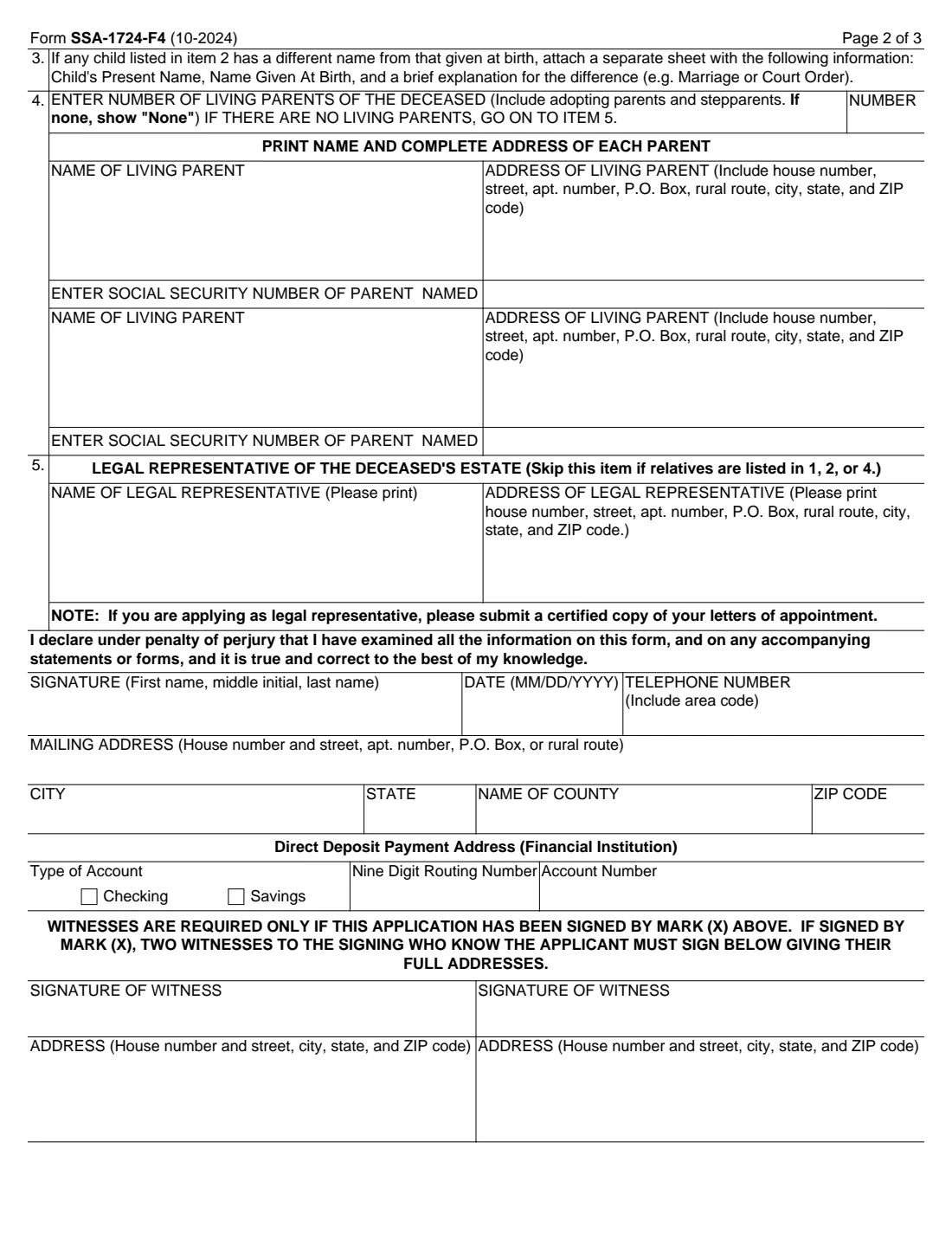
The number of living children and parents (or NONE) with their details, and the estate's legal representative if no relatives are listed.
4 Signature and payment
Your address and phone, and an account for direct deposit. Sign by hand.
Common mistakes to avoid
- Leaving the widow(er) or count boxes empty instead of writing NONE.
- Filling in items 2 to 5 when the widow(er) lived with the deceased or was entitled on the same record: the form says to skip them.
- Applying as legal representative without the certified copy of the letters of appointment.
- Not attaching a sheet when a child's present name differs from the name given at birth (item 3).
After you fill it out
Print the form and sign it by hand.
Attach any sheets the form asks for, such as a child's name change or your letters of appointment.
Return it to Social Security in the envelope SSA sent, and keep a copy. FileIt files the PDF in the vault folder.
Fill out Form SSA-1724 online with FileIt
- Pick the person. Choose someone from People and FileIt fills in their name, date of birth, address and other details it already knows.
- Answer plain-language questions. One part of the form at a time, with the official help text beside each question — 44 fields in all. Your answers save as you go.
- Check the live preview. Watch your answers land on the real Social Security Administration (SSA) form, and let FileIt do any worksheet arithmetic.
- Generate the official PDF. FileIt prints your answers into the agency’s own PDF and files it in that person’s folder in your vault.
FileIt fills the form — it never files or submits anything for you. Deliver the finished form to whoever asked for it, the way the form’s instructions say.
Start Form SSA-1724 now — it’s freeForm SSA-1724: frequently asked questions
What is Form SSA-1724 for?
To claim amounts that were due to a Social Security beneficiary who died, such as an unpaid benefit or a Medicare premium refund.
Who gets the money?
The law sets an order among the next of kin and the legal representative of the estate. The form collects the details SSA needs to decide.
When can I skip most of the form?
If the surviving widow(er) was living in the same household as the deceased at the time of death, or was entitled to a monthly benefit on the same earnings record, the form says to skip items 2 to 5 and sign.
Can I sign it electronically?
No. SSA's PDF says a wet signature is required. If you sign by mark (X), two witnesses who know you sign and give their addresses.
Can the payment go to my bank?
Yes. The form has a direct deposit section for the account type, the nine-digit routing number and the account number.
Official sources
- Blank form (PDF), published by Social Security Administration (SSA): https://www.ssa.gov/forms/ssa-1724.pdf
- Official instructions and guidance: https://www.ssa.gov/forms/ssa-1724.pdf
- Edition shown on this page: Form SSA-1724-F4 (10-2024) (OMB No. 0960-0101); discontinue prior editions (checked 2026-10-25).
FileIt is not affiliated with or endorsed by Social Security Administration (SSA) or any government. This page explains the form in general terms and is not legal, tax or immigration advice. Always read the official instructions, and check that you are using the edition the recipient accepts. Page last reviewed 2026-10-25.