What is Form RD-1061?
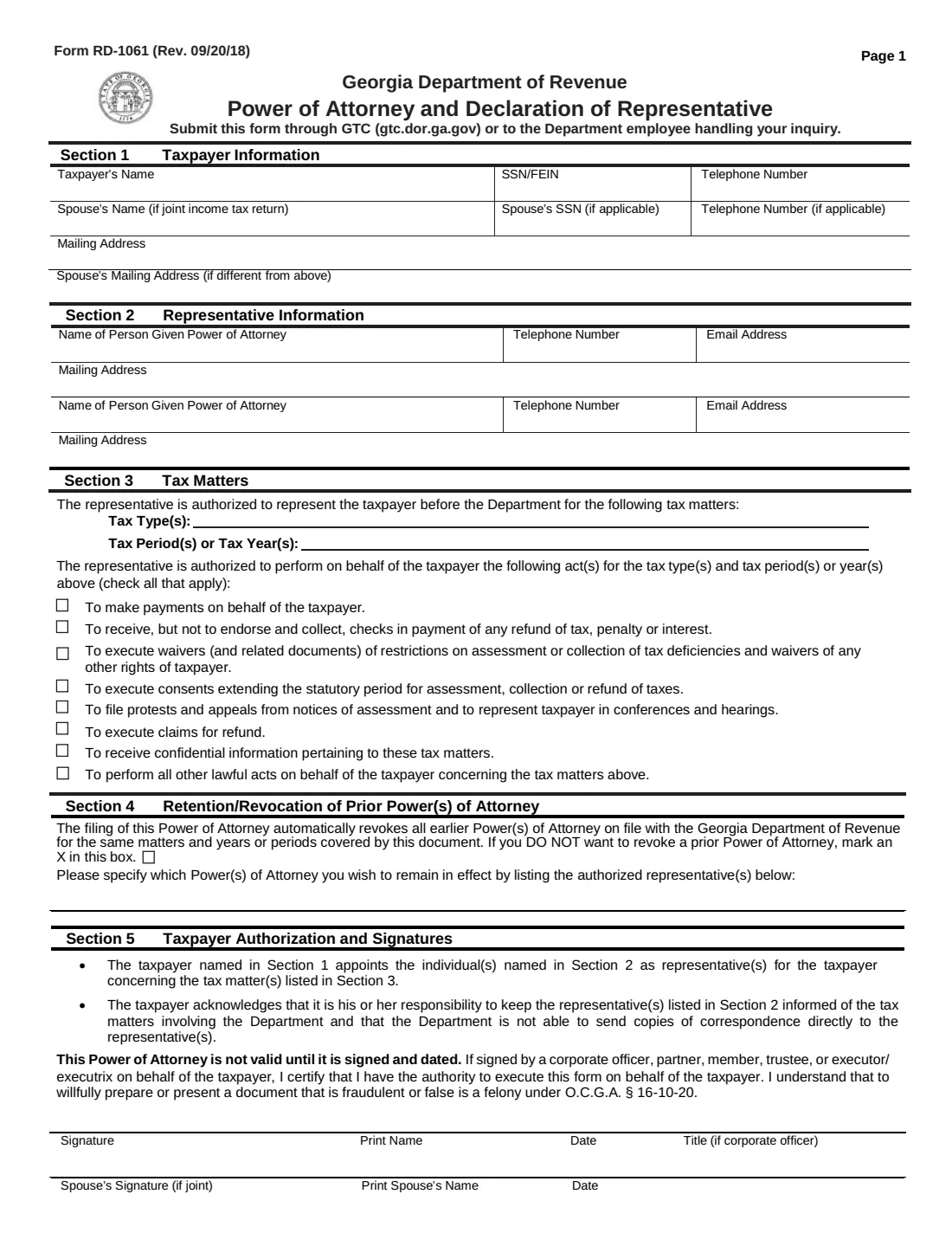
Form RD-1061 is the Georgia Department of Revenue's power of attorney. A taxpayer uses it to authorize one or more individuals to represent them before the Department, to discuss and access confidential information, and to perform the acts you tick — such as making payments, signing waivers or consents, filing protests and appeals, or claiming refunds — for the tax types and periods you list.
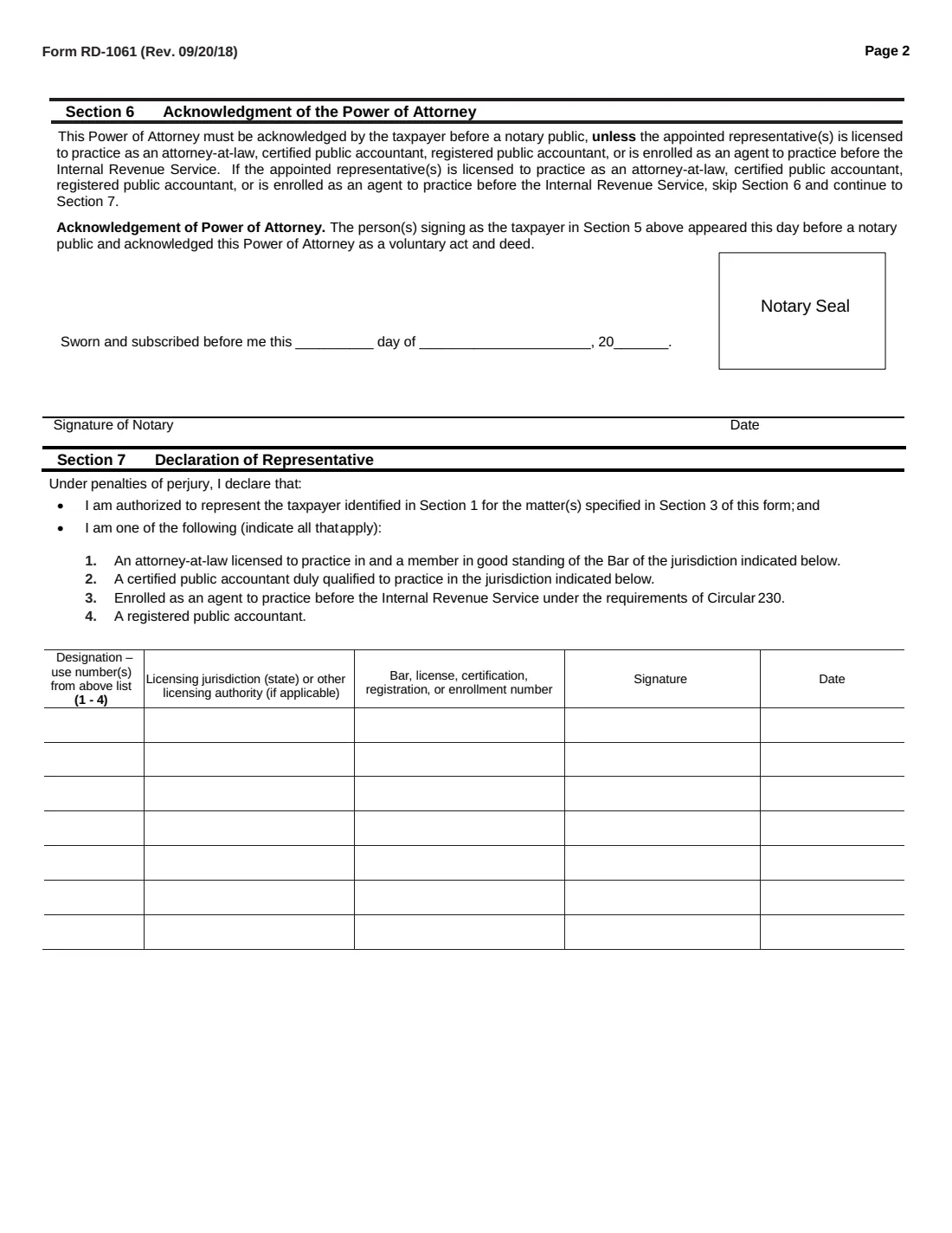
The power of attorney must be acknowledged before a notary public unless the representative is an attorney, certified public accountant, registered public accountant or IRS enrolled agent; in that case the representative completes Section 7 instead. Notices and correspondence still go to the taxpayer, not the representative.
FileIt walks you through each section and prints your answers into the Department's own RD-1061 PDF, ready to sign and upload through the Georgia Tax Center.
- Who fills it
- The taxpayer (individual or business); the representative signs Section 7
- Sent to
- Uploaded through the Georgia Tax Center (GTC), or sent to the DOR employee handling your inquiry
- Notary
- Required unless a representative is an attorney, CPA, registered public accountant or enrolled agent
- Signatures
- Taxpayer (and spouse for a joint return); licensed representatives in Section 7
- Edition
- Rev. 09/20/18
- Agency
- Georgia Department of Revenue
Who needs to fill out Form RD-1061?
- Individuals who want a CPA, attorney or enrolled agent to handle a Georgia income tax matter for them.
- Married couples giving someone access to a joint Georgia income tax return — both spouses sign.
- Businesses (corporations, partnerships, LLCs) authorizing a representative for sales, withholding or other Georgia taxes.
- Trusts and estates, signed by the trustee or executor.
When to use Form RD-1061
- When someone else will talk to the Department of Revenue about your account, a notice or an audit.
- When a representative needs to file a protest or appeal, sign a waiver or consent, or claim a refund for you.
- When you change representatives — a new RD-1061 revokes earlier ones for the same matters and periods unless you keep them in Section 4.
What you need before you start
- The taxpayer's name, full SSN (individual) or FEIN (business), phone and mailing address.
- For a joint return, the spouse's name, full SSN and address.
- Each representative's name, phone, email and mailing address — representatives must be individuals, not firms.
- The tax type(s) and the specific years or periods covered.
- For a licensed representative: their designation and license, bar or enrollment number.
What’s on Form RD-1061
The 2018 edition has 4 pages. FileIt asks for it in 8 parts, and it is signed by Taxpayer and Spouse (joint return) and Representative 1 and Representative 2:
- Section 1: Taxpayer informationTaxpayer
- Section 2: RepresentativeTaxpayer
- Section 2: Second representativeTaxpayer
- Section 3: Tax mattersTaxpayer
- Section 4: Earlier powers of attorneyTaxpayer
- Section 5: Taxpayer authorization and signaturesTaxpayer
- Section 6: Notary acknowledgmentTaxpayer
- Section 7: Declaration of representativeRepresentative 1
How to fill out Form RD-1061, step by step
1 Section 1: Taxpayer information
Enter the name, address and contact details. An individual gives the full Social Security number; a business gives its Federal Employer Identification Number. To grant access to a joint return, add the spouse's name, address and full SSN.
2 Section 2: Representative information
Enter each representative's name and contact details. The form has room for two; for more, the instructions say to attach a schedule like Section 2, signed by the taxpayer.
3 Section 3: Tax matters
List the tax type(s) and the specific period(s) or year(s). The Department will only discuss and disclose information for what you list. Then tick each act the representative may perform: payments, receiving (not endorsing) refund checks, waivers, consents to extend the statutory period, protests and appeals, refund claims, receiving confidential information, and all other lawful acts.
4 Section 4: Earlier powers of attorney
Filing the form revokes all earlier RD-1061s for the same matters and periods. To keep one, mark the box and list the representatives who should stay; if you mark it without naming anyone, all existing RD-1061s stay in effect.
5 Section 5: Signatures
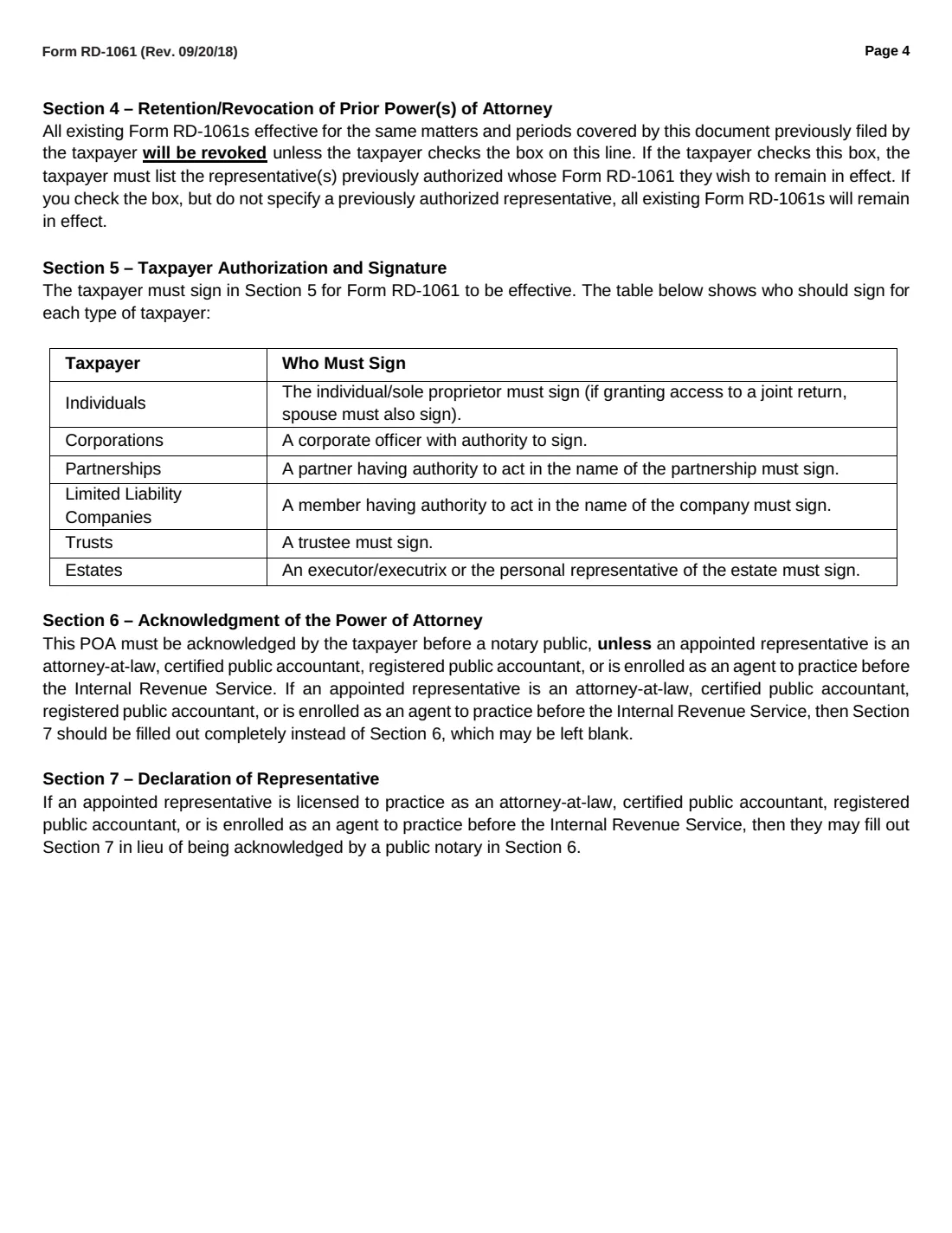
The form is not valid until it is signed and dated. Individuals sign themselves (and the spouse for a joint return). For a business, a corporate officer, partner, LLC member, trustee or executor with authority signs and gives their title.
6 Sections 6 and 7: Notary or declaration
If no representative is an attorney, CPA, registered public accountant or enrolled agent, sign before a notary, who completes Section 6. Otherwise each licensed representative completes Section 7 with their designation (1–4), licensing jurisdiction, license number, signature and date, and no notary is needed.
Common mistakes to avoid
- Leaving the tax types or periods vague — the Department only discusses what is listed.
- Naming a firm rather than an individual as the representative.
- Forgetting the notary when the representative isn't an attorney, CPA, registered public accountant or enrolled agent.
- Accidentally revoking an existing representative — mark Section 4 if an earlier power of attorney should stay.
- Leaving out the spouse's signature on a joint-return authorization.
- Expecting the representative to receive notices — correspondence still goes to the taxpayer.
After you fill it out
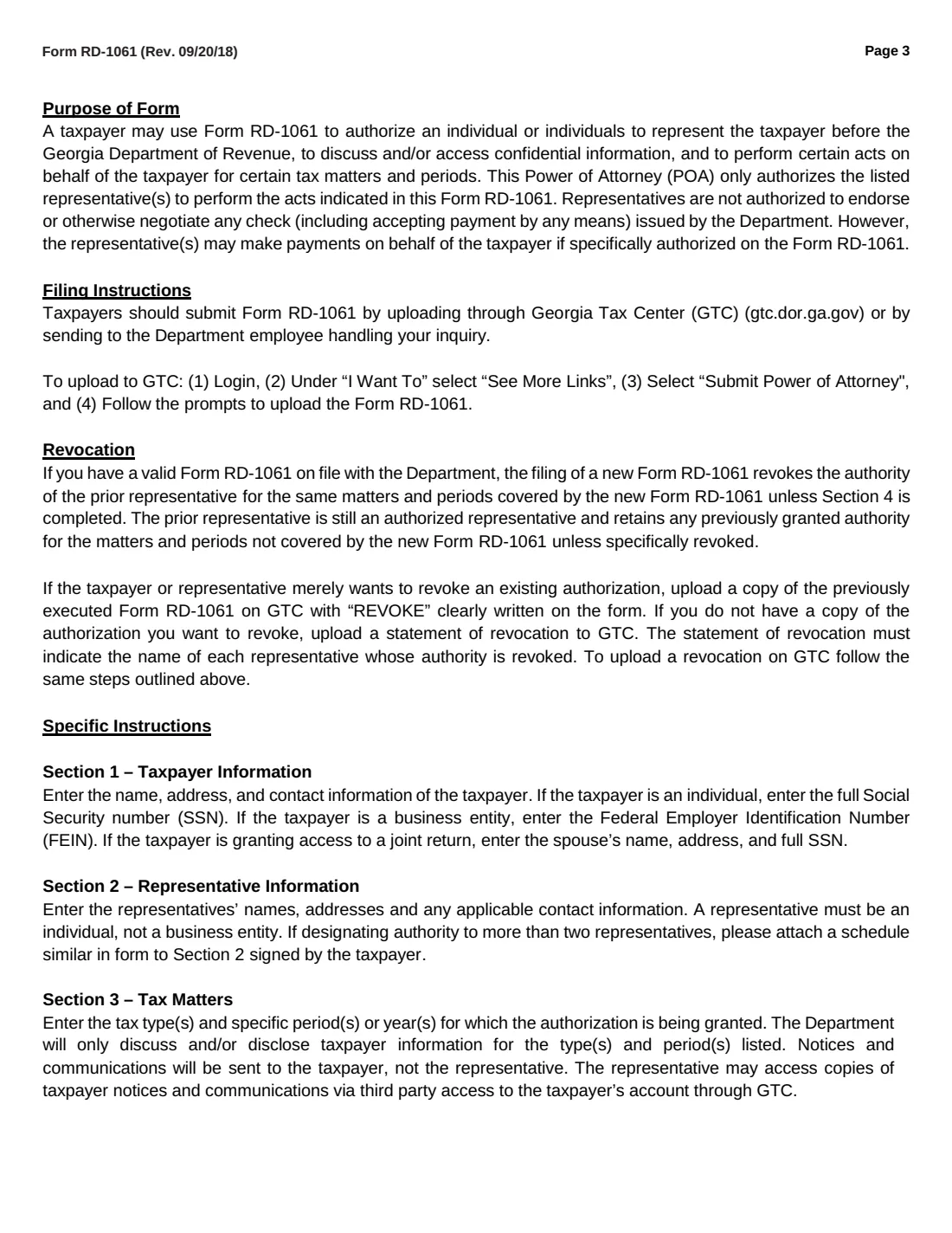
Sign and date Section 5, have it notarized or have the licensed representative complete Section 7, then upload it through the Georgia Tax Center: log in, under "I Want To" select "See More Links", choose "Submit Power of Attorney" and follow the prompts. You can instead send it to the Department employee handling your inquiry.
The representative can see copies of your notices through third-party access to your account in GTC.
To revoke an authorization later, the instructions say to upload a copy of the earlier RD-1061 with "REVOKE" clearly written on it, or, without a copy, a statement of revocation naming each representative whose authority is revoked. FileIt keeps the signed form in your vault.
Fill out Form RD-1061 online with FileIt
- Pick the person. Choose someone from People and FileIt fills in their name, date of birth, address and other details it already knows.
- Answer plain-language questions. One part of the form at a time, with the official help text beside each question — 43 fields in all. Your answers save as you go.
- Check the live preview. Watch your answers land on the real Georgia Department of Revenue form, and let FileIt do any worksheet arithmetic.
- Generate the official PDF. FileIt prints your answers into the agency’s own PDF and files it in that person’s folder in your vault. Sign it, or send it for e-signature.
FileIt fills the form — it never files or submits anything for you. Deliver the finished form to whoever asked for it, the way the form’s instructions say.
Start Form RD-1061 now — it’s freeForm RD-1061: frequently asked questions
Can I appoint more than two representatives?
Yes. The form has room for two; the instructions say to attach a schedule similar in form to Section 2, signed by the taxpayer, for more.
Does the RD-1061 need to be notarized?
Yes, unless an appointed representative is an attorney, CPA, registered public accountant or IRS enrolled agent, who then completes Section 7 instead.
How do I submit Form RD-1061?
Upload it through the Georgia Tax Center (gtc.dor.ga.gov) using "Submit Power of Attorney", or send it to the Department employee handling your inquiry.
Will my representative get my notices?
No. Notices and communications are sent to the taxpayer. The representative can see copies through third-party access in GTC.
Does a new RD-1061 cancel my old one?
It revokes earlier RD-1061s for the same matters and periods, unless you mark the Section 4 box and list the representatives to keep.
Can my representative cash my refund check?
No. The form lets a representative receive refund checks, but not endorse or collect them.
Official sources
- Blank form (PDF), published by Georgia Department of Revenue: https://dor.georgia.gov/document/form/rd-1061poaformpdf/download
- Official instructions and guidance: https://dor.georgia.gov/document/form/rd-1061poaformpdf/download
- Edition shown on this page: Rev. 09/20/18 (checked 2026-09-28).
FileIt is not affiliated with or endorsed by Georgia Department of Revenue or any government. This page explains the form in general terms and is not legal, tax or immigration advice. Always read the official instructions, and check that you are using the edition the recipient accepts. Page last reviewed 2026-09-28.