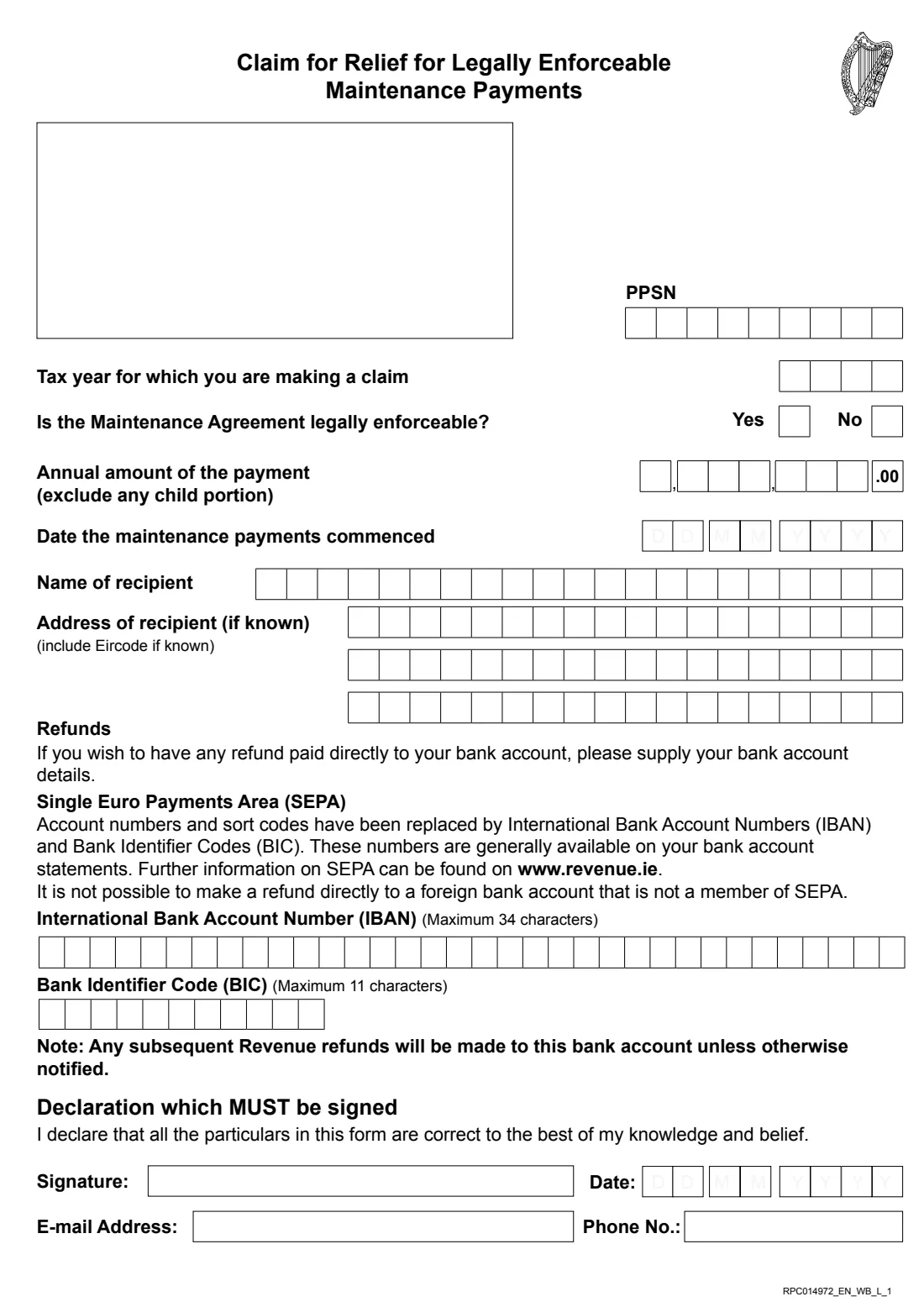

What is Maintenance payments relief claim?
If you pay maintenance to a former spouse or civil partner under a legally enforceable arrangement, you can deduct those payments when your total income is worked out. Revenue lists the arrangements that count: an order of court, a deed of separation, a rule of court, a trust, a covenant, or any other arrangement that creates a legally enforceable obligation.
The payments must be made gross, the person receiving them is normally taxed on them, and you are both assessed as single people. Any part paid for the benefit of a child is ignored for tax, so it is left out of the amount you claim. Voluntary maintenance gets no deduction at all.
FileIt fills Revenue's own form box by box, prints the amount and dates in their cells, checks your IBAN and dates, and saves the result in your vault. You sign and send it to Revenue yourself.
- Issued by
- Office of the Revenue Commissioners (Revenue)
- Relief
- A deduction from total income
- Who can claim
- The payer of legally enforceable maintenance
- Child portion
- Excluded
- Keep records
- Six years, in case of audit
- Edition
- RPC014972_EN_WB_L_1 (January 2026 PDF)
Who needs to fill out Maintenance payments relief claim?
- People paying maintenance to a former spouse or civil partner under a court order or deed of separation.
- Payers under a trust, covenant or other legally binding maintenance agreement.
- Anyone who wants the relief for an earlier year and has a refund to claim.
When to use Maintenance payments relief claim
- When legally enforceable maintenance payments start, so the deduction is reflected in your tax.
- For a previous tax year, within four years after the end of that year.
- Not for voluntary payments, and not for the child part of any payment.
What you need before you start
- Your name, address and PPSN.
- The tax year you're claiming for.
- The yearly amount you pay, leaving out any child portion.
- The date the payments began.
- The name and, if known, the address of the person you pay.
- Your IBAN and BIC if you'd like any refund paid to your account.
What’s on Maintenance payments relief claim
The 2026 edition has 2 pages. FileIt asks for it in 4 parts, and it is signed by Claimant (the payer):
- Your claimClaimant (the payer)
- RecipientClaimant (the payer)
- Refunds: bank details (SEPA)Claimant (the payer)
- DeclarationClaimant (the payer)
How to fill out Maintenance payments relief claim, step by step
1 Your details
Your name and address go in the large box at the top, then your PPSN.
2 The claim
The tax year, Yes or No to whether the agreement is legally enforceable, the yearly amount and the start date.
3 The recipient
The name of your former spouse or civil partner, and their address if you know it.
4 Refunds
Optional bank details. Refunds for the current year come through your wages, and for earlier years directly from Revenue.
5 Declaration
Sign and date the declaration, and add an email and phone number.
Common mistakes to avoid
- Including the part of a payment that's for your children.
- Claiming for voluntary maintenance, which doesn't qualify.
- Giving the date of the court order instead of the date the payments started, if they differ.
- Not keeping the court order or deed. Revenue asks you to keep documents for six years.
After you fill it out
Sign the form and send it to your Revenue office. FileIt never files it for you.
Store the filled form and a copy of the order or deed in your FileIt vault.
For the current year, look for an amended certificate of tax credits; for earlier years, watch for Revenue's refund.
Fill out Maintenance payments relief claim online with FileIt
- Pick the person. Choose someone from People and FileIt fills in their name, date of birth, address and other details it already knows.
- Answer plain-language questions. One part of the form at a time, with the official help text beside each question — 15 fields in all. Your answers save as you go.
- Check the live preview. Watch your answers land on the real Office of the Revenue Commissioners (Revenue) form, and let FileIt do any worksheet arithmetic.
- Generate the official PDF. FileIt prints your answers into the agency’s own PDF and files it in that person’s folder in your vault. Sign it, or send it for e-signature.
FileIt fills the form — it never files or submits anything for you. Deliver the finished form to whoever asked for it, the way the form’s instructions say.
Start Maintenance payments relief claim now — it’s freeMaintenance payments relief claim: frequently asked questions
What counts as legally enforceable maintenance?
The form lists payments under an order of court, a deed of separation, a rule of court, a trust, a covenant, or any other arrangement giving rise to a legally enforceable obligation.
Can I claim for child maintenance?
No. Revenue's notes say child maintenance is effectively ignored for tax, with no deduction for the payer.
Is the person I pay taxed on it?
Usually yes. The form's notes explain that the recipient is taxable on the payments, unless the couple jointly elect to be treated as married or civil partners, in which case the payments are ignored for tax.
What happens to a refund?
For the current year, your employer pays any refund through your wages after Revenue sends an amended certificate. For an earlier year, Revenue pays you by cheque or to your bank account.
Can FileIt fill this form?
Yes. FileIt fills Revenue's own PDF, checks your answers and saves it in your vault. You can sign by hand or e-sign in FileIt, then send it to Revenue yourself.
Official sources
- Blank form (PDF), published by Office of the Revenue Commissioners (Revenue): https://www.revenue.ie/en/additional-incomes/documents/claim-relief-legally-enforceable-maintenance-payments.pdf
- Official instructions and guidance: https://www.revenue.ie/en/personal-tax-credits-reliefs-and-exemptions/marital-and-civil-status/maintenance-payments-relief/legally-enforceable-maintenance-payments.aspx
- Edition shown on this page: RPC014972_EN_WB_L_1 (PDF of January 2026) (checked 2026-10-19).
FileIt is not affiliated with or endorsed by Office of the Revenue Commissioners (Revenue) or any government. This page explains the form in general terms and is not legal, tax or immigration advice. Always read the official instructions, and check that you are using the edition the recipient accepts. Page last reviewed 2026-10-19.