What is Form Double Deduction 1?
When an Irish employee works some of their duties in a country Ireland has a double taxation agreement with, both countries can deduct tax from the same pay. Form Double Deduction 1 asks Revenue to give credit for the non-refundable foreign tax in real time through PAYE, rather than waiting until the end of the year.
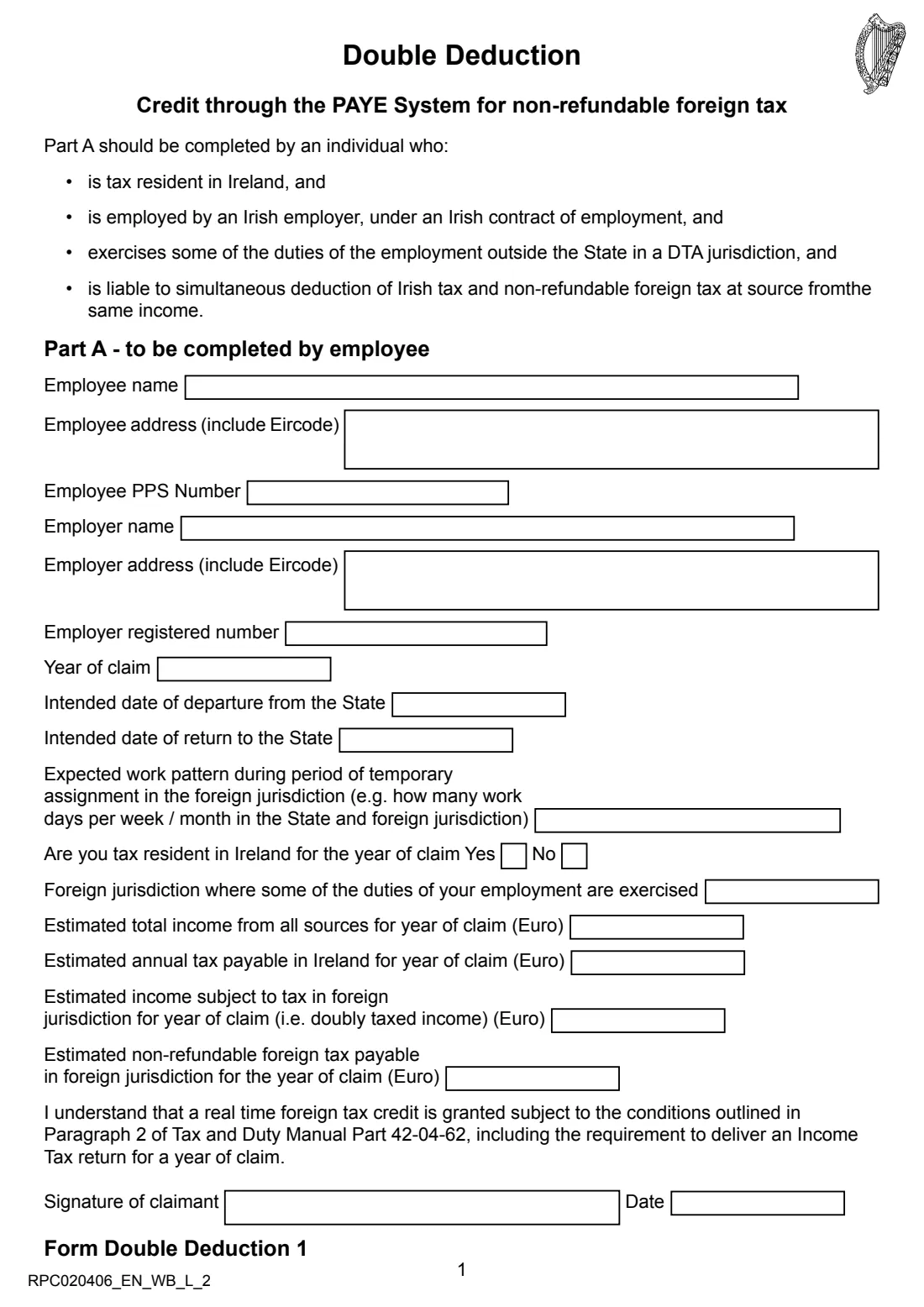
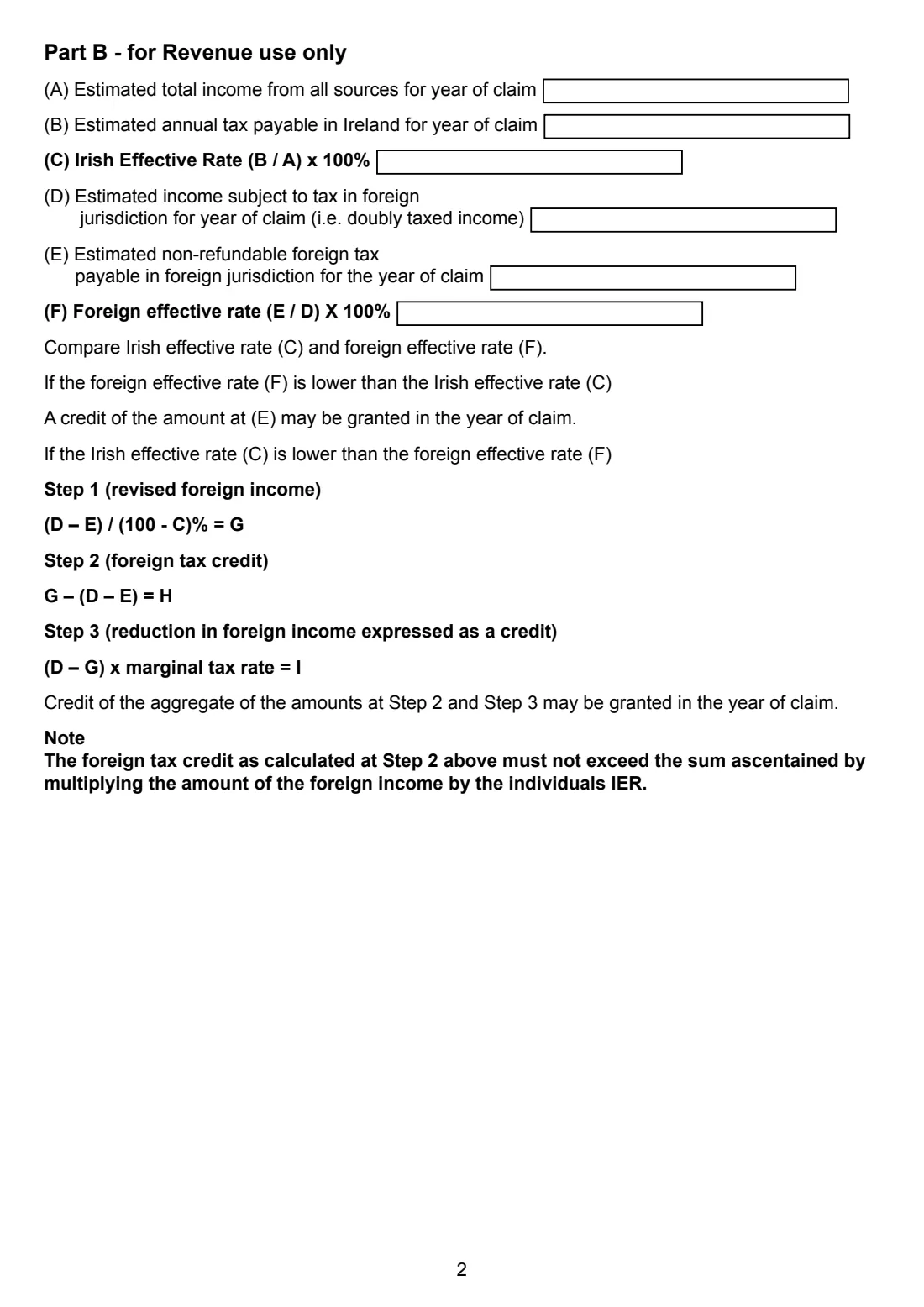
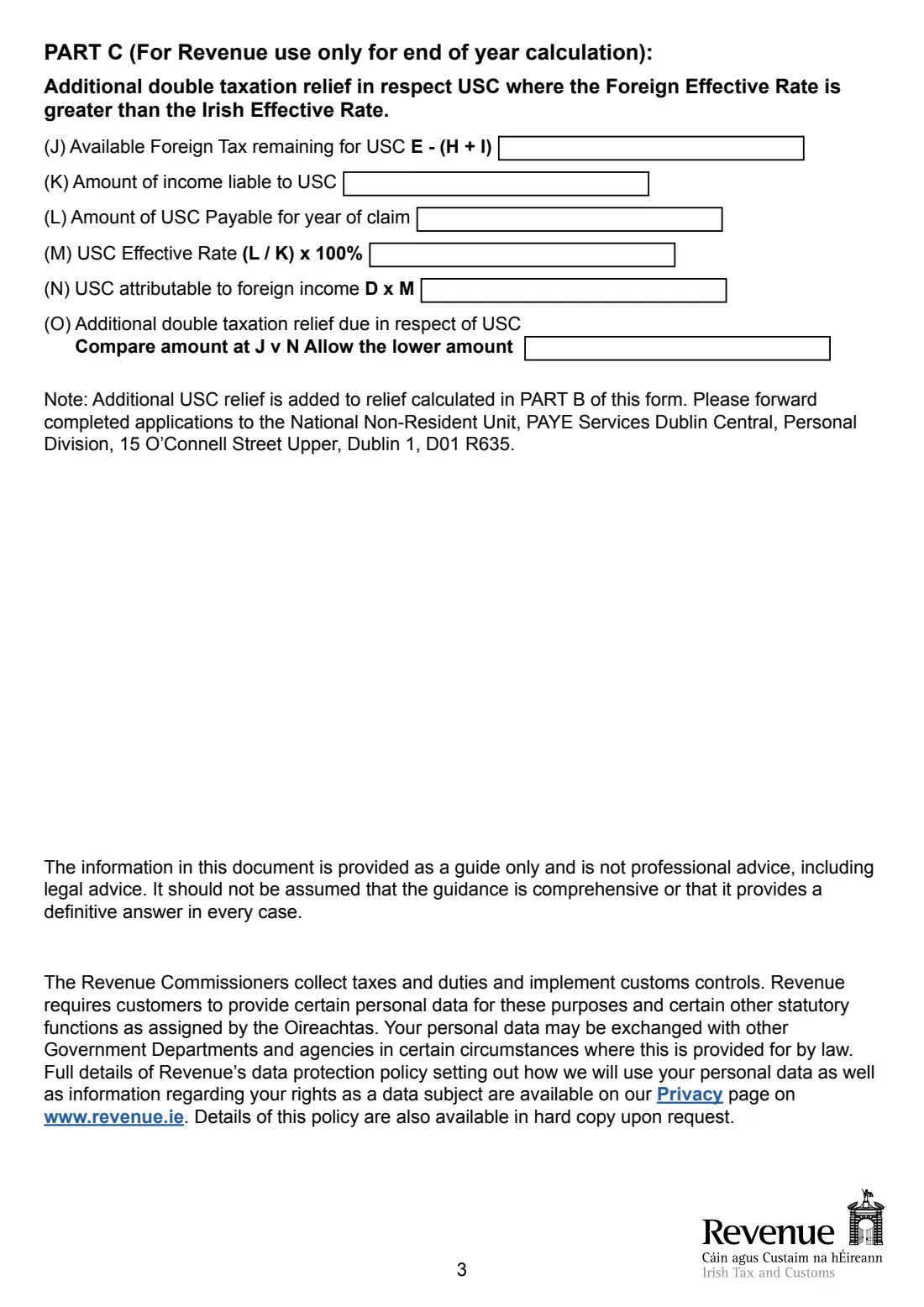
Part A is completed by the employee: personal and employer details, the dates of the temporary assignment, the work pattern, and estimates of income and tax in Ireland and abroad. Revenue completes Parts B and C, comparing the Irish and foreign effective rates. You still file an income tax return for the year to claim the foreign tax credit formally.
FileIt fills Part A of Revenue's form, checks that the dates and estimates make sense, and saves the result in your vault. You sign it and send it to Revenue yourself.
- Issued by
- Office of the Revenue Commissioners (Revenue)
- Guidance
- Tax and Duty Manual Part 42-04-62
- Who completes
- The employee (Part A)
- Revenue's parts
- B and C, the effective-rate calculation
- Send to
- National Non-Resident Unit, PAYE Services Dublin Central
- Edition
- RPC020406_EN_WB_L_2 (May 2026 PDF)
Who needs to fill out Form Double Deduction 1?
- Irish-resident employees on temporary assignments abroad for an Irish employer.
- Employees taxed at source in a treaty country on part of their Irish pay.
- Employers' payroll teams helping staff apply for relief in real time.
When to use Form Double Deduction 1
- Before or early in an assignment, so relief can come through payroll.
- When your foreign tax at source can't be refunded by the other country.
- Not when the assignment is expected to end your Irish tax residence. Split-year treatment applies then.
What you need before you start
- Your name, address and PPSN.
- Your employer's name, address and registered number.
- The planned departure and return dates and your work pattern.
- The foreign country where you work.
- Estimates for the year: total income, Irish tax, income taxed abroad and the foreign tax.
What’s on Form Double Deduction 1
The 2026 edition has 3 pages. FileIt asks for it in 4 parts, and it is signed by Employee:
- Part A: Employee and employerEmployee
- Part A: The assignment abroadEmployee
- Part A: Estimates for the year of claim (euro)Employee
- Undertaking and signatureEmployee
How to fill out Form Double Deduction 1, step by step
1 Employee and employer
Your name, address and PPSN, then your employer's name, address and registered number.
2 The assignment
Year of claim, intended departure and return dates, and the expected days in Ireland and abroad.
3 Residence and country
Confirm you are tax resident in Ireland and name the foreign jurisdiction.
4 Estimates
Total income, Irish tax, the doubly taxed income and the non-refundable foreign tax, in euro.
5 Undertaking
Sign and date the undertaking that you'll file an income tax return for the year.
Common mistakes to avoid
- Using it when you won't be Irish resident for the year.
- Including foreign tax the other country will refund.
- Entering foreign income in the local currency instead of euro.
- Forgetting the end-of-year income tax return Revenue requires.
After you fill it out
Sign the form and send it to the National Non-Resident Unit, as the form directs. FileIt doesn't send it.
Keep the filled PDF and your foreign payslips in your FileIt vault.
File your income tax return after the year ends to claim the foreign tax credit formally.
Fill out Form Double Deduction 1 online with FileIt
- Pick the person. Choose someone from People and FileIt fills in their name, date of birth, address and other details it already knows.
- Answer plain-language questions. One part of the form at a time, with the official help text beside each question — 17 fields in all. Your answers save as you go.
- Check the live preview. Watch your answers land on the real Office of the Revenue Commissioners (Revenue) form, and let FileIt do any worksheet arithmetic.
- Generate the official PDF. FileIt prints your answers into the agency’s own PDF and files it in that person’s folder in your vault. Sign it, or send it for e-signature.
FileIt fills the form — it never files or submits anything for you. Deliver the finished form to whoever asked for it, the way the form’s instructions say.
Start Form Double Deduction 1 now — it’s freeForm Double Deduction 1: frequently asked questions
What does Double Deduction 1 do?
It asks Revenue to grant, through PAYE, a credit for non-refundable foreign tax deducted from the same pay that Irish tax is deducted from.
Who can use it?
An individual who is tax resident in Ireland, employed by an Irish employer under an Irish contract, working part of the job in a double taxation agreement country, and taxed at source in both places.
Do I fill in Parts B and C?
No. Those are for Revenue, which compares your Irish and foreign effective tax rates.
Is the relief guaranteed?
No. Revenue considers each application case by case and the credit is an estimate. You still claim formally in your tax return.
Can FileIt fill it in?
Yes. FileIt fills Part A of Revenue's own PDF and saves it in your vault. You sign it and send it to Revenue yourself.
Official sources
- Blank form (PDF), published by Office of the Revenue Commissioners (Revenue): https://www.revenue.ie/en/jobs-and-pensions/documents/form-double-deduction1.pdf
- Official instructions and guidance: https://www.revenue.ie/en/tax-professionals/tdm/income-tax-capital-gains-tax-corporation-tax/part-42/42-04-62.pdf
- Edition shown on this page: RPC020406_EN_WB_L_2 (PDF of May 2026) (checked 2026-10-19).
FileIt is not affiliated with or endorsed by Office of the Revenue Commissioners (Revenue) or any government. This page explains the form in general terms and is not legal, tax or immigration advice. Always read the official instructions, and check that you are using the edition the recipient accepts. Page last reviewed 2026-10-19.