What is N180 Directions questionnaire?
When a county court claim is defended and looks suitable for the small claims track, the court sends each party a notice of proposed allocation (N149A) and a directions questionnaire, form N180. The judge uses the answers to give 'directions': instructions on how the case will proceed to a decision.
N180 asks for your contact details and address for service, whether you agree the small claims track is right, whether the claim could be decided on the papers without a hearing, who will attend the free Small Claims Mediation Service appointment, and practical details about the hearing: your preferred court, expert evidence, how many witnesses, dates to avoid, interpreters and any vulnerability or support needs.
FileIt asks each question in plain English, only shows the follow-up boxes you need, checks your longer answers will fit their boxes, and prints everything into HMCTS's own N180 PDF, including names with accents and non-English letters. You print it, sign it and return it yourself. FileIt never files anything with the court.
- Who fills it
- Each claimant and defendant (or their legal representative) in a small claim
- Returned to
- The court at the address shown on form N149A, Notice of proposed allocation to small claims track, with a copy to every other party
- When
- By the date given on the court's notice. Note it, and the court named, which may differ from where the claim was issued
- Track
- Small claims: generally lower value, less complex claims worth under £10,000
- Signatures
- The party or their legal representative must sign the form
- Edition
- N180 (11.24), 8 pages
Who needs to fill out N180 Directions questionnaire?
- Claimants and defendants in a county court money claim that the court proposes to allocate to the small claims track.
- People representing themselves: the form is sent to parties who aren't using a legal representative.
- A defendant who has made a counterclaim (a Part 20 claimant).
- Legal representatives completing it on a client's behalf.
- Businesses that are a party to a small claim, completed by someone on the business's behalf.
When to use N180 Directions questionnaire
- When the court sends you a notice of proposed allocation to the small claims track (N149A) with N180.
- Return it by the date on the notice. If you settle the claim, tell the court immediately instead of carrying on.
What you need before you start
- The name of the court and the claim number from the court's notice.
- Your address for service, phone numbers and email.
- The name, UK phone number and email of whoever will attend the mediation appointment, and any dates in the next 3 months they can't make.
- Your preferred county court hearing centre and why.
- Details of any expert you want to rely on: why, their name and area of expertise, and the likely cost.
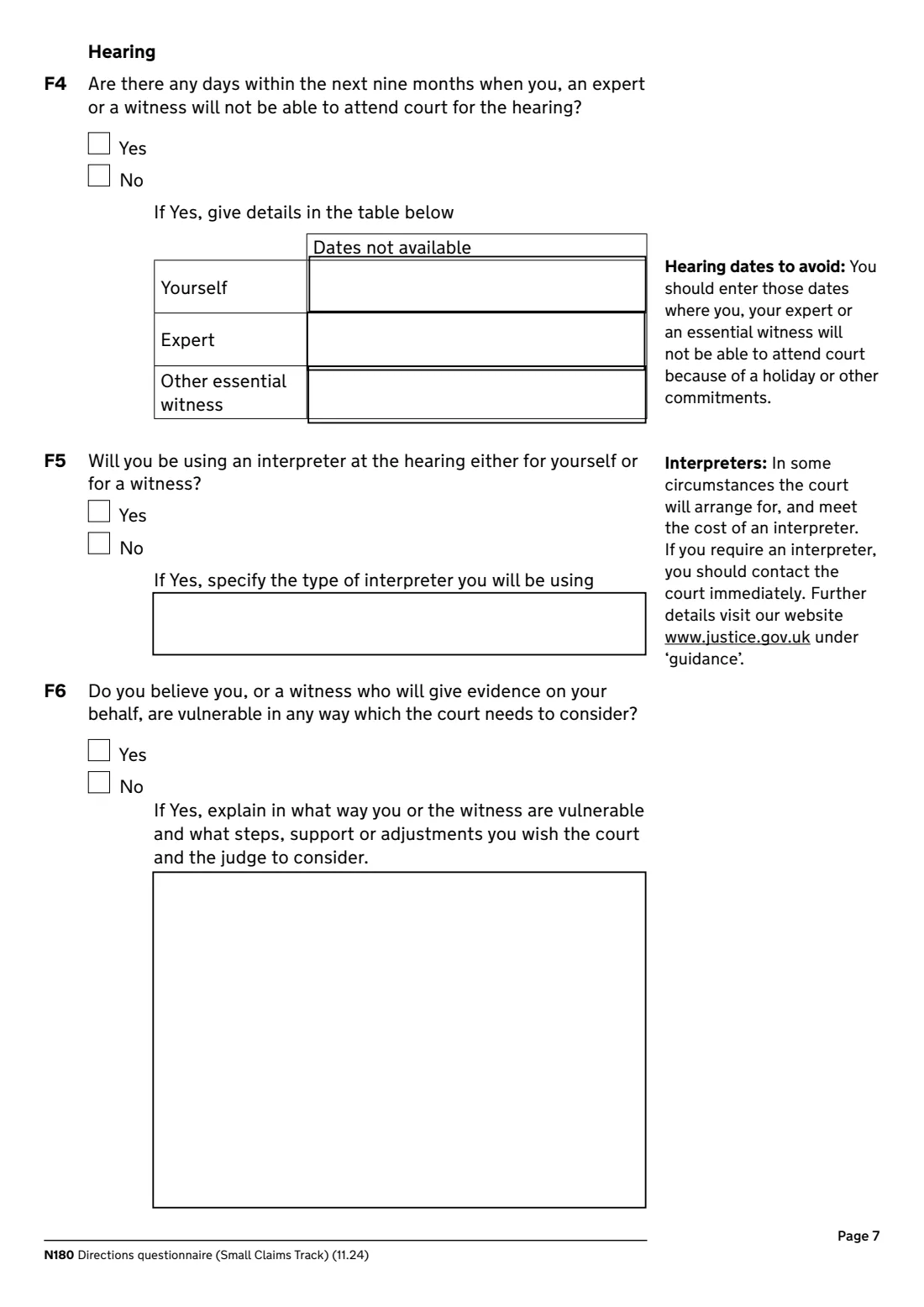
- How many witnesses, including you, will give evidence, and any dates in the next nine months when you, your expert or a key witness can't attend.
- Whether you or a witness need an interpreter, or support because of a vulnerability.
What’s on N180 Directions questionnaire
The 2024 edition has 8 pages. FileIt asks for it in 7 parts, and it is signed by Party:
- The claim and who you areParty
- B. Your contact detailsParty
- C-D. Track and paper determinationParty
- E. About the mediation appointmentParty
- F. About the hearingParty
- G. Other informationParty
- SignatureParty
How to fill out N180 Directions questionnaire, step by step
1 Page 1: the claim and who you are
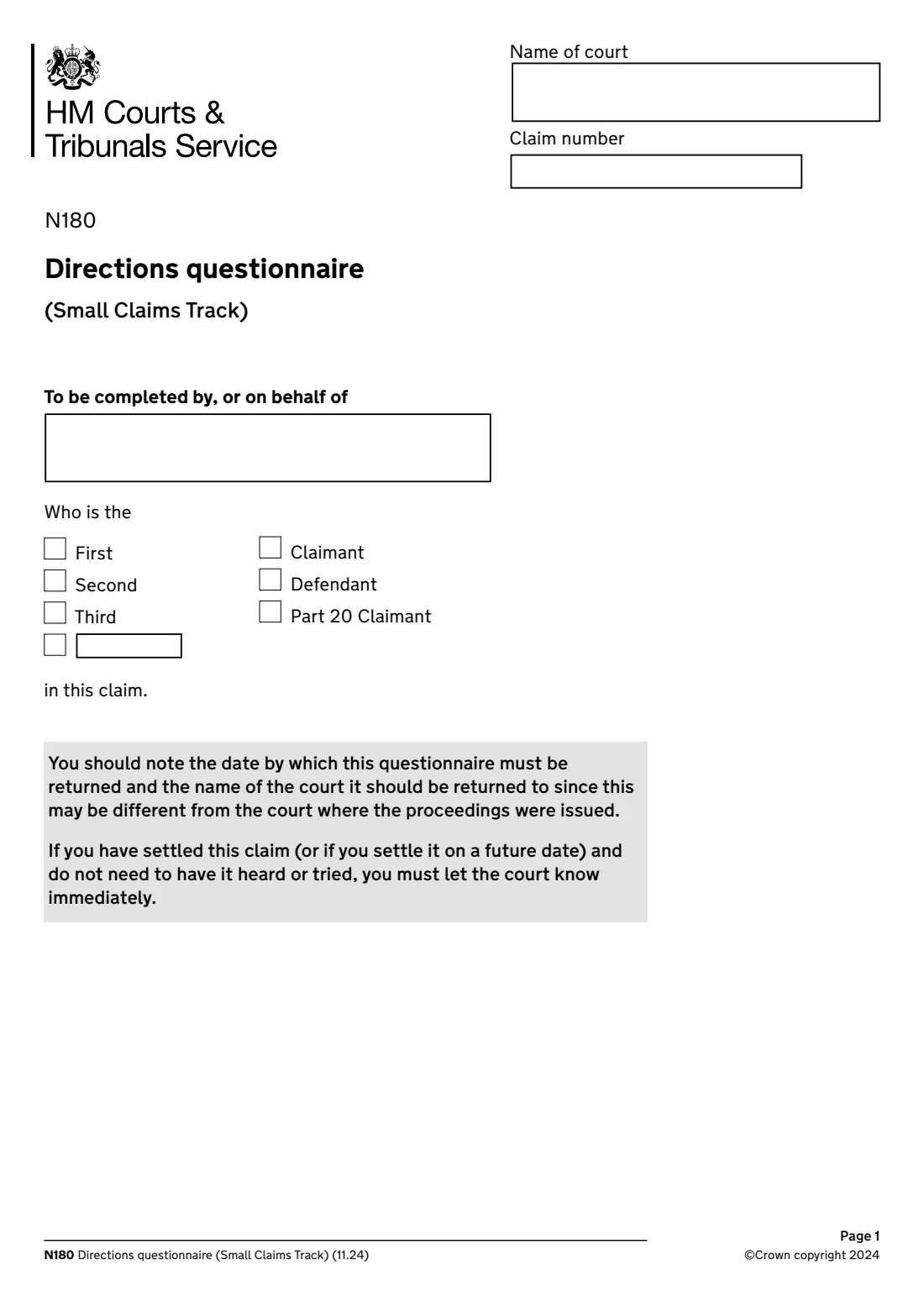
Enter the name of the court and the claim number from the court's notice, and the name of the party the questionnaire is for. Then say which party you are: first, second, third (or another number) claimant, defendant or Part 20 claimant. In a simple claim with one claimant and one defendant, you are the first claimant or first defendant.
2 A and B: settlement and your contact details
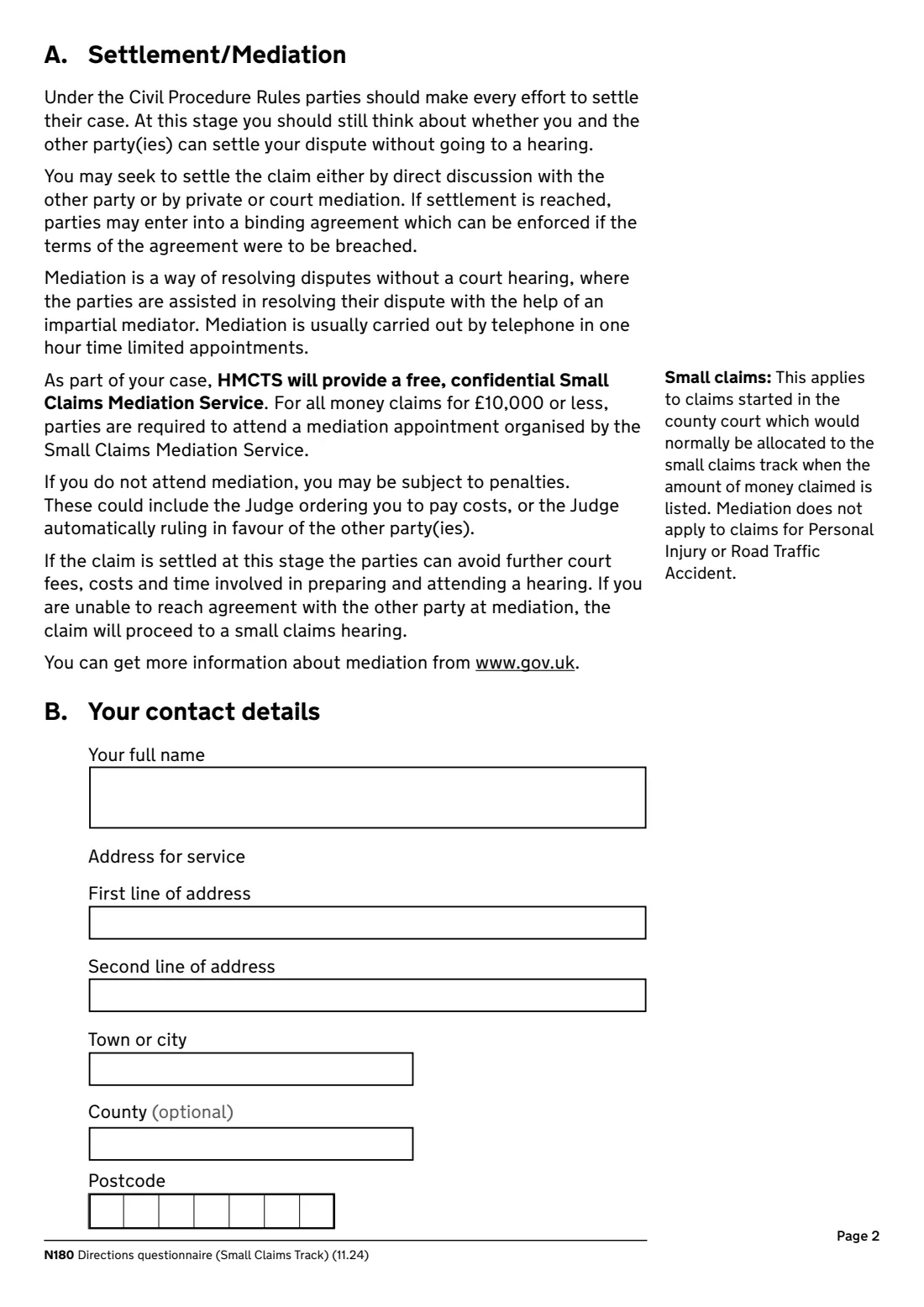
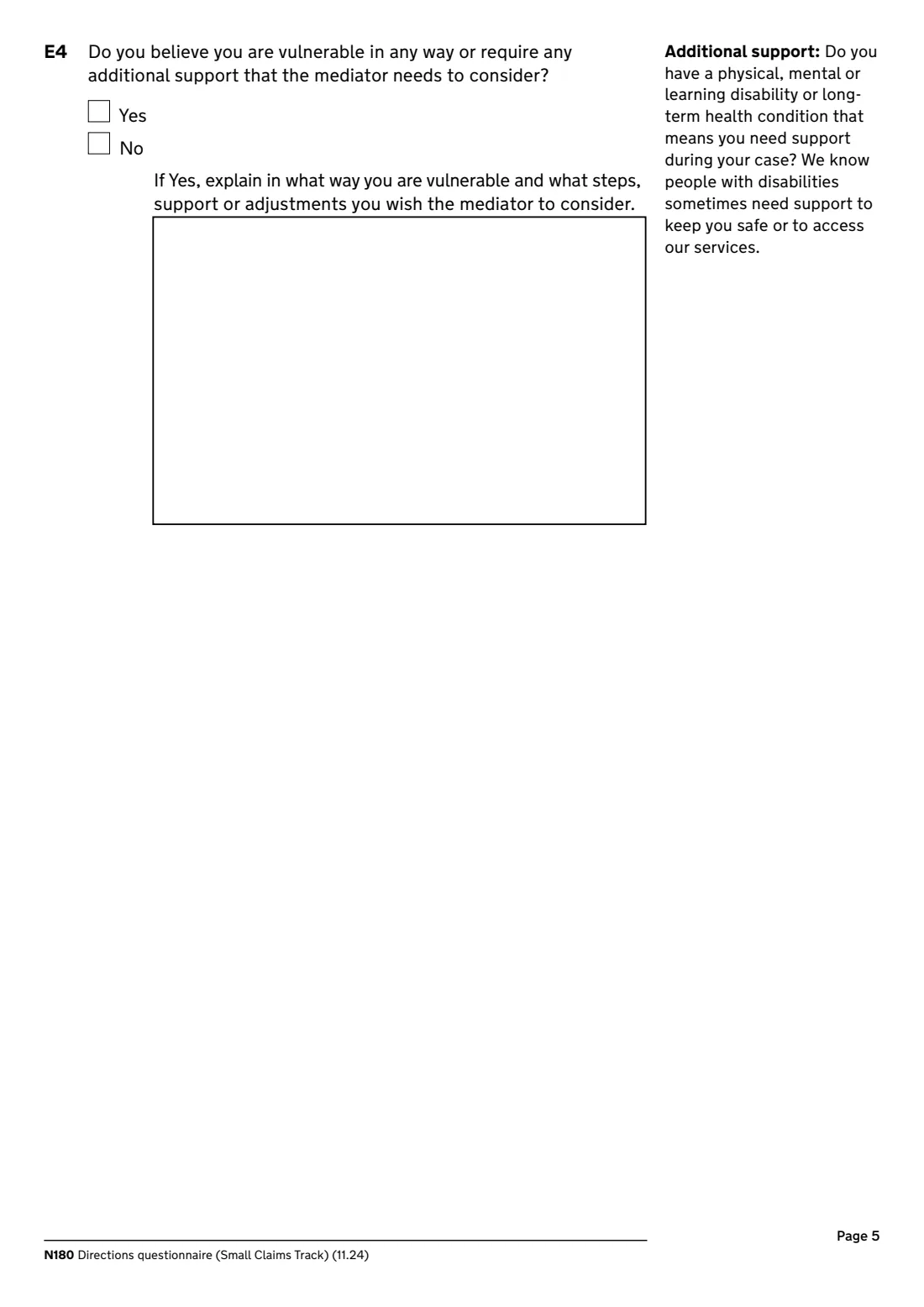
Section A explains that parties should try to settle, and that for money claims of £10,000 or less HMCTS's free Small Claims Mediation Service arranges a mediation appointment that the parties are required to attend. The form warns that not attending can lead to penalties, such as paying costs or the judge ruling for the other side.
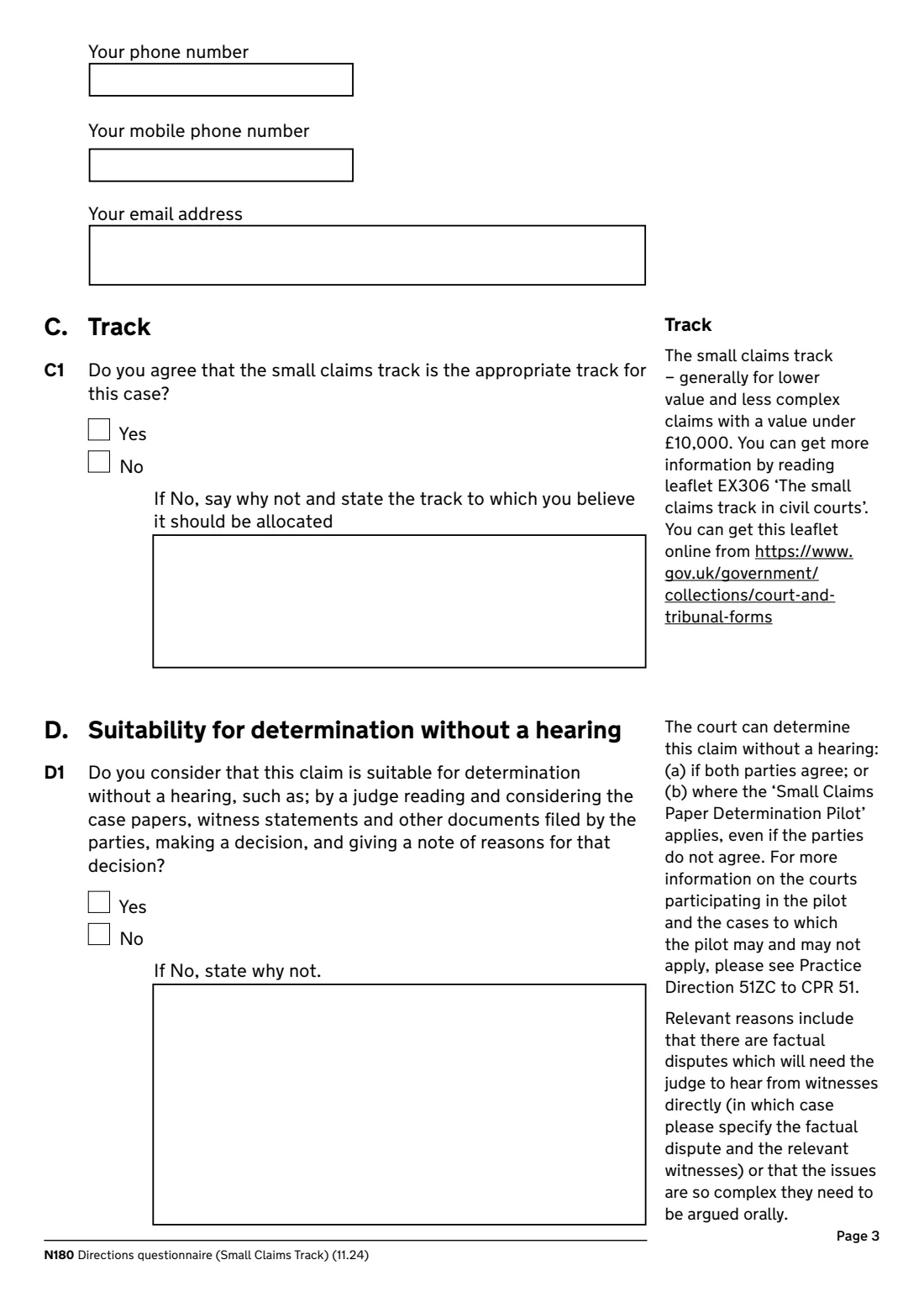
Section B is your full name, the address where you want to receive court documents, your phone numbers and email.
3 C and D: the track and a decision on paper
C1 asks whether you agree the small claims track is right. If not, say why and which track you think it should be. D1 asks whether the claim could be decided without a hearing, by a judge reading the papers. If not, explain why, for example a factual dispute where the judge needs to hear from witnesses directly.
4 E: the mediation appointment
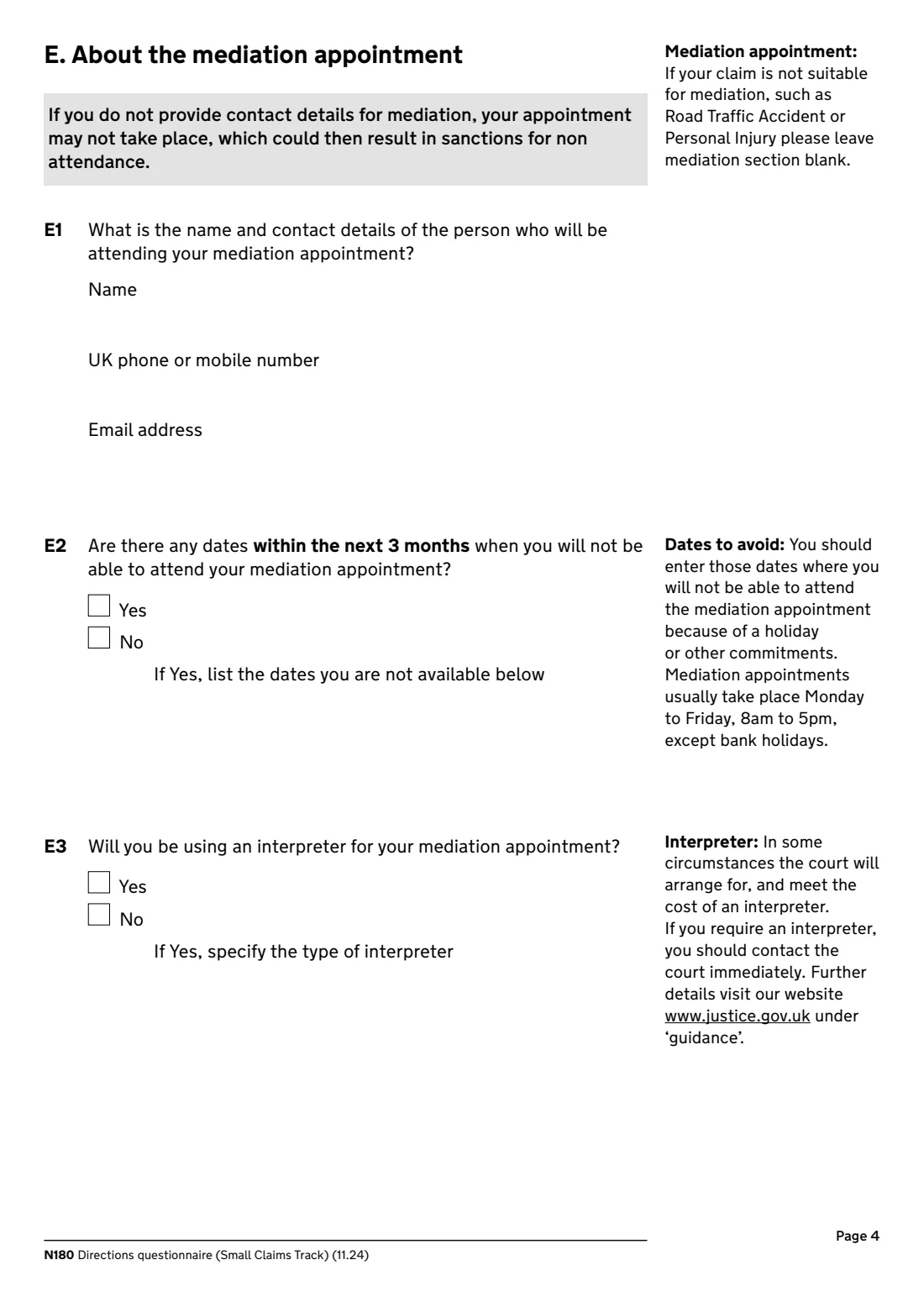
Give the name, UK phone number and email of the person who will attend mediation, any dates in the next 3 months they can't make, and whether they need an interpreter or any support. Mediation appointments usually take place Monday to Friday, 8am to 5pm. Claims that aren't suitable for mediation, such as road traffic accident or personal injury claims, leave this section blank.
5 F: the hearing
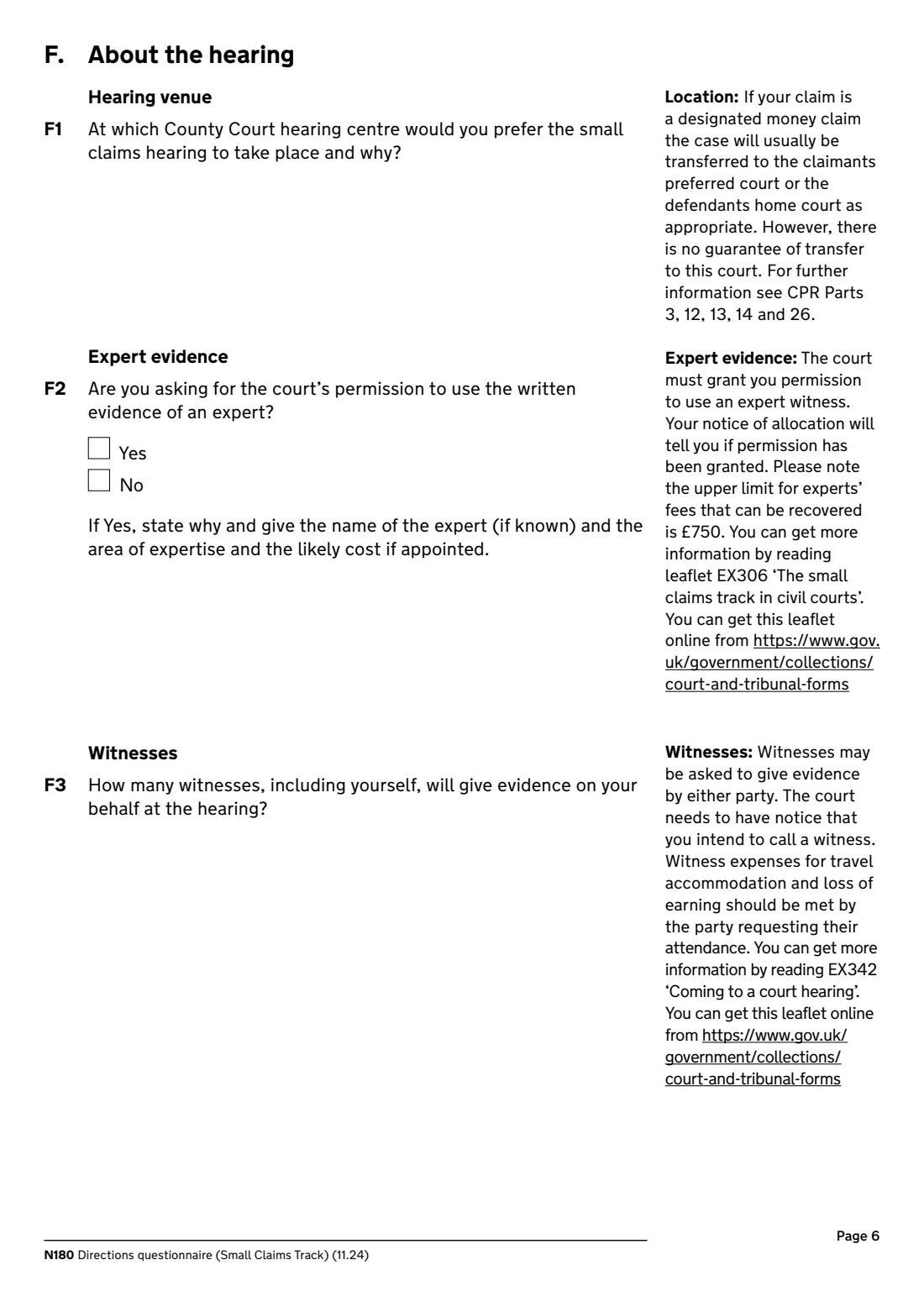
Your preferred county court hearing centre and why, whether you want permission to use an expert's written evidence (and details), how many witnesses including yourself will give evidence, dates in the next nine months when you, an expert or an essential witness can't attend, whether you need an interpreter, and whether you or a witness are vulnerable in a way the court should consider.
6 G: Welsh or English, and signing
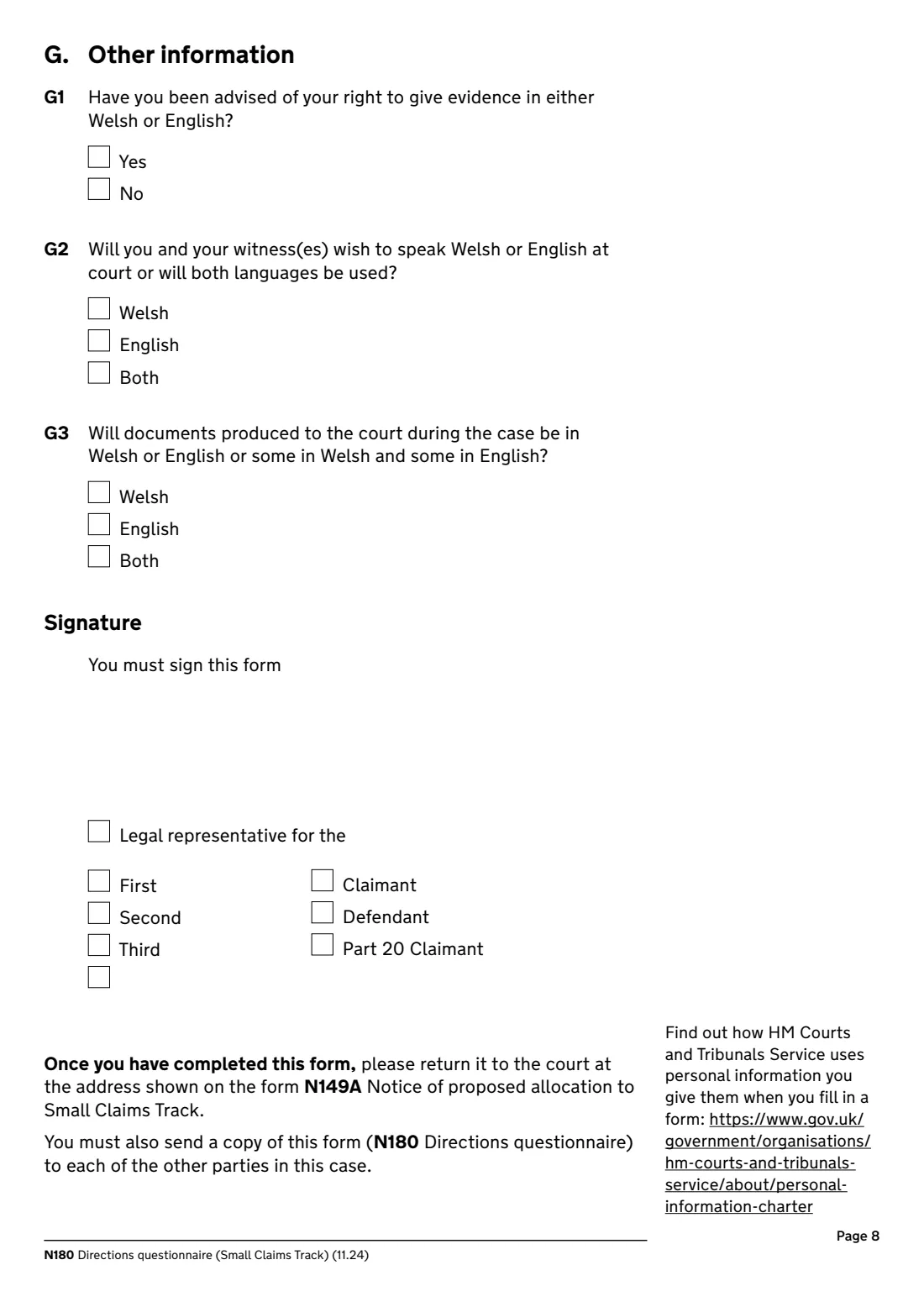
Say whether you've been told of your right to give evidence in Welsh or English, and which language you'll speak and your documents will be in. Then sign the form, ticking whether you sign as the party or as their legal representative.
Common mistakes to avoid
- Missing the return date, or sending the form to the wrong court. The form says to note both, because the court may be different from where the claim was issued.
- Leaving out mediation contact details. The form warns the appointment may not go ahead, which could lead to sanctions.
- Forgetting to send a copy to every other party.
- Saying you disagree with the small claims track, or with a paper decision, without giving reasons.
- Assuming expert fees will be repaid in full: the form notes the upper limit for experts' fees that can be recovered is £750, and experts need the court's permission.
- Not listing dates when you or key witnesses are unavailable.
- Not signing the form.
After you fill it out
Print the questionnaire, check it and sign it.
Return it to the court at the address shown on form N149A, and send a copy to each of the other parties. FileIt doesn't send anything for you.
The court's notice of allocation will set out the directions, including whether an expert has been allowed. Keep your copy, the court's notices and your evidence together in FileIt, and tell the court immediately if you settle.
Fill out N180 Directions questionnaire online with FileIt
- Pick the person. Choose someone from People and FileIt fills in their name, date of birth, address and other details it already knows.
- Answer plain-language questions. One part of the form at a time, with the official help text beside each question — 53 fields in all. Your answers save as you go.
- Check the live preview. Watch your answers land on the real HM Courts & Tribunals Service form, and let FileIt do any worksheet arithmetic.
- Generate the official PDF. FileIt prints your answers into the agency’s own PDF and files it in that person’s folder in your vault. Sign it, or send it for e-signature.
FileIt fills the form — it never files or submits anything for you. Deliver the finished form to whoever asked for it, the way the form’s instructions say.
Start N180 Directions questionnaire now — it’s freeN180 Directions questionnaire: frequently asked questions
What is form N180 for?
It is the directions questionnaire for claims heading to the small claims track. Your answers help the judge decide how the case will be dealt with: mediation, whether a hearing is needed, where it will be, and what evidence can be used.
Where do I send the N180?
To the court at the address shown on form N149A, Notice of proposed allocation to the small claims track. You must also send a copy to each of the other parties.
Do I have to go to mediation?
The form says that for all money claims for £10,000 or less, parties are required to attend a mediation appointment organised by the free Small Claims Mediation Service, and that not attending may lead to penalties. Mediation doesn't apply to personal injury or road traffic accident claims.
Can a small claim be decided without a hearing?
Yes. The form says the court can decide it on the papers if both parties agree, or where the Small Claims Paper Determination Pilot applies, even if they don't. Question D1 asks for your view and your reasons if you disagree.
Can I use an expert in a small claim?
Only with the court's permission, and the form notes the upper limit for experts' fees that can be recovered is £750. Question F2 asks for your reasons and the expert's details.
Who counts as a witness in question F3?
Everyone who will give evidence on your side at the hearing, including yourself.
Can I fill in the N180 online with FileIt?
Yes. FileIt lets you complete it for free and prints your answers into the official PDF. You then sign it and return it to the court and the other parties yourself.
Official sources
- Blank form (PDF), published by HM Courts & Tribunals Service: https://assets.publishing.service.gov.uk/media/673341e779e9143625613543/N180_1124.pdf
- Official instructions and guidance: https://www.gov.uk/government/publications/form-n180-directions-questionnaire-small-claims-track
- Edition shown on this page: N180 (11.24) (checked 2026-09-28).
FileIt is not affiliated with or endorsed by HM Courts & Tribunals Service or any government. This page explains the form in general terms and is not legal, tax or immigration advice. Always read the official instructions, and check that you are using the edition the recipient accepts. Page last reviewed 2026-09-28.