What is DS01 Striking off application?
Form DS01 is how the directors of a UK company ask Companies House to strike it off the register and dissolve it. It's usually used for a small company that has stopped trading and has no further use. Companies House's guidance says you can only strike off a company that hasn't traded or sold off any stock in the last 3 months, hasn't changed its name in the last 3 months, isn't threatened with liquidation and has no agreements with creditors such as a CVA. Otherwise it has to be liquidated instead.
The directors apply and declare that none of the circumstances in sections 1004 and 1005 of the Companies Act 2006 applies, and that they will send a copy to every notifiable party (members, creditors, employees, pension managers or trustees, and any directors who didn't authenticate it) within 7 days. On this edition each authenticating director gives their name and the date. It must be the sole director if there's 1, both if there are 2, and a majority if there are more.
FileIt checks that enough directors authenticate, prints everyone's names and dates into Companies House's own DS01 PDF (Version 9.0, 02/26), and keeps a copy in your vault. Companies House prefers the online service, which costs £13 by card. The paper application costs £18, paid by cheque or postal order to 'Companies House'. FileIt never submits it for you.
- Who fills it
- The company's directors: the sole director, both of two, or a majority
- Given to
- Companies House, with the fee
- Fee
- £18 on paper (cheque or postal order), £13 online
- Notify
- Copies to all notifiable parties within 7 days
- Signature
- Each authenticating director gives their name and date
- Edition
- DS01 Version 9.0 (02/26)
Who needs to fill out DS01 Striking off application?
- Directors of a UK limited company that has stopped trading and is no longer needed.
- Families winding up a dormant company or a small company that has finished its purpose.
- Only companies that haven't traded, sold stock or changed name in the last 3 months, aren't threatened with liquidation and have no arrangement with creditors.
- Directors who can't use the online close-a-company service. Companies House says to use the paper form only then.
- Not a limited liability partnership: an LLP uses form LL DS01.
When to use DS01 Striking off application
- After the company has been closed down properly: assets dealt with, bank accounts closed, employees and HMRC told, final accounts and Company Tax Return sent to HMRC.
- When the company meets the 3-month and other conditions for striking off.
- If the company becomes ineligible after applying (for example it starts trading again), withdraw the application with form DS02.
What you need before you start
- The company number and name exactly as on the register.
- How many directors the company has, and the names of those who will authenticate.
- The date each director authenticates the form.
- The £18 fee by cheque or postal order payable to 'Companies House', not from the company's own bank account.
- A list of everyone who must get a copy within 7 days: members, creditors, employees, pension managers or trustees, and any directors who didn't authenticate.
- The DS01 continuation page from gov.uk if more than 4 directors must authenticate.
What’s on DS01 Striking off application
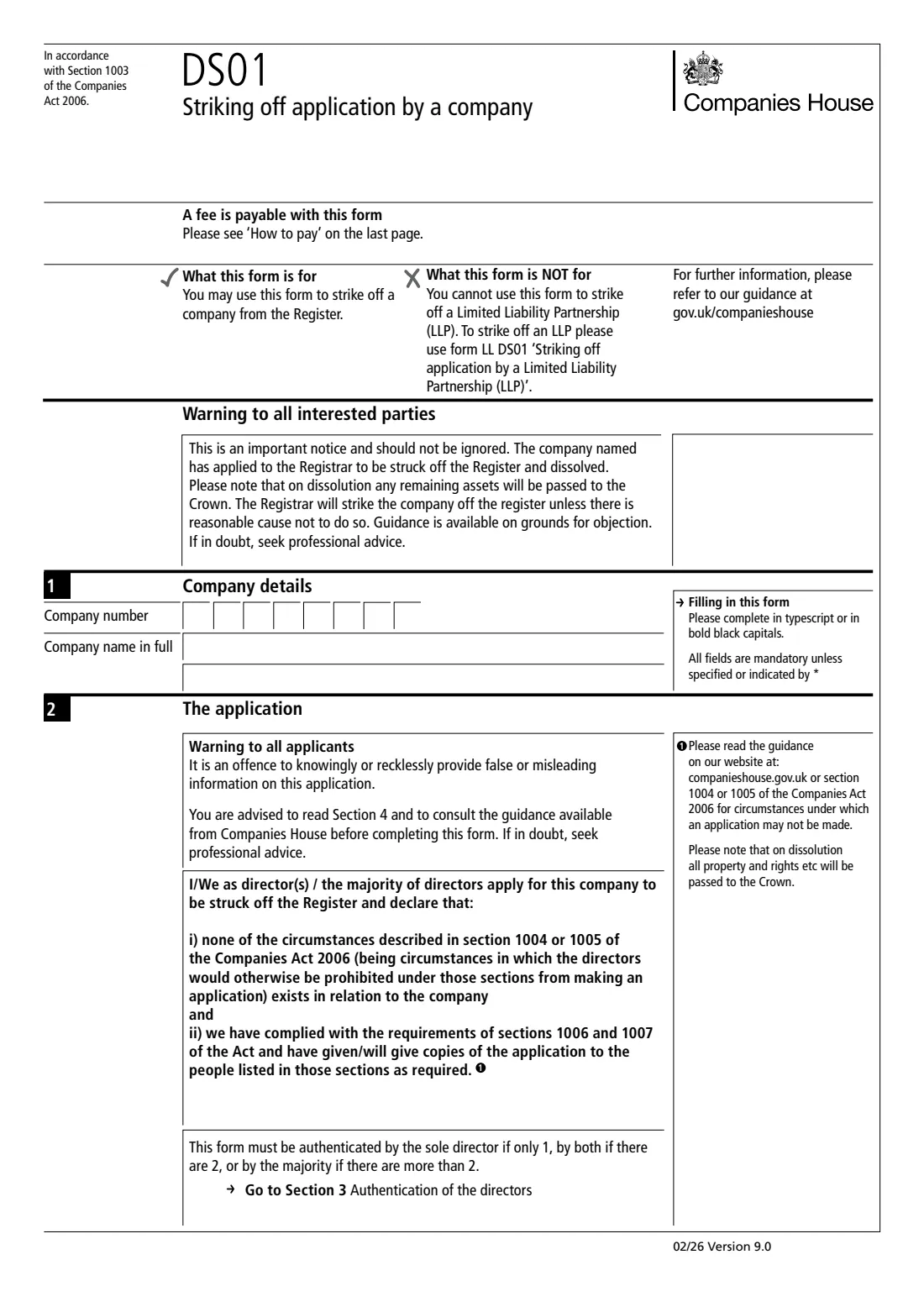
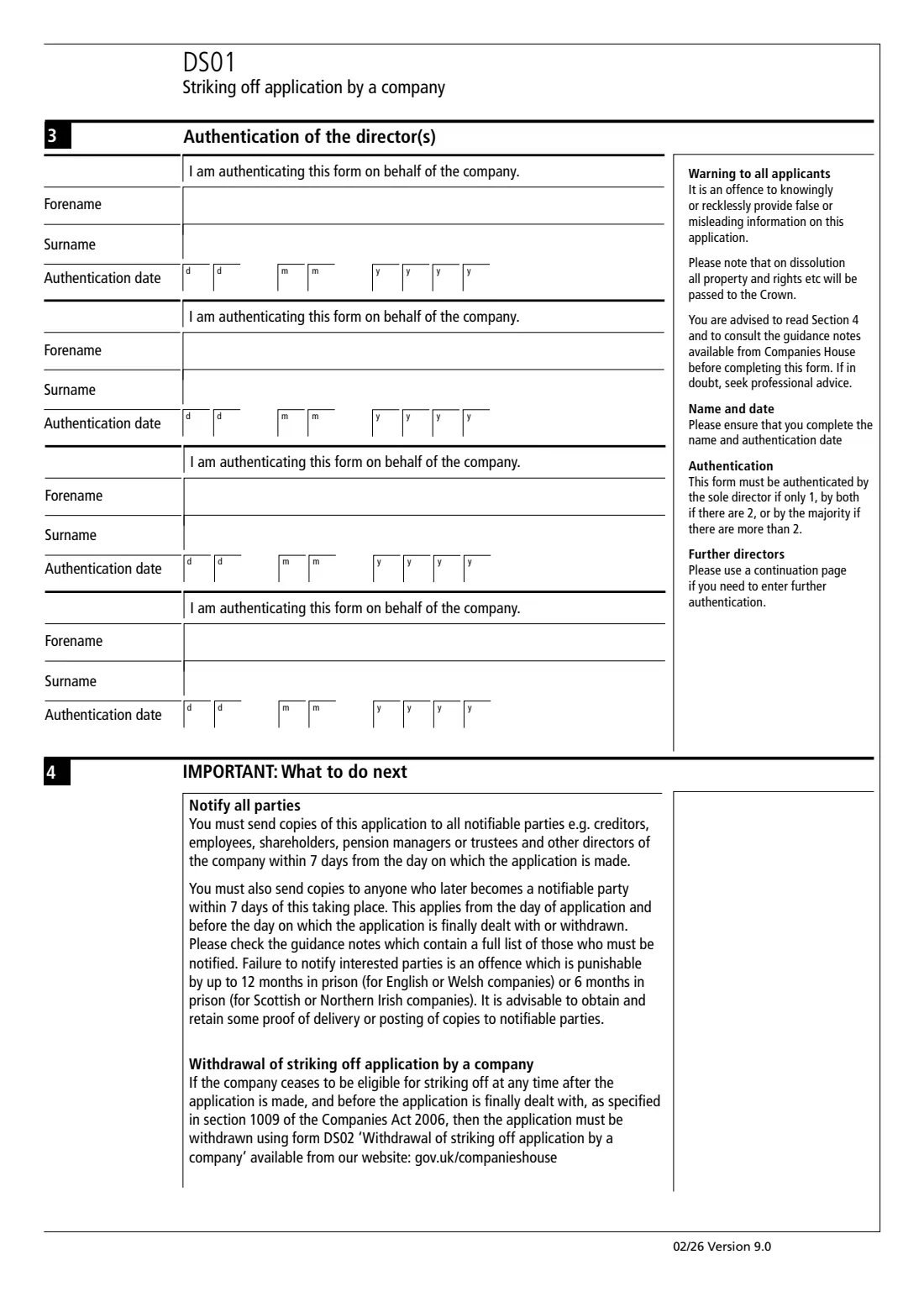
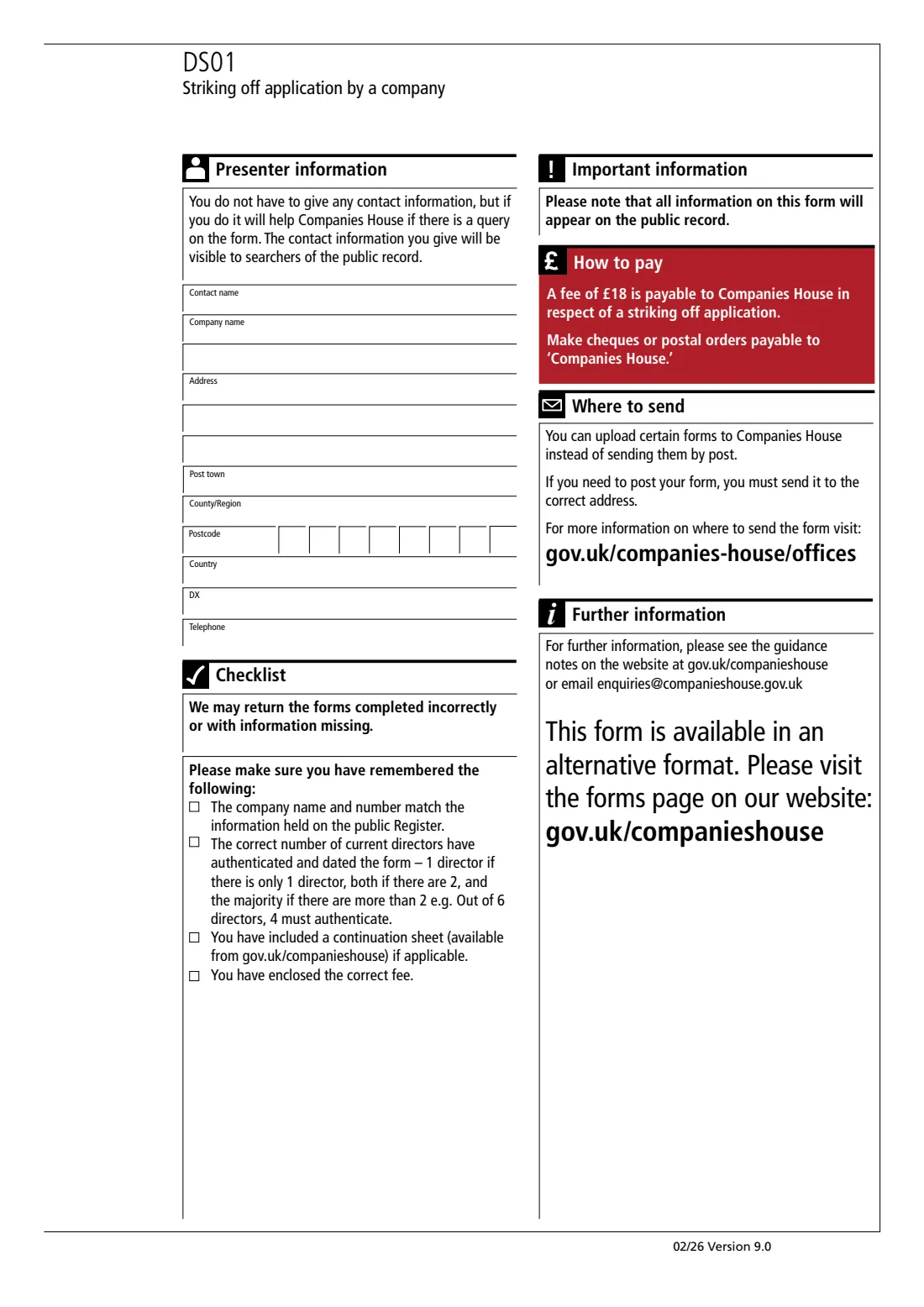
The 2026 edition has 3 pages. FileIt asks for it in 7 parts:
- 1. Company detailsCompany
- 2. The applicationCompany
- 3. Authentication — director 1Director
- 3. Authentication — director 2Director
- 3. Authentication — director 3Director
- 3. Authentication — director 4Director
- Presenter information (optional)Presenter
How to fill out DS01 Striking off application, step by step
1 Company details
The company number and full name, both matching the register. Wrong or missing details are one of the most common reasons Companies House returns a DS01.
2 The application
The directors apply for the company to be struck off and declare that none of the circumstances in sections 1004 or 1005 of the Companies Act 2006 exists, and that they have complied, or will comply, with sections 1006 and 1007 by giving copies to the people listed there. It's an offence to knowingly or recklessly give false or misleading information.
3 Authentication of the directors
Up to 4 directors, each with forename, surname and authentication date. It must be the sole director if there's only 1, both if there are 2, or a majority if there are more (for example 4 out of 6). Use the continuation page for more.
4 What to do next
Send copies to all notifiable parties within 7 days of applying, and to anyone who becomes a notifiable party later while the application is pending. It's advisable to keep proof of posting or delivery. The form warns that failing to notify is an offence.
5 Presenter information and payment
Optional contact details (visible on the public record), then enclose the £18 fee by cheque or postal order payable to 'Companies House'.
Common mistakes to avoid
- A missing printed name or authentication date for a director.
- Not enough directors authenticating. Both of 2, or a majority of 3 or more.
- Forgetting the £18 fee, or paying with a cheque from the company's own account.
- A company name or number that doesn't match the register.
- Applying while the company has traded or changed its name in the last 3 months.
- Not sending copies to creditors, employees, shareholders and other notifiable parties within 7 days.
- Leaving money or assets in the company. On dissolution they pass to the Crown.
After you fill it out
Print the DS01, check every director's name and date, enclose the £18 cheque or postal order and send it to Companies House (see gov.uk/companies-house/offices). FileIt doesn't send it for you.
Within 7 days, send a copy to every notifiable party and keep proof of posting. Companies House writes to say whether the form was accepted, then publishes a notice in The Gazette. If nobody objects, the company is struck off once the 2 months in the notice have passed, and a second notice confirms it.
Keep business records such as bank statements and invoices for 7 years after the company is struck off, as gov.uk advises, in the company's FileIt folder. If the company stops being eligible before it's struck off, withdraw with form DS02.
Fill out DS01 Striking off application online with FileIt
- Pick the person. Choose someone from People and FileIt fills in their name, date of birth, address and other details it already knows.
- Answer plain-language questions. One part of the form at a time, with the official help text beside each question — 30 fields in all. Your answers save as you go.
- Check the live preview. Watch your answers land on the real Companies House form, and let FileIt do any worksheet arithmetic.
- Generate the official PDF. FileIt prints your answers into the agency’s own PDF and files it in that person’s folder in your vault.
FileIt fills the form — it never files or submits anything for you. Deliver the finished form to whoever asked for it, the way the form’s instructions say.
Start DS01 Striking off application now — it’s freeDS01 Striking off application: frequently asked questions
How much does it cost to strike off a company with DS01?
The paper DS01 costs £18, paid by cheque or postal order made payable to 'Companies House'. Applying online costs £13 by debit or credit card.
How many directors must sign a DS01?
The sole director if there's only 1, both if there are 2, and a majority if there are more than 2, for example 4 out of 6. On this edition each one gives their name and authentication date.
When can't a company be struck off?
Companies House's guidance says a company can only be struck off if in the last 3 months it hasn't traded or sold off any stock and hasn't changed its name, isn't threatened with liquidation, and has no agreements with creditors such as a CVA. Sections 1004 and 1005 of the Companies Act 2006 set out the full rules.
Who needs a copy of the DS01?
Members (usually shareholders), creditors, employees, managers or trustees of any employee pension fund, and any directors who didn't sign, within 7 days of applying. The form warns that failing to notify is an offence.
What happens to money left in the company?
On dissolution any remaining property and rights, including bank balances and future refunds, pass to the Crown. Deal with the company's assets before applying.
How long does striking off take?
If the form is correct, Companies House publishes a notice in The Gazette. If nobody objects, the company is struck off after the 2 months stated in the notice, and a second notice is published.
Can I withdraw a DS01?
Yes, while the company is still on the register, using form DS02 or the online service. You must withdraw it if the company stops being eligible, for example because it starts trading again.
Official sources
- Blank form (PDF), published by Companies House: https://assets.publishing.service.gov.uk/media/696f5fcac0f4afaa9536a085/DS01_v9.0-FINAL.pdf
- Official instructions and guidance: https://www.gov.uk/government/publications/strike-off-a-company-from-the-register-ds01
- Edition shown on this page: DS01, Version 9.0 02/26 (checked 2026-09-28).
FileIt is not affiliated with or endorsed by Companies House or any government. This page explains the form in general terms and is not legal, tax or immigration advice. Always read the official instructions, and check that you are using the edition the recipient accepts. Page last reviewed 2026-09-28.