What is Form RC66?
Form RC66, the Canada Child Benefits Application, is the Canada Revenue Agency (CRA) form used to apply for the Canada child benefit (CCB) for children in your care. According to the form, the information you give is also used to work out your eligibility for the goods and services tax/harmonized sales tax (GST/HST) credit and related federal, provincial and territorial programs the CRA administers. You can also use it when you start a shared-custody arrangement for a child.
The form is for people who haven't already applied another way. It says not to fill it out if you already applied through My Account on the CRA website, or when you registered your newborn's birth with your province or territory (except Nunavut). For many families, the RC66 is the route after an adoption, a move to Canada, a change in who the child lives with, or when a child comes into your care later in life.
FileIt takes you through the RC66's seven steps in plain language and prints your answers into the CRA's own fillable PDF (edition RC66 E (24)), including ticking the right living-arrangement boxes for each child. Your own name and date of birth can be pre-filled from People records in your vault. The completed PDF is saved in your vault folder so you have a copy of exactly what you applied with. The RC66 isn't on the CRA's list of forms that accept electronic signatures, so you print it, sign it by hand and mail it yourself — FileIt never sends it. Filling forms is free on every FileIt plan.
- Who fills it
- The person primarily responsible for the care and upbringing of the child
- Sent to
- The CRA tax centre that serves your province or territory, by mail
- When
- When a child comes into your care, you start shared custody, or you arrive in or return to Canada
- Signatures
- You, plus your spouse or common-law partner if married or living common-law — signed by hand
- Edition
- RC66 E (24)
- Children per form
- Two; use Form RC66-1 or a separate sheet for more
Who needs to fill out Form RC66?
- A parent or caregiver who is primarily responsible for a child's care and upbringing and hasn't applied for the CCB through My Account or birth registration.
- Parents of a newborn in Nunavut, where the form notes that applying through birth registration isn't available.
- Families who have adopted a child or had a child come into their care.
- Newcomers to Canada and residents returning after an absence of at least six months, who also complete Form RC66SCH.
- Parents who have started a shared-custody arrangement, where the child lives with them 40% to 60% of the time.
- A parent who is primarily responsible for the child when the child lives with a female parent who is not — with a signed letter from her, as the form explains.
When to use Form RC66
- As soon as a child starts living with you and you become primarily responsible for them.
- When a shared-custody arrangement begins, or the share of time a child spends with you changes.
- When a child who left your care returns to live with you.
- When you or your spouse or partner become a newcomer to Canada, or return after an absence of at least six months.
- When you previously didn't meet the eligibility criteria and now do — the form says you need to re-apply once you meet all the conditions.
What you need before you start
- Your social insurance number, and your spouse's or common-law partner's if you have one (Booklet T4114 explains what to do if either of you has none).
- Full names and dates of birth for you, your spouse or partner, and each child.
- Your mailing address, home address if different, and the date you moved if you changed province or territory in the last 12 months.
- The date your current marital status began.
- Each child's city and province, territory or country of birth.
- The date each child started living with you more than 60% of the time, or 40% to 60% of the time if shared custody.
- Proof of birth for any child the CRA hasn't paid benefits to anyone for.
- Form RC66SCH if you or your spouse haven't been citizens for the last 12 months, or became newcomers or returning residents in the last two years.
- If a child started living with you more than 11 months ago: proof of birth, at least three proofs you lived in Canada, at least three proofs you were primarily responsible for the child, and proof of citizenship or immigration status.
- Translations into English or French for any documents in another language.
What’s on Form RC66
The 2024 edition has 6 pages. FileIt asks for it in 7 parts:
- Step 1 – Your informationApplicant
- Step 2 – Your addressApplicant
- Step 3 – Your marital statusApplicant
- Steps 4 and 5 – Citizenship, newcomers and returning residentsApplicant
- Step 6 – Child 1Applicant
- Step 6 – Child 2Applicant
- Step 7 – SignatureApplicant
How to fill out Form RC66, step by step
1 Step 1 – Your information
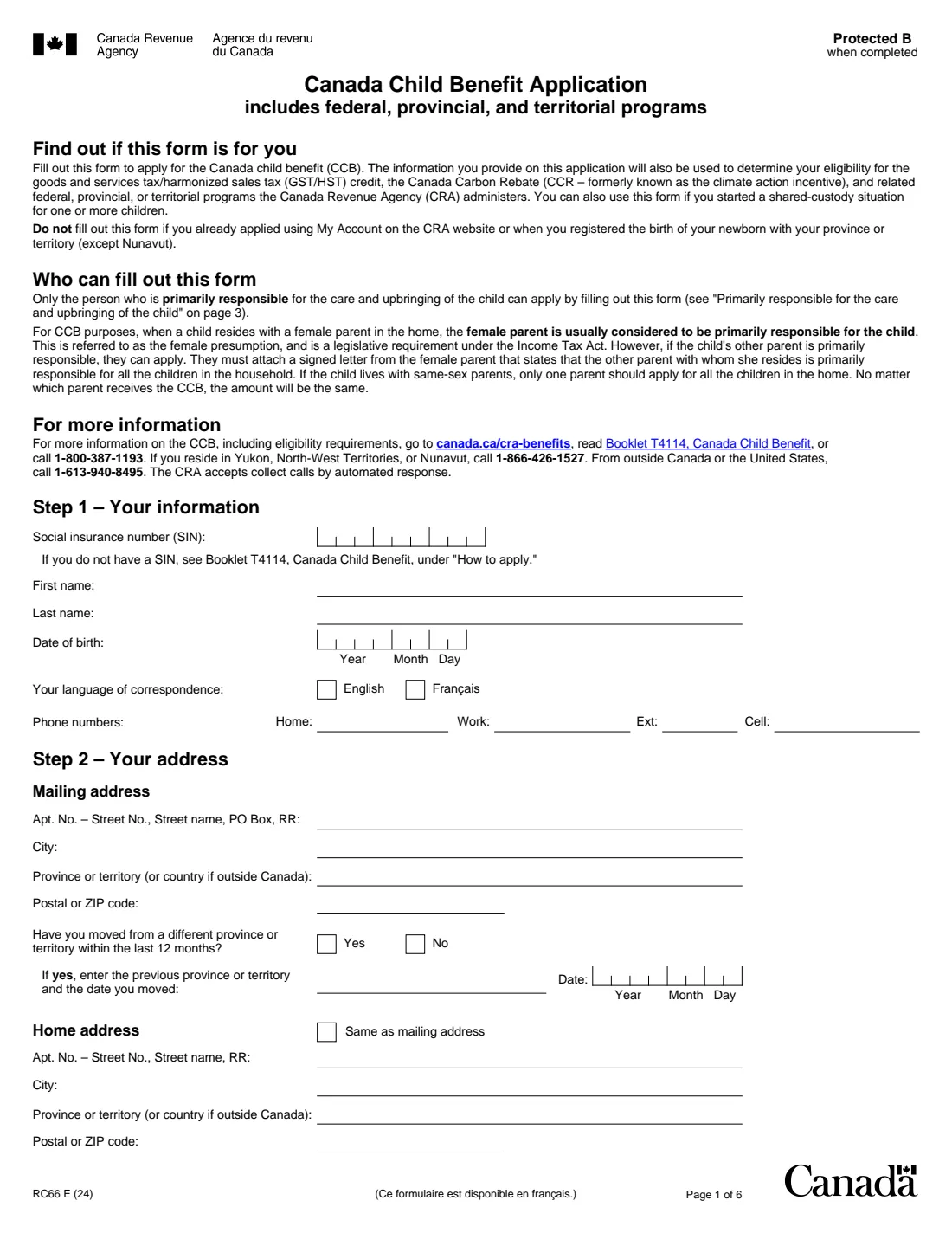
Enter your social insurance number, first and last name, date of birth, preferred language of correspondence (English or French) and your home, work and cell phone numbers.
Only the person primarily responsible for the child applies. When the child lives with a female parent, the form explains that she is usually considered primarily responsible — the female presumption, a legislative requirement under the Income Tax Act. If the other parent is in fact primarily responsible, they can apply by attaching a signed letter from the female parent saying so. For same-sex parents, one parent applies for all the children in the home. The form notes the CCB amount is the same whichever parent receives it.
2 Step 2 – Your address
Give your mailing address — street, city, province or territory (or country if outside Canada) and postal or ZIP code. Say whether you moved from a different province or territory in the last 12 months, and if so, which one and the date you moved.
If your home address differs from your mailing address (for example, you use a PO box), enter the home address too; otherwise tick "Same as mailing address".
3 Step 3 – Your marital status
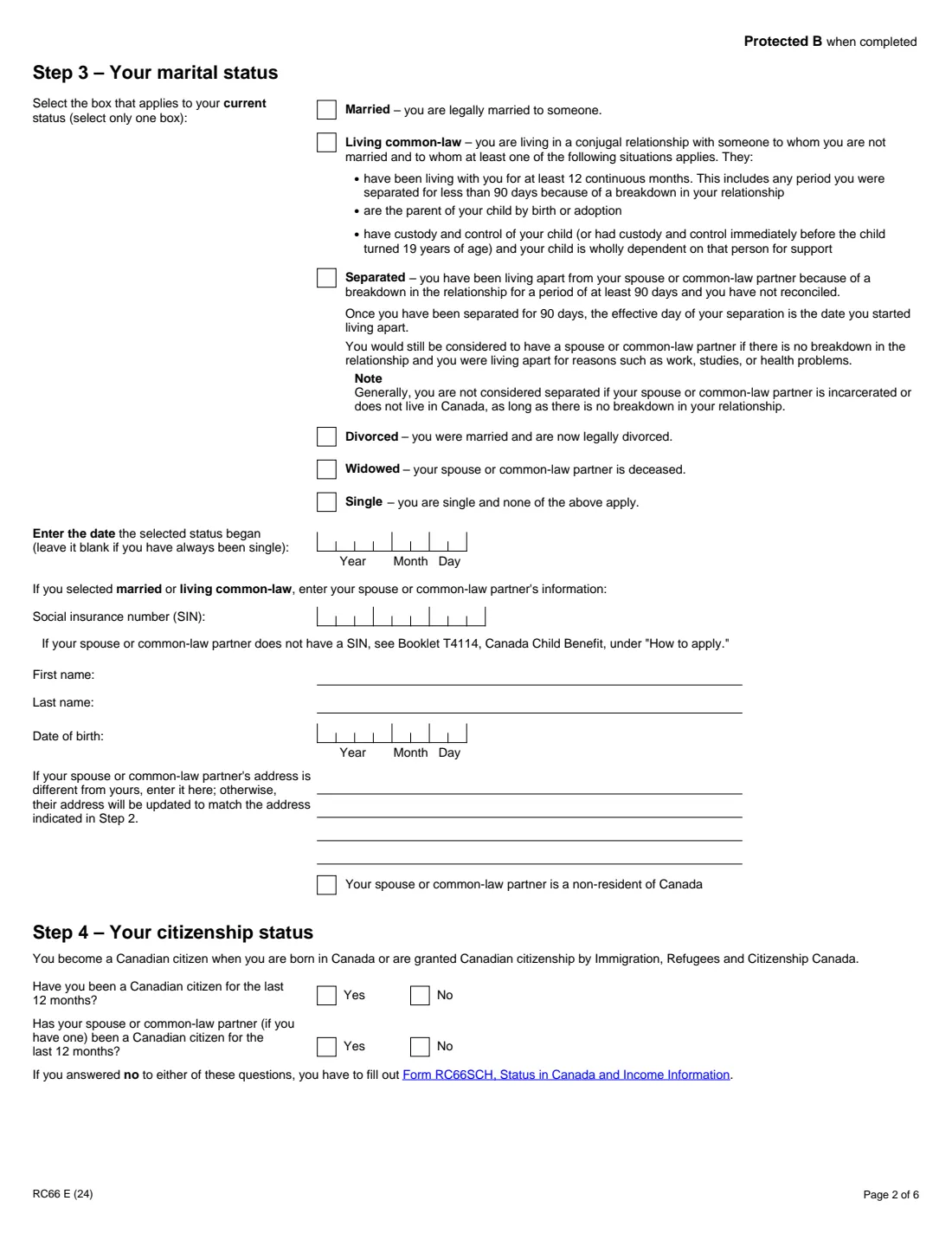
Tick one status: married, living common-law, separated, divorced, widowed or single, and give the date it began (leave it blank if you've always been single). The form defines each one. Living common-law applies when your partner has lived with you for at least 12 continuous months, is the parent of your child by birth or adoption, or has custody and control of your child as the form describes. Separated means living apart because of a breakdown in the relationship for at least 90 days.
If you're married or living common-law, add your spouse's or partner's SIN, name and date of birth, their address if it's different from yours, and tick the box if they are a non-resident of Canada. Living apart for work, studies or health with no breakdown in the relationship doesn't make you separated.
4 Step 4 – Your citizenship status
Answer whether you, and your spouse or partner if you have one, have been Canadian citizens for the last 12 months. If either answer is no, you also need to fill out Form RC66SCH, Status in Canada and Income Information, and send it with your application.
5 Step 5 – Newcomer or returning resident of Canada
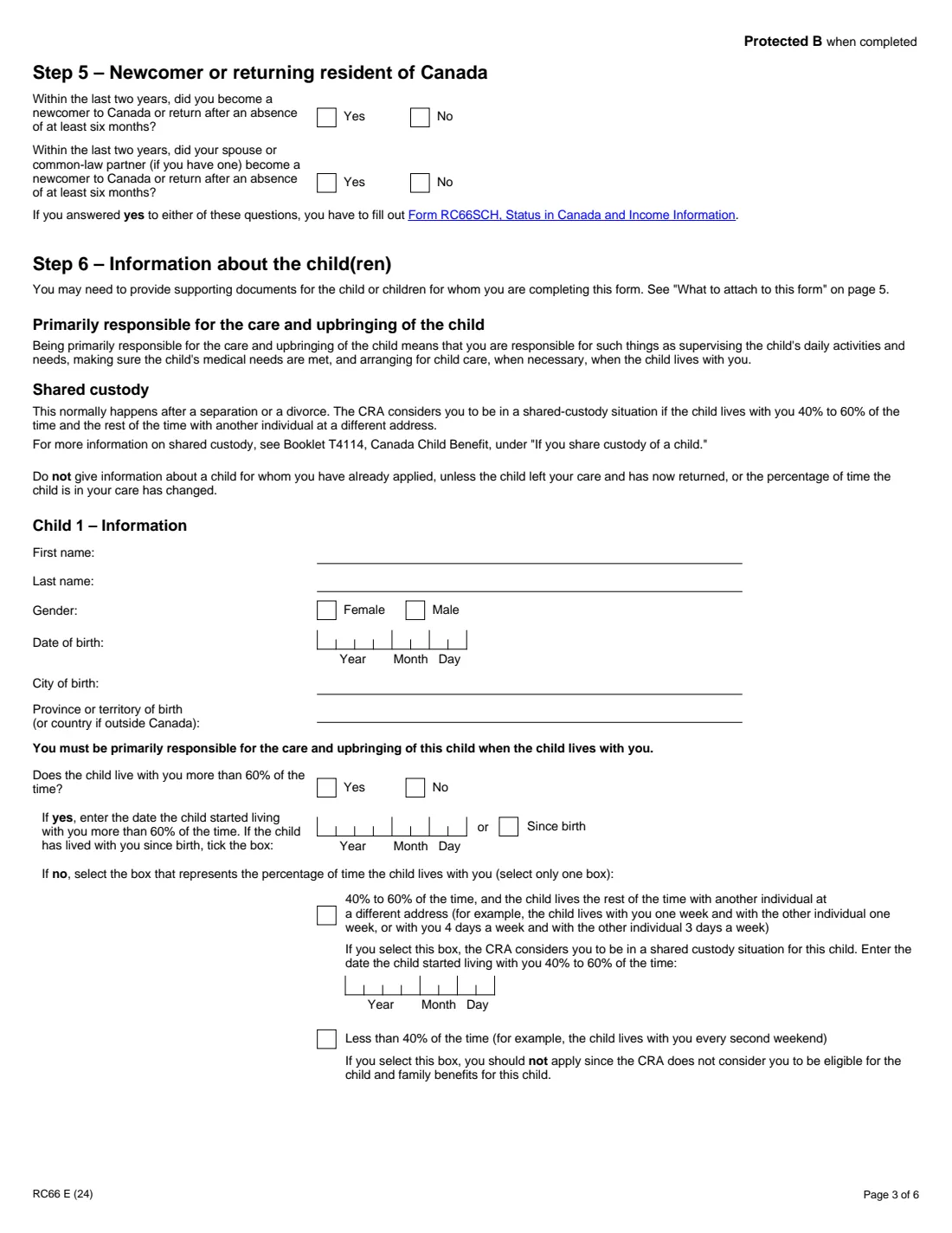
Answer whether, within the last two years, you or your spouse or partner became a newcomer to Canada or returned after an absence of at least six months. A yes to either question also means filling out Form RC66SCH.
As its name says, RC66SCH collects your status in Canada and income information; send it together with the RC66.
6 Step 6 – Information about the child(ren)
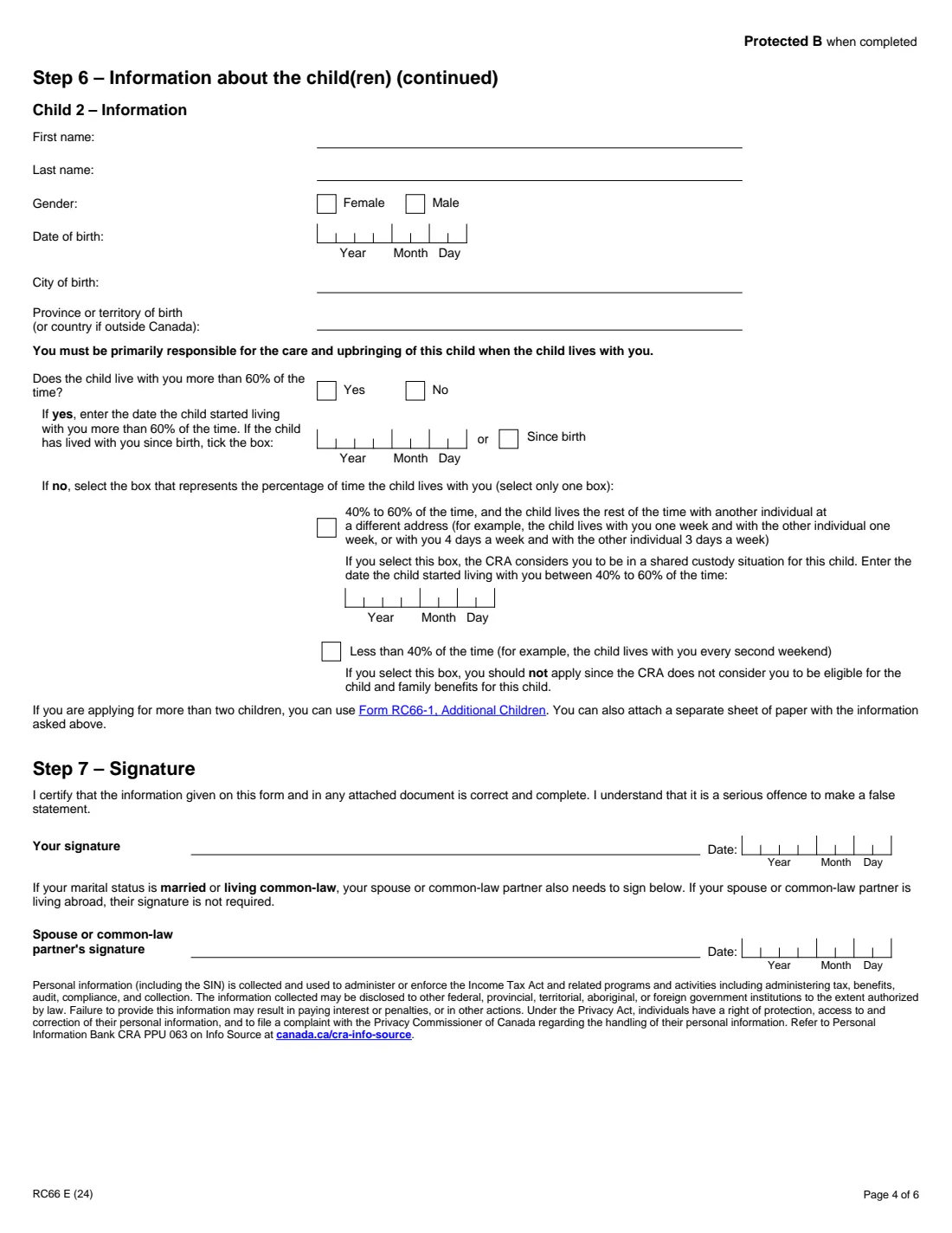
For each child, give their name, gender, date of birth, city of birth and province, territory or country of birth. Then answer whether the child lives with you more than 60% of the time. If yes, give the date that started, or tick "Since birth". If no, tick either 40% to 60% of the time (shared custody, with the date it started) or less than 40% of the time.
The form is clear that if the child lives with you less than 40% of the time, you shouldn't apply, because the CRA doesn't consider you eligible for that child. Don't list a child you've already applied for unless they left your care and returned, or the percentage of time with you has changed. The form has room for two children; FileIt ticks the matching boxes from one simple question per child.
7 Step 7 – Signature
You certify that the information on the form and in any attached document is correct and complete, and that a false statement is a serious offence. Sign and date it. If you're married or living common-law, your spouse or partner also signs and dates it — unless they are living abroad.
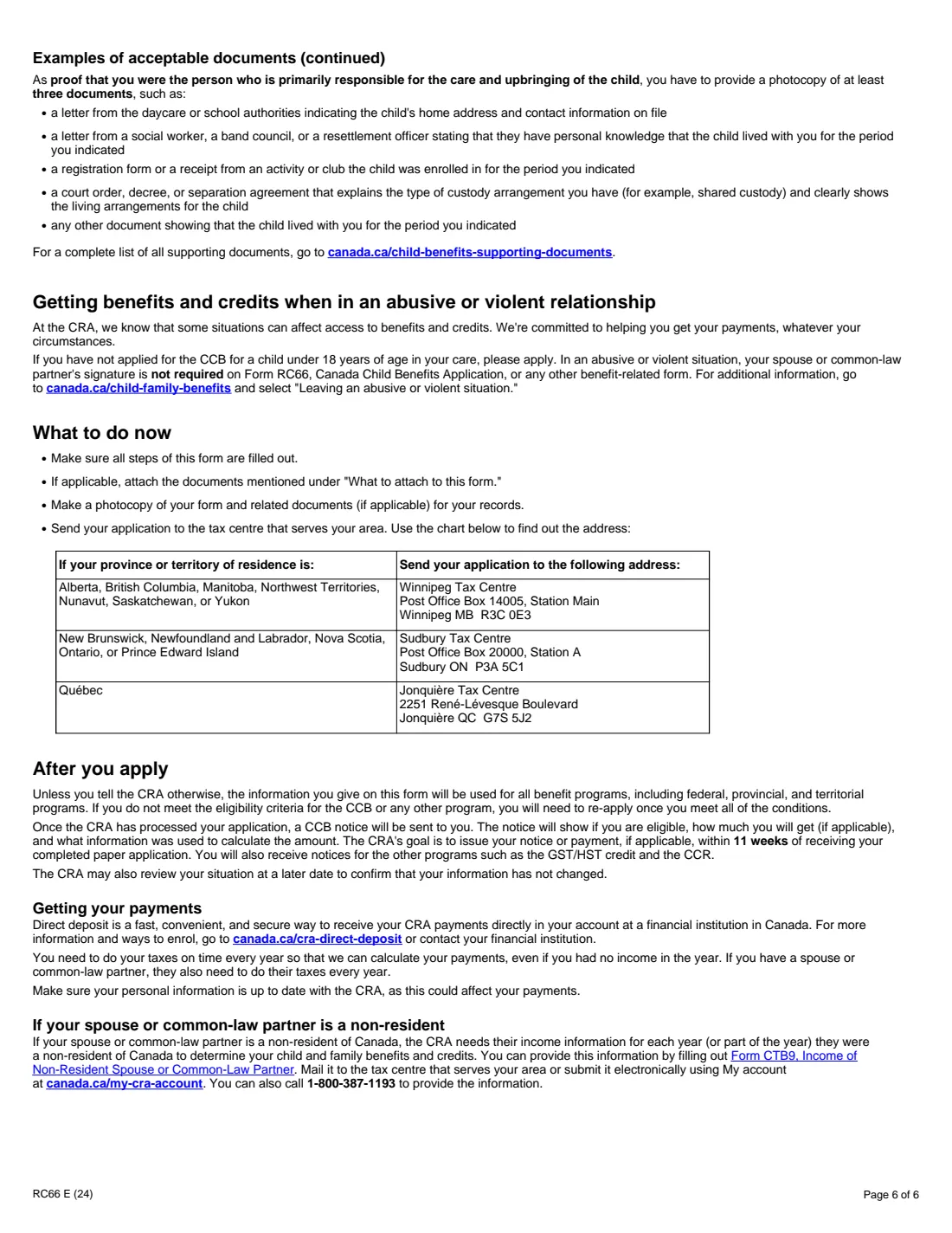
The CRA's guidance printed on the form also says that in an abusive or violent situation, your spouse's or partner's signature is not required on Form RC66. Because the RC66 isn't on the CRA's list of forms that accept electronic signatures, sign on paper.
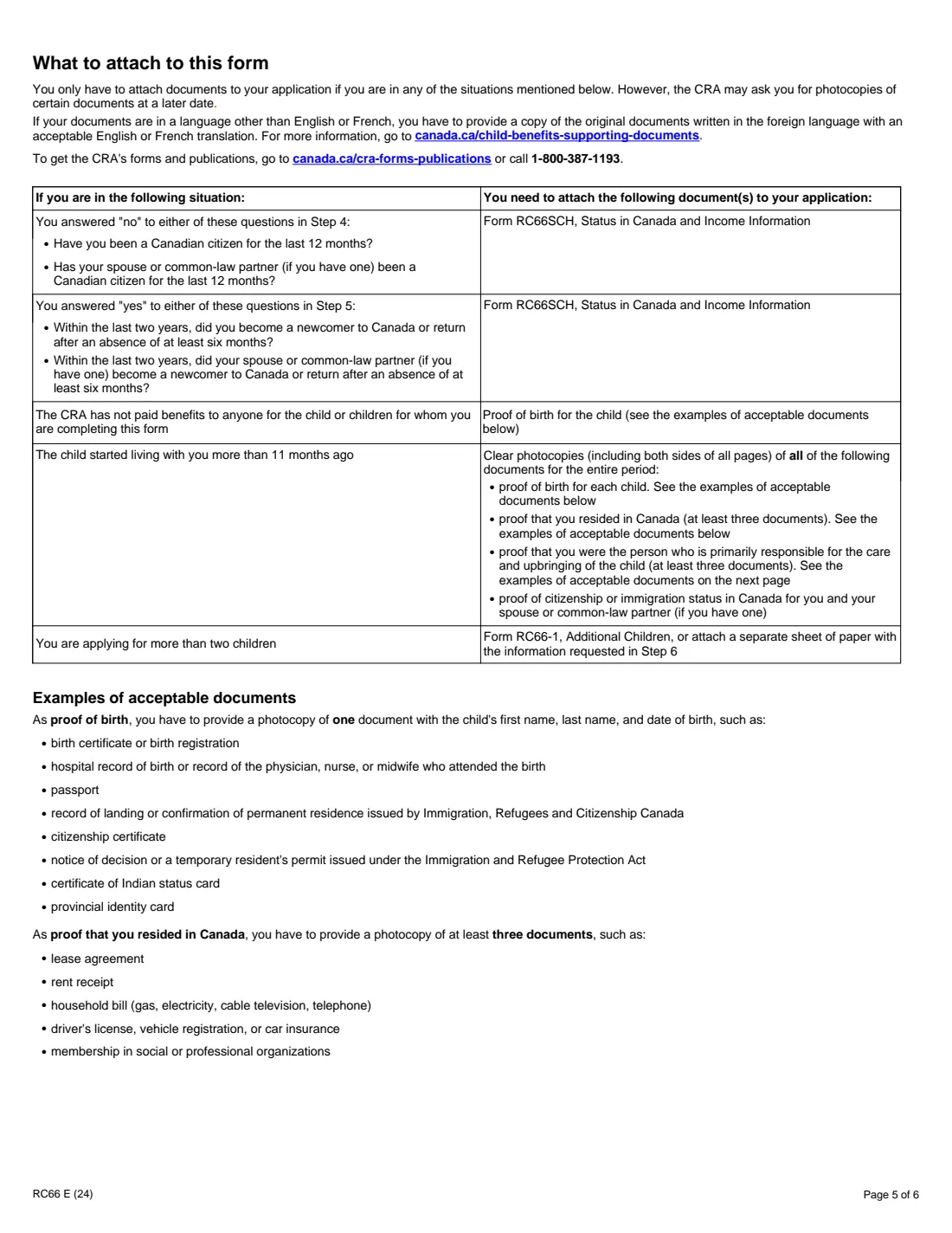
8 What to attach to this form
Page 5 lists what to attach depending on your situation: Form RC66SCH (from Steps 4 and 5); proof of birth if the CRA hasn't paid benefits to anyone for the child; and, if the child started living with you more than 11 months ago, clear photocopies (both sides of every page) of proof of birth, at least three proofs you lived in Canada, at least three proofs you were primarily responsible for the child, and proof of citizenship or immigration status for you and your spouse or partner. For more than two children, add Form RC66-1 or a separate sheet.
Acceptable proof of birth includes a birth certificate or birth registration, a hospital record of birth, a passport or a citizenship certificate. Proof of residence can be a lease, rent receipts, household bills or a driver's licence; proof of responsibility can be letters from a daycare or school, activity registrations, or a custody order or separation agreement. Your FileIt vault is a natural place to gather these.
Common mistakes to avoid
- Filling out the RC66 when you already applied through My Account or when registering your newborn's birth.
- The wrong parent applying — check the female presumption rule and attach the signed letter if the other parent applies.
- Applying for a child who lives with you less than 40% of the time; the form says you shouldn't apply in that case.
- Forgetting your spouse's or common-law partner's signature when you are married or living common-law (unless they live abroad or you are leaving an abusive or violent situation).
- Leaving out Form RC66SCH when you answered no in Step 4 or yes in Step 5.
- Sending originals instead of clear photocopies, or omitting translations for documents not in English or French.
- Not keeping a copy of the application and documents before mailing.
- Not filing your taxes every year — the form says you, and your spouse or partner, need to do so for payments to be calculated.
After you fill it out
Print the PDF from your FileIt vault, sign and date Step 7 by hand, and have your spouse or common-law partner sign too if needed. Attach the documents that apply to you and make a photocopy of everything for your records — the vault copy of the filled form helps, but also keep copies of what you attach. Mail the application to the tax centre that serves your province or territory as shown on the form: Winnipeg Tax Centre for Alberta, British Columbia, Manitoba, the Northwest Territories, Nunavut, Saskatchewan and Yukon; Sudbury Tax Centre for New Brunswick, Newfoundland and Labrador, Nova Scotia, Ontario and Prince Edward Island; and Jonquière Tax Centre for Quebec. FileIt never mails or submits the form for you, and eligibility is decided by the CRA.
Once the CRA processes your application, it sends a CCB notice showing whether you're eligible, how much you'll get and what information was used. The 2024 edition says the CRA's goal is to issue your notice or payment within 11 weeks of receiving a completed paper application, and that you'll also get notices for other programs such as the GST/HST credit. Save those notices in the same vault folder.
Keep your information up to date with the CRA and file your tax returns every year, even with no income. If your marital status, address or custody arrangements change, tell the CRA. The form itself says to list a child again on an RC66 if the child left your care and has now returned, or if the percentage of time the child is in your care has changed.
Fill out Form RC66 online with FileIt
- Pick the person. Choose someone from People and FileIt fills in their name, date of birth, address and other details it already knows.
- Answer plain-language questions. One part of the form at a time, with the official help text beside each question — 66 fields in all. Your answers save as you go.
- Check the live preview. Watch your answers land on the real Canada Revenue Agency (CRA) form, and let FileIt do any worksheet arithmetic.
- Generate the official PDF. FileIt prints your answers into the agency’s own PDF and files it in that person’s folder in your vault.
FileIt fills the form — it never files or submits anything for you. Deliver the finished form to whoever asked for it, the way the form’s instructions say.
Start Form RC66 now — it’s freeForm RC66: frequently asked questions
Can I fill out the RC66 online?
You can fill it out online with FileIt: guided questions for each step, printed into the CRA's official RC66 PDF and saved in your vault, free on every plan. You then print it, sign it by hand and mail it. Separately, the CRA lets you apply through My Account — and if you do that, the form says not to send an RC66 as well.
Where do I mail the RC66?
To the tax centre that serves your province or territory, as listed on page 6 of the form: Winnipeg (AB, BC, MB, NT, NU, SK, YT), Sudbury (NB, NL, NS, ON, PE) or Jonquière (Quebec). FileIt does not mail it for you.
Who should apply for the Canada child benefit, the mother or the father?
The person primarily responsible for the child's care and upbringing. When the child lives with a female parent, she is usually presumed to be that person; if the other parent is, they can apply with a signed letter from her. The form notes the CCB amount is the same whichever parent receives it.
Do both parents have to sign the RC66?
If you're married or living common-law, your spouse or partner also signs, unless they live abroad. The form also says their signature isn't required if you are in an abusive or violent situation.
What documents do I need to attach?
It depends on your situation. You may need Form RC66SCH, proof of birth, and — if the child started living with you more than 11 months ago — proof of residence in Canada, proof you were primarily responsible for the child, and proof of citizenship or immigration status. Send clear photocopies and keep the originals.
Can I apply if we share custody?
Yes. If the child lives with you 40% to 60% of the time and the rest with another individual at a different address, the CRA considers it shared custody. Tick that box in Step 6 and give the date the arrangement started.
How many children can I list on the RC66?
The form has space for two children. For more, use Form RC66-1, Additional Children, or attach a separate sheet with the same Step 6 information.
Can I sign the RC66 electronically?
No. The RC66 isn't on the CRA's list of forms that accept electronic signatures, so print it and sign by hand.
How long does the CRA take to process a paper RC66?
The 2024 edition says the CRA aims to issue your notice or payment within 11 weeks of receiving a completed paper application. Attaching everything that applies to you helps avoid follow-up requests.
Official sources
- Blank form (PDF), published by Canada Revenue Agency (CRA): https://www.canada.ca/content/dam/cra-arc/formspubs/pbg/rc66/rc66-fill-24e.pdf
- Official instructions and guidance: https://www.canada.ca/en/revenue-agency/services/forms-publications/publications/t4114.html
- Edition shown on this page: RC66 E (24) (checked 2026-09-25).
FileIt is not affiliated with or endorsed by Canada Revenue Agency (CRA) or any government. This page explains the form in general terms and is not legal, tax or immigration advice. Always read the official instructions, and check that you are using the edition the recipient accepts. Page last reviewed 2026-09-25.