
What is the criminal defense intake form template?
Calls to a criminal defense office often come from someone other than the client: a parent whose son was arrested last night, or a partner trying to find out where someone is being held. The firm needs the same facts either way — what the charges are, when the next court date is, whether the person is in custody and where — and it needs them fast.
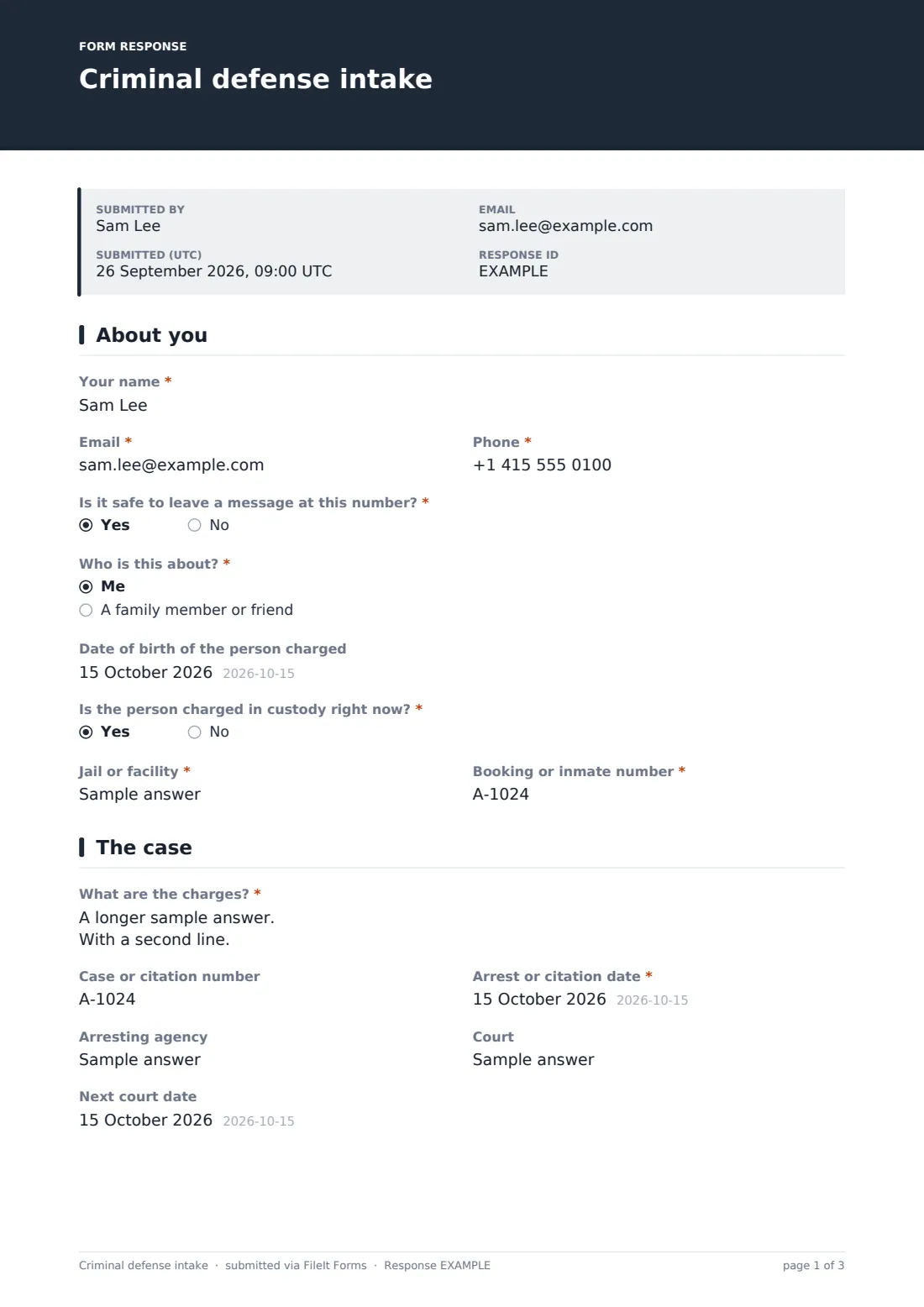
This intake template runs over three pages. The first asks who is filling it in and "Who is this about?" A family member or friend adds the person's name and their relationship. "Is the person charged in custody right now?" opens "Jail or facility" and "Booking or inmate number" on a yes, which is what you need to visit or arrange a call. The form also asks whether it's safe to leave a message, because not every household is a safe place for a call from a law firm.
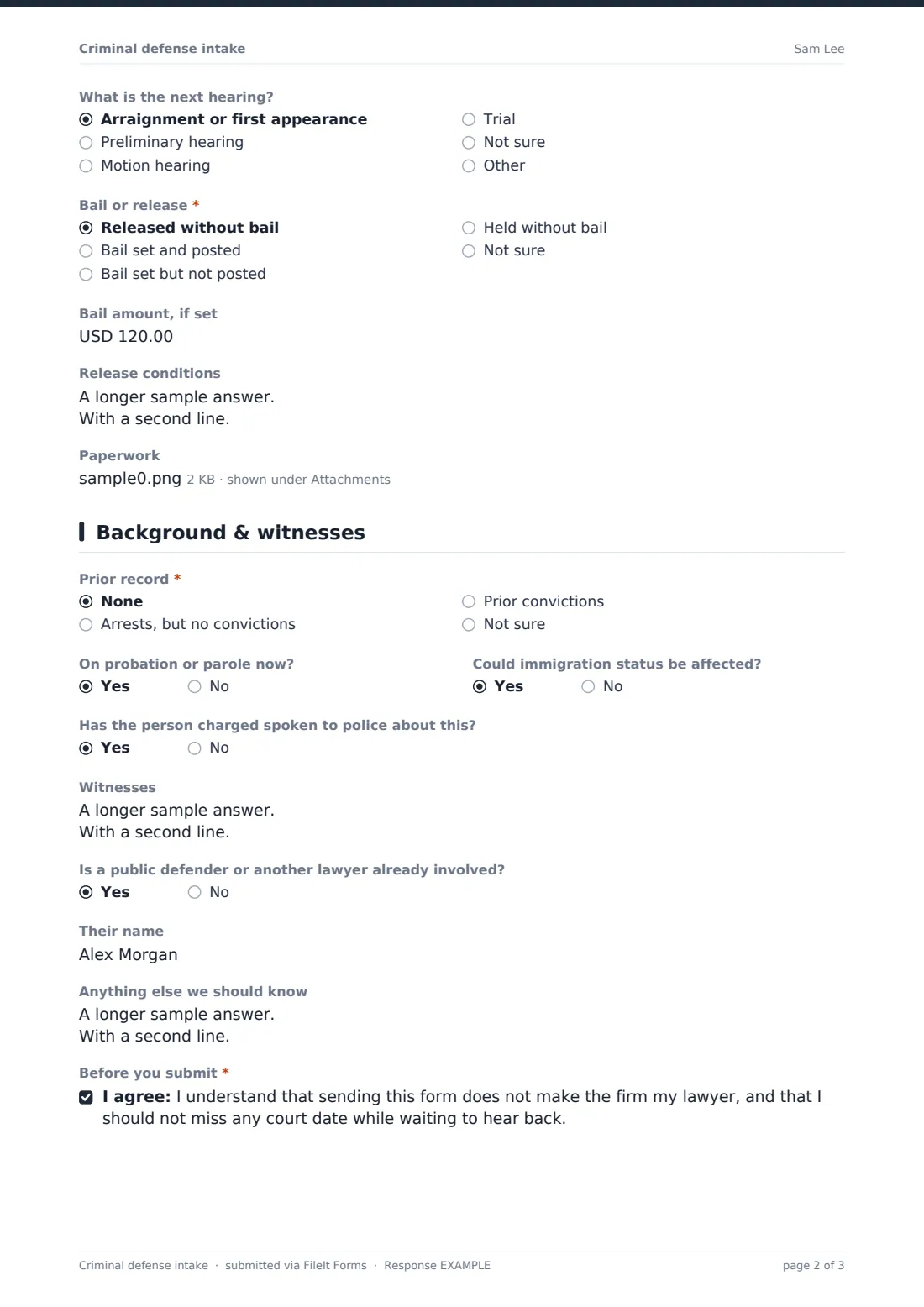
The case page records "What are the charges?", the case number, the arrest date and agency, the court, the "Next court date" and the type of hearing. "Bail or release" separates release without bail, bail posted, bail set but not posted and being held without bail. Release conditions and paperwork uploads follow. The background page covers prior record, probation or parole, possible immigration consequences, statements to police, witnesses and any lawyer already involved. Each intake is filed as a PDF in your FileIt vault, with uploaded paperwork attached.
- Best for
- Criminal defense lawyers, small defense firms and legal clinics
- Filled in by
- The person charged, or a family member or friend
- Time to complete
- About 12 minutes
- Includes
- Custody follow-ups, charges and court dates, bail status, release conditions, paperwork upload, prior record, witnesses and an acknowledgement
Who uses a criminal defense intake form?
- A family member reaching out the morning after an arrest
- Clients charged with a DUI or traffic offense booking a consultation
- A website "tell us about your case" form for a defense practice
- Gathering details before a first jail visit
- Clients with an upcoming arraignment who need a lawyer quickly
- Legal clinics triaging requests for help
Questions on this criminal defense intake form
32 questions over 3 pages · includes file upload, conditional questions, multiple pages, consent checkbox.
1 About you
- Your name*
- Email*
- Phone*
- Is it safe to leave a message at this number?*
- Who is this about?* Me · A family member or friend
- Their full name* asked only when it applies
- Your relationship to them* asked only when it applies
- Date of birth of the person charged
- Is the person charged in custody right now?*
- Jail or facility* asked only when it applies
- Booking or inmate number* asked only when it applies
2 The case
- What are the charges?*
- Case or citation number
- Arrest or citation date*
- Arresting agency
- Court
- Next court date
- What is the next hearing? Arraignment or first appearance · Preliminary hearing · Motion hearing · Trial · Not sure
- Bail or release* Released without bail · Bail set and posted · Bail set but not posted · Held without bail · Not sure
- Bail amount, if set
- Release conditions
- Paperwork
3 Background & witnesses
- Prior record* None · Arrests, but no convictions · Prior convictions · Not sure
- What, where and roughly when asked only when it applies
- On probation or parole now?
- Could immigration status be affected?
- Has the person charged spoken to police about this?
- Witnesses
- Is a public defender or another lawyer already involved?
- Their name asked only when it applies
- Anything else we should know
- Before you submit*
The criminal defense intake form, page by page
1 About you
Your name, email and phone, and "Is it safe to leave a message at this number?". "Who is this about?" — me, or a family member or friend, which asks for their full name and your relationship. The date of birth of the person charged, then the custody question, which opens the jail or facility and the booking or inmate number.
2 The case
"What are the charges?" with help to copy them from the paperwork. The case or citation number, arrest or citation date, arresting agency, court and next court date. "What is the next hearing?" offers arraignment or first appearance, preliminary hearing, motion hearing, trial, not sure, or other. "Bail or release" is required, and the bail amount and release conditions are optional. Up to ten files of paperwork can be uploaded: charging documents, citations, bail papers and court notices.
3 Background & witnesses
"Prior record" is none, arrests without convictions, prior convictions or not sure; anything but none opens a box for what, where and roughly when. Yes or no questions cover probation or parole, possible immigration consequences, and whether the person has spoken to police. Witnesses are listed one per line, and an existing public defender or lawyer can be named. A short "Anything else we should know" box and an acknowledgement finish the form: sending it doesn't make the firm their lawyer, and they shouldn't miss a court date while waiting to hear back.
Make the template yours
- Add the courts you practice in as a dropdown
- Add a question for the offense type if you specialize, such as DUI or juvenile
- Route in-custody intakes to an urgent notification address
- Edit the acknowledgement to match your firm's engagement process
- Add a conflict-check question for co-defendants or alleged victims
- File intakes into a folder per attorney or office
Tips for a better criminal defense intake form
- Look at in-custody intakes first, as they're the most urgent
- Respect the safe-to-message answer before you call or text back
- Run a conflict check on any co-defendants or alleged victims before discussing the case
- Ask for the charging paperwork — it's more reliable than a description
- Keep the free-text summary short and discuss the facts in a private consultation
Every response becomes a PDF in your vault
The intake is filed as a PDF in your vault, with any paperwork attached, and the firm is notified by email. The person who filled it in gets a copy at the email they gave.
The Responses table lists intakes newest first. Search by name or case number to find an intake when the client calls back, and export to CSV to track enquiries over time.
- Start from this template. It opens in the FileIt Forms designer — change any question, add pages, set the rules for when questions appear.
- Share it. Turn on a public link, or send it to people by email, each with their own link. They don’t need a FileIt account.
- Get the answers as PDFs. Each response is saved as a PDF in the vault folder you choose, with uploaded files attached — and listed in a Responses table you can export to CSV.
Criminal defense intake form: frequently asked questions
Is this criminal defense intake template free?
Yes. It's a starter template in FileIt's Forms app, on every plan including free.
Does submitting the form make someone a client?
No. The acknowledgement says that sending the form doesn't make the firm their lawyer. Edit the wording to suit your practice.
Can a family member fill it in?
Yes. Choosing "A family member or friend" asks for the person's name and the relationship.
Why does it ask about immigration?
Some charges can affect immigration status, so the lawyer may need to know early. The question is a simple yes or no.
Are the answers kept private?
Answers are encrypted when stored, and only people with access to your FileIt account can see responses.