What is a phased retirement agreement?
Many people would rather wind down than stop overnight, and many employers would rather keep their experience a little longer. A phased retirement lets both happen: the employee reduces hours or responsibilities in stages while passing on what they know, then retires on a date they've chosen.
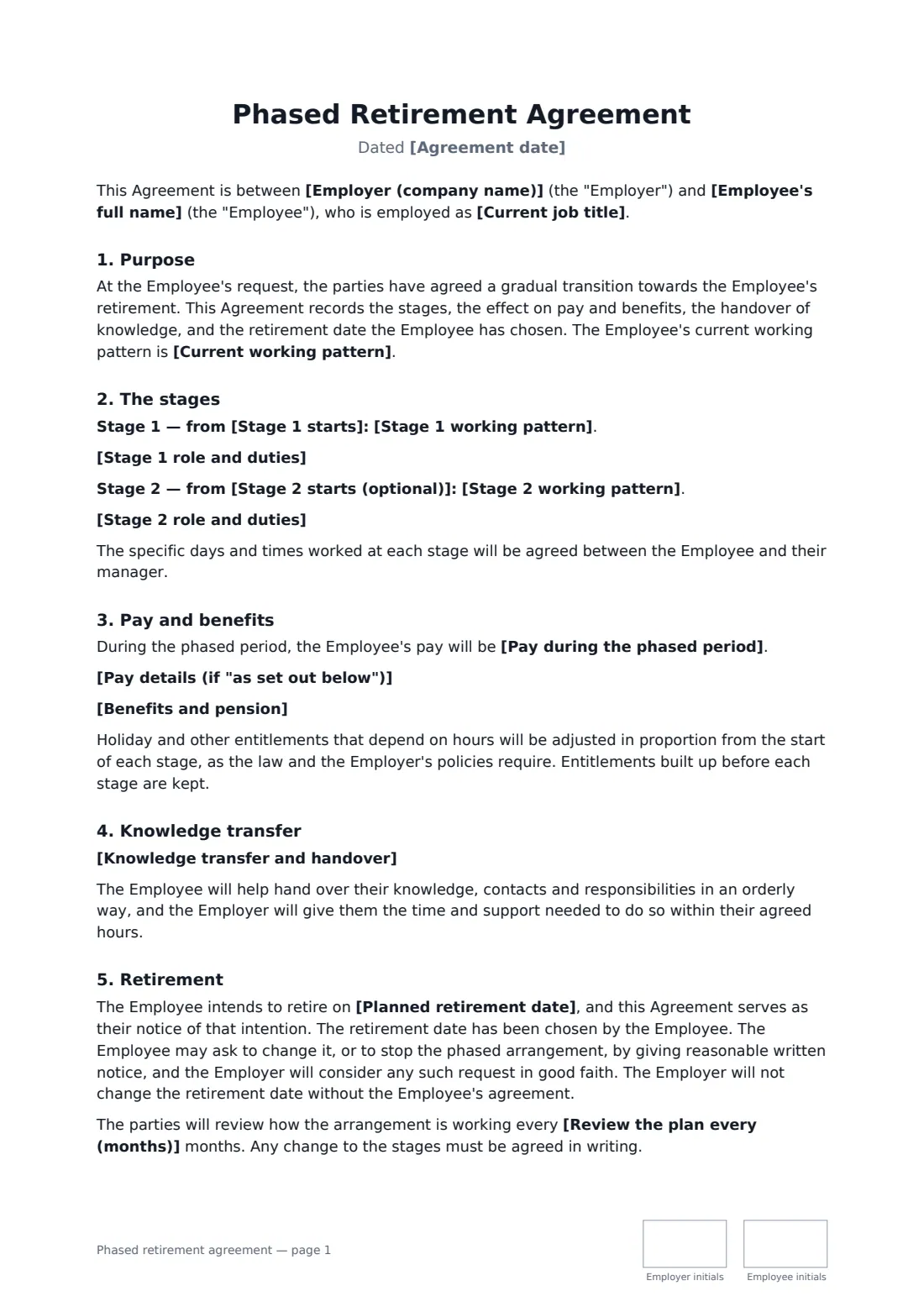
This agreement records the employee's current pattern and up to two stages, each with a start date, working pattern and role. You choose pro-rata pay or set out other pay terms, and the agreement encourages the employee to check the effect on pension and benefits before signing. It covers knowledge transfer, regular reviews and the planned retirement date — making clear the date is the employee's choice, can't be changed by the employer alone, and that age discrimination protection is unaffected.
- Best for
- Experienced employees planning a gradual retirement
- Signed by
- The employer and the employee
- Stages
- One or two, each with dates, hours and role
- Length
- About 2 pages, initialled on every page
When to use a phased retirement agreement
- A long-serving manager moving to four days, then three, before retiring
- A specialist becoming a part-time advisor while training their successor
- A family business founder's employee stepping back over a year
- Keeping key client relationships stable during a handover
- Recording the employee's chosen retirement date alongside a reduced schedule
What you fill in
18 blanks, then the name and email of each person who signs: employer, employee.
1 The parties
- Agreement date*
- Employer (company name)*
- Employee's full name*
- Current job title*
- Current working pattern*
2 Stage 1
- Stage 1 starts*
- Stage 1 working pattern*
- Stage 1 role and duties
3 Stage 2
- Stage 2 starts (optional)
- Stage 2 working pattern
- Stage 2 role and duties
4 Pay and benefits
- Pay during the phased period* in proportion to the hours worked at each stage, at the current rate · as set out below
- Pay details (if "as set out below")
- Benefits and pension*
5 Handover
- Knowledge transfer and handover
6 Retirement
- Planned retirement date*
- Review the plan every (months)*
- Governing law*
7 Who signs
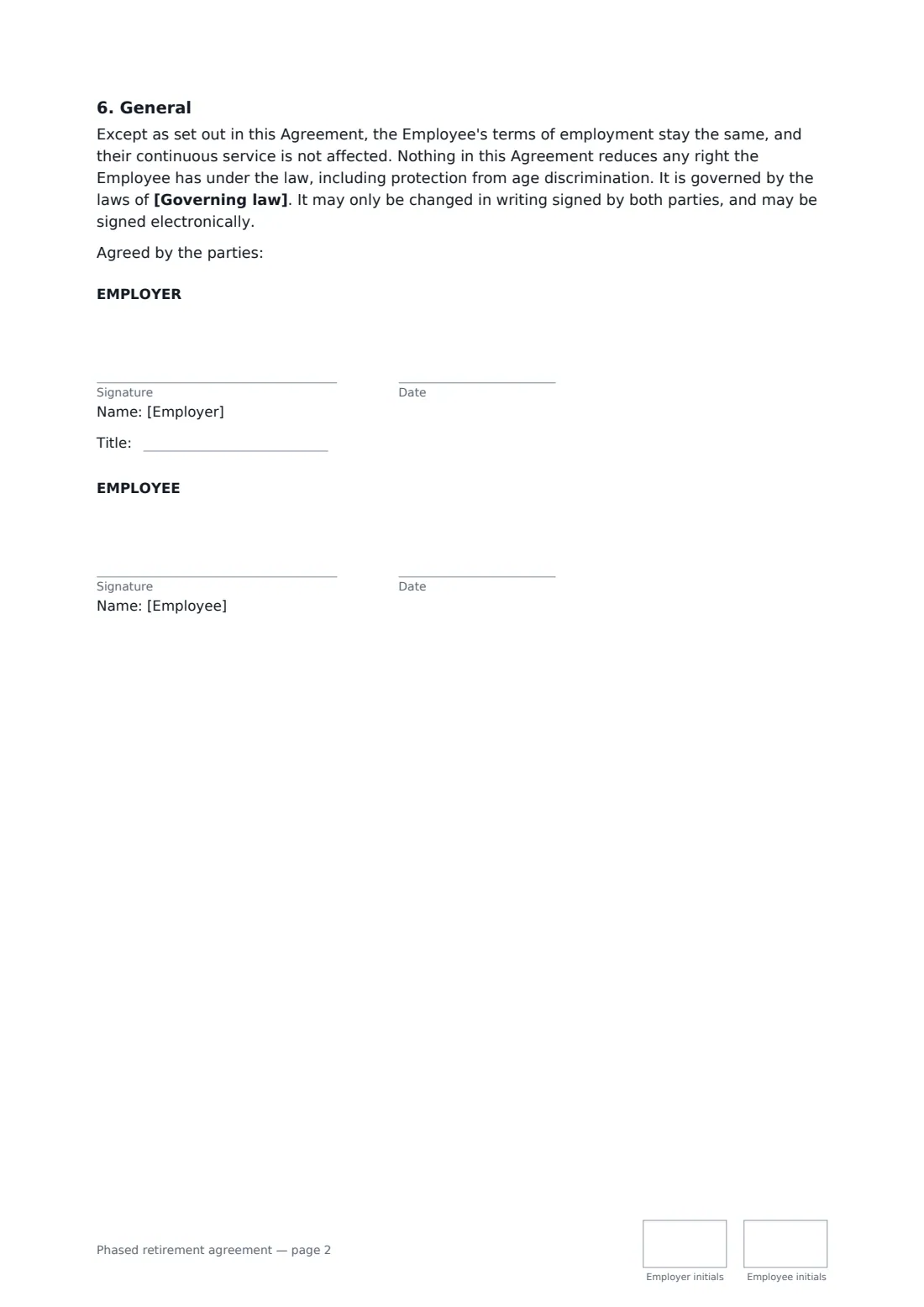
- Employer signature and date, job title, initials on every page
- Employee signature and date, initials on every page
What the phased retirement agreement covers
- Purpose
- The stages
- Pay and benefits
- Knowledge transfer
- Retirement
- General
Using the phased retirement agreement, step by step
1 Record where things stand
Enter the employee's current job title and working pattern.
2 Plan the stages
Set the start date, working pattern and role for stage 1, and optionally stage 2. Leave stage 2 empty for a single step-down.
3 Pay, benefits and handover
Choose pro-rata pay or describe other terms, review the benefits wording, and list the knowledge-transfer tasks.
4 Set the date and send
Enter the retirement date the employee has chosen, how often to review the plan and the governing law. Both parties initial and sign.
Tips before you send it
- Let the employee raise retirement. In most places, an employer can't require someone to retire because of their age.
- Encourage the employee to check pension and benefit effects with the plan administrator or an independent adviser before signing.
- Plan the handover early, so the final stage isn't spent firefighting.
- Review the plan regularly — health, family or business needs may change.
Sign it online in minutes
- Fill in the blanks. Names, dates and amounts go straight into the agreement — the preview shows exactly where.
- Name who signs. Tick “This is me” for your own part. FileIt builds the PDF with every signature, date and initials box on the right line, and you can check or move anything before sending.
- Send it. Each signer gets a secure link and signs from any device — no account needed. The signed PDF, with an audit trail and a Certificate of Completion, is filed in your vault and emailed to everyone.
Phased retirement agreement: frequently asked questions
Can an employer require an employee to retire?
In most places, not because of age. This agreement is built around a retirement date the employee has chosen, and says the employer can't change it without the employee's agreement.
How does phased retirement affect pension?
It depends on the plan and local rules — reduced pay can affect some pension calculations. The agreement encourages the employee to check before signing; it doesn't give pension advice.
Can the employee change their mind?
Yes. They can ask to change the retirement date or stop the phased arrangement by reasonable written notice, and the employer will consider the request in good faith.
Does the agreement count as notice of retirement?
Yes. It states that it serves as the employee's notice of their intention to retire on the planned date.