What is a apprenticeship agreement?
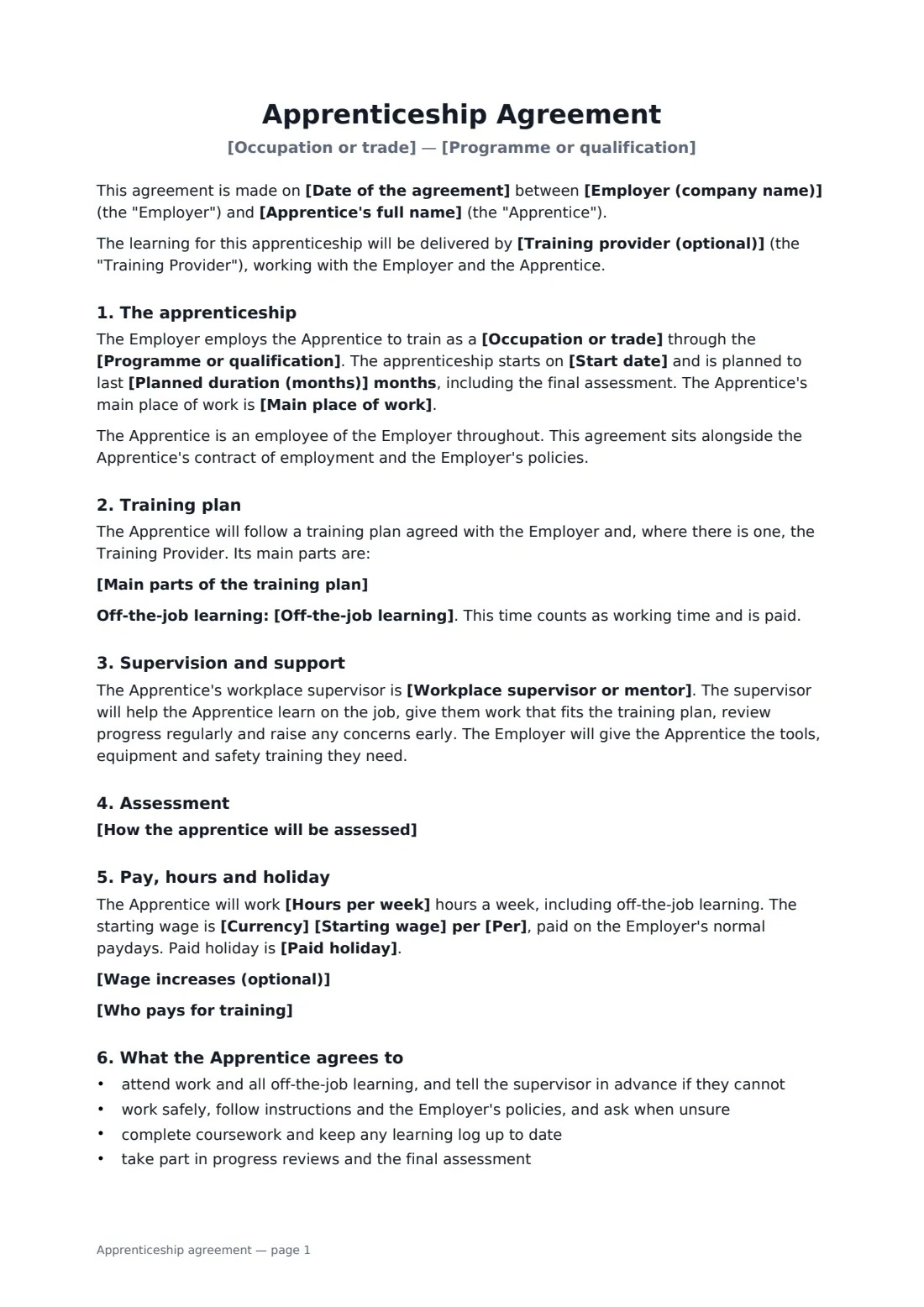
An apprentice is both an employee and a learner, and the agreement has to work for both. It needs the usual employment basics, such as pay, hours and holiday, but also the things that make an apprenticeship succeed: a real training plan, protected time for college or online learning, a named person on site who teaches and checks in, and a clear picture of how progress is assessed.
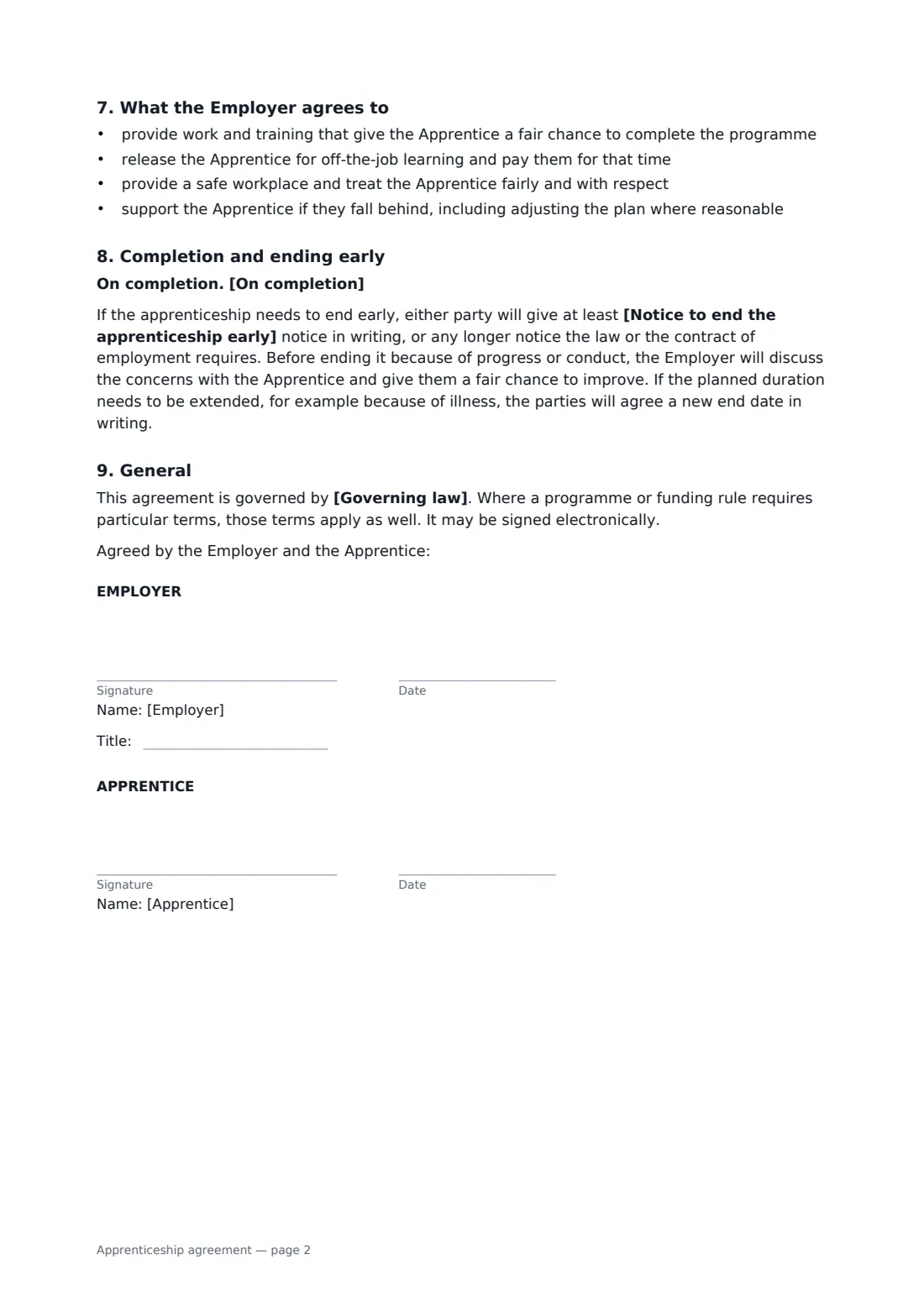
This template records the occupation and the programme or qualification, the start date and planned length, and the main stages of the training plan. It confirms off-the-job learning is paid working time and names the workplace supervisor. Assessment, wage, hours, holiday and who pays training fees follow. It lists what the apprentice and the employer each agree to do, what happens on completion, and a fair process before ending early. A training provider can be named in the agreement, and if they or a parent need to sign, you add them as extra signers before sending.
- Best for
- Trade, technical, office and care apprenticeships
- Signed by
- The employer and the apprentice, with extra signers if needed
- Covers
- Programme, training plan, off-the-job learning, supervisor, pay, assessment, completion
- Length
- About 2 pages
When to use a apprenticeship agreement
- Taking on an electrician, plumber or carpenter apprentice
- A small business hiring its first apprentice with a local college
- Office apprenticeships in accounting, IT support or business administration
- Chef and hospitality apprenticeships with block release at college
- Recording a new training plan when an existing employee starts an apprenticeship
What you fill in
23 blanks, then the name and email of each person who signs: employer, apprentice.
1 The parties
- Date of the agreement*
- Employer (company name)*
- Apprentice's full name*
- Training provider (optional)
2 The apprenticeship
- Occupation or trade*
- Programme or qualification*
- Start date*
- Planned duration (months)*
- Main place of work*
3 Training
- Workplace supervisor or mentor*
- Main parts of the training plan*
- Off-the-job learning*
- How the apprentice will be assessed*
4 Pay and hours
- Hours per week*
- Currency*
- Starting wage*
- Per* hour · week · month · year
- Wage increases (optional)
- Paid holiday*
- Who pays for training* The Employer will pay all training and assessment fees. The Apprentice will not be asked to pay them back. · Training and assessment fees are funded through a government or provider scheme, with any balance paid by the Employer.
5 Completion
- On completion* The Employer intends to offer the Apprentice a permanent role, subject to the business needs at the time. · The apprenticeship and the employment end on completion, unless the parties agree otherwise in writing. · The Apprentice's employment continues on the Employer's standard terms for the role.
- Notice to end the apprenticeship early*
- Governing law*
6 Who signs
- Employer signature and date, job title · Someone with authority to employ the apprentice.
- Apprentice signature and date · The apprentice. If they are under 18, a parent or guardian may also need to sign — add them as an extra signer in the editor.
What the apprenticeship agreement covers
- The apprenticeship
- Training plan
- Supervision and support
- Assessment
- Pay, hours and holiday
- What the Apprentice agrees to
- What the Employer agrees to
- Completion and ending early
- General
Using the apprenticeship agreement, step by step
1 Name the people and programme
Enter your company, the apprentice and the training provider if there is one. Add the occupation, the programme or qualification, the start date, the planned length in months and the main workplace.
2 Write the training plan
List the main stages of learning, describe the off-the-job learning, name the workplace supervisor and say how progress will be assessed.
3 Set pay and hours
Enter weekly hours, the starting wage and how often it is paid, holiday, and any planned wage increases. Choose who pays training and assessment fees.
4 Completion, then send
Choose what happens when the apprentice completes, set the notice to end early and the governing law. Add any extra signers in the editor, then send. The signed agreement is kept in your FileIt vault.
Tips before you send it
- Agree the training plan with the training provider before the start date, so the dates in the agreement match their timetable.
- Apprentices often have their own minimum wage rates and rules on off-the-job time. Check the rules for your programme and country.
- Choose a supervisor who has the time to teach. Weekly ten-minute check-ins prevent most problems.
- If the apprentice is under 18, check whether a parent or guardian must also sign, and any extra limits on hours or tasks.
Sign it online in minutes
- Fill in the blanks. Names, dates and amounts go straight into the agreement — the preview shows exactly where.
- Name who signs. Tick “This is me” for your own part. FileIt builds the PDF with every signature, date box on the right line, and you can check or move anything before sending.
- Send it. Each signer gets a secure link and signs from any device — no account needed. The signed PDF, with an audit trail and a Certificate of Completion, is filed in your vault and emailed to everyone.
Apprenticeship agreement: frequently asked questions
Is an apprentice an employee?
In most apprenticeship schemes, yes: the apprentice is employed and paid, and learns on the job and through off-the-job study. This agreement assumes that and sits alongside their employment contract.
Can the training provider sign too?
Yes. Name the provider in the form, then add them as an extra signer in the eSignature editor before you send, and place their signature box where you want it.
Does this meet our government's apprenticeship rules?
It covers the points most schemes ask for, but some programmes require a specific form or wording. Check your funding rules. The agreement says that any terms they require apply as well. It is a starting point, not legal advice.
What happens if the apprentice needs more time?
The agreement allows the planned duration to be extended, for example after illness, with the new end date agreed in writing.