What is 166 — Joint or individual taxation choice 2026?
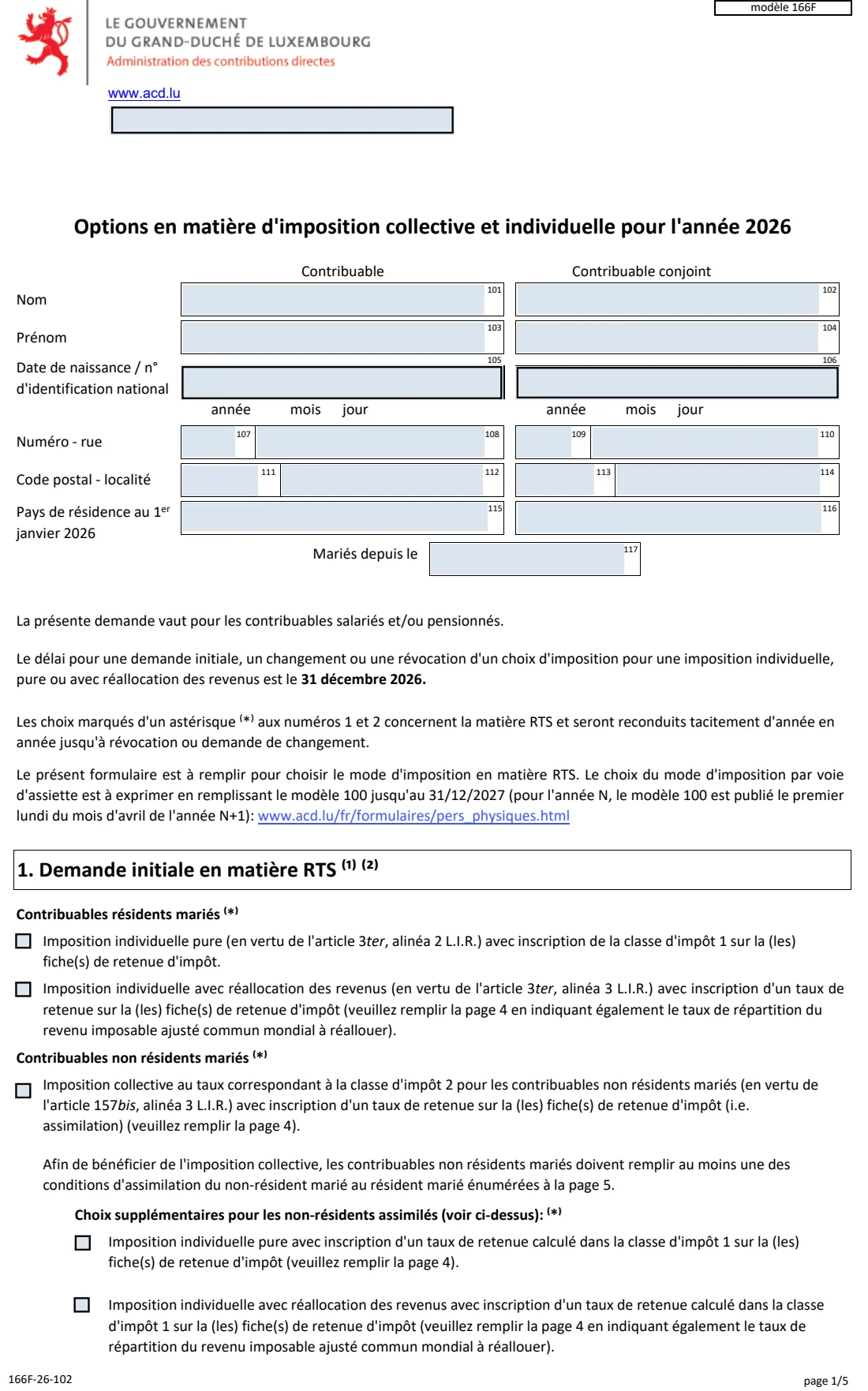
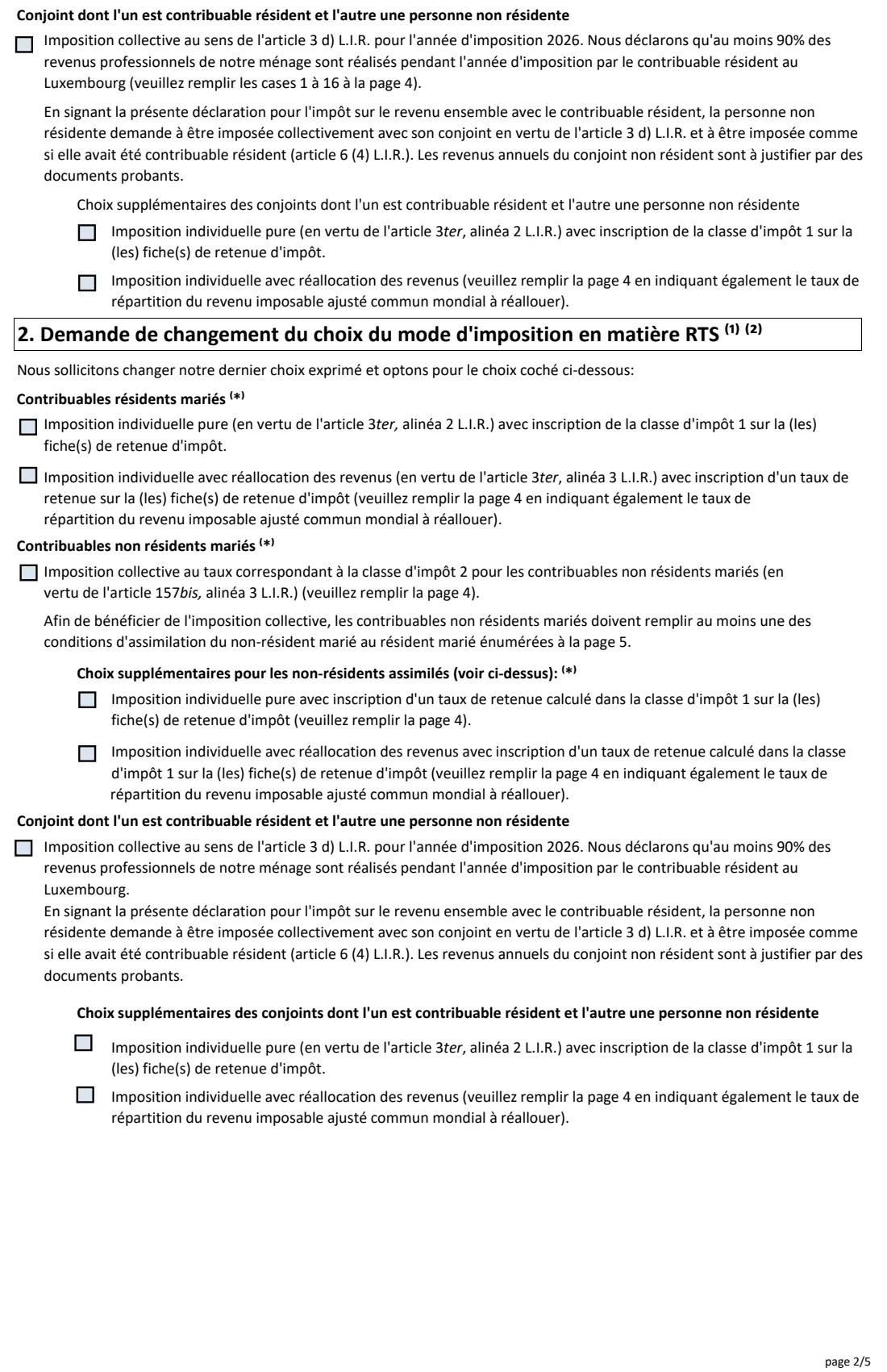
In Luxembourg, married couples who are both resident are taxed jointly (imposition collective) by default. With modèle 166, Options en matière d'imposition collective et individuelle, a couple can instead choose individual taxation for the tax withheld from wages and pensions (retenue d'impôt sur traitements et salaires, RTS). That can be pure individual taxation, with tax class 1 on each spouse's tax card, or individual taxation with reallocation of income, where a withholding rate goes on the tax cards and the couple's common income is split between them in percentages they choose. Non-resident couples who meet an assimilation condition can choose joint taxation at the class 2 rate, or the individual options. A resident married to a non-resident can ask to be taxed jointly when at least 90% of the household's professional income is earned by the resident spouse in Luxembourg.
The same form changes or revokes an earlier choice. The form says the deadline for a first request, a change or a revocation for 2026 is 31 December 2026, and that choices marked (*) carry over from year to year until revoked or changed. It applies to employees and pensioners. The choice for the final tax assessment is made separately, on the tax return (modèle 100).
FileIt asks your situation first, then shows only the options that apply to it, so the right box is ticked. For page 4 it adds up the grey boxes with the form's own formulas and prints every amount in the ACD's 1.234,56 style. The finished PDF is saved in your vault. You both sign it and send it yourselves. FileIt never sends it.
- Issued by
- Administration des contributions directes (ACD)
- Who fills it
- Married couples who are employees or pensioners
- Deadline
- 31 December 2026 (as printed on the form)
- Signatures
- Both spouses (one is enough for a revocation)
- Pages
- 5 (in French)
- Edition
- Modèle 166 F 2026 (166F-26-102)
Who needs to fill out 166 — Joint or individual taxation choice 2026?
- Resident married couples who want individual taxation instead of the default joint taxation, pure or with income reallocated.
- Married non-resident couples who meet at least one assimilation condition and want joint taxation at the class 2 rate, or an individual option.
- A Luxembourg resident married to a non-resident, when the resident earns at least 90% of the household's professional income in Luxembourg and they want joint taxation.
- Couples who want to change or revoke a choice made earlier.
- Not for registered partners: the form's footnote says the RTS choices don't apply to partners, nor to taxpayers whose only income is not subject to withholding on wages and pensions.
When to use 166 — Joint or individual taxation choice 2026
- By 31 December 2026 for a first request, a change or a revocation for 2026, as the form states.
- When you marry, or when your circumstances change enough that another option suits you better.
- There's no need to file it again each year to keep a choice marked (*): it carries over until you change or revoke it.
What you need before you start
- Both spouses' names, dates of birth or 13-digit national identification numbers (matricule), and addresses.
- Each spouse's country of residence on 1 January 2026, and the date of the marriage.
- Your RTS tax office (optional). FileIt prints the address the form itself gives.
- For the options marked 'fill in page 4': each spouse's expected 2026 net income by type, split into income taxable in Luxembourg (indigènes) and exempt income (exonérés), plus deductions such as social security contributions and special expenses.
- For reallocation: the percentage of the common income each spouse takes (the two must add up to 100).
- If income from employment abroad is involved: the number of days worked outside Luxembourg and the net pay for those days.
What’s on 166 — Joint or individual taxation choice 2026
The 2026 edition has 5 pages. FileIt asks for it in 6 parts, and it is signed by Taxpayer (contribuable) and Spouse (contribuable conjoint):
- Tax office (bureau RTS)Taxpayer (contribuable)
- The taxpayer (contribuable)Taxpayer (contribuable)
- The spouse (contribuable conjoint)Spouse (contribuable conjoint)
- Your choice (parts 1, 2 and 3)Taxpayer (contribuable)
- Page 4 — your income for 2026Taxpayer (contribuable)
- SignatureTaxpayer (contribuable)
How to fill out 166 — Joint or individual taxation choice 2026, step by step
1 Identity (page 1)
Surname and first name of each spouse (boxes 101 to 104), date of birth or national ID number (105 and 106), address (107 to 114), country of residence on 1 January 2026 (115 and 116), and the date of the marriage (117).
2 1. First request (Demande initiale)
Tick one option for your situation. Resident couples choose pure individual taxation (class 1 on each tax card) or individual taxation with reallocation. Non-resident couples choose joint taxation at the class 2 rate, which requires one of the assimilation conditions on page 5, or, as assimilated non-residents, one of the two individual options. For a resident married to a non-resident, joint taxation needs the 90% declaration and boxes 1 to 16 on page 4; the individual options are also available.
3 2. Change of choice (Demande de changement)
The same options as part 1, to replace the choice you made before. Tick only one.
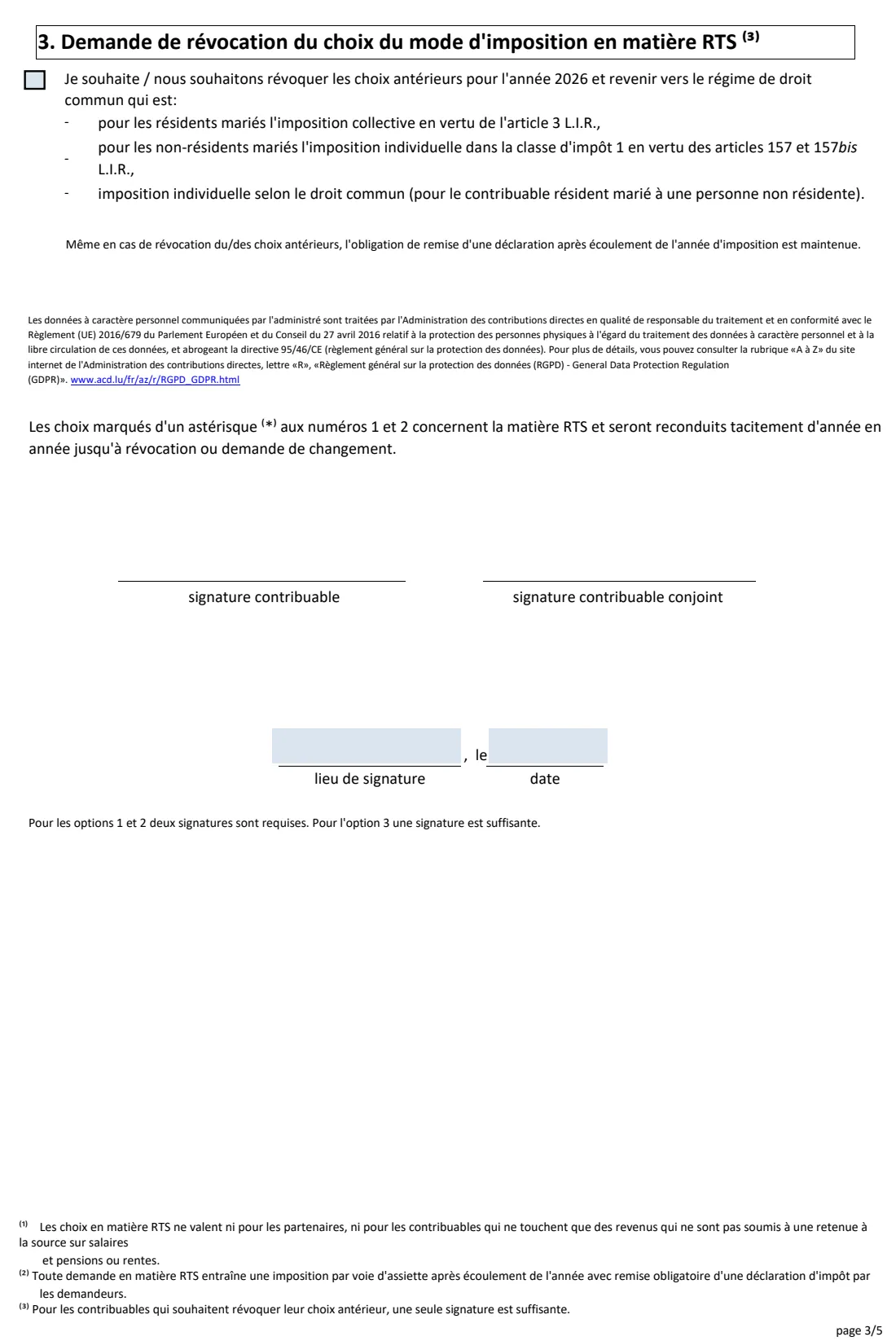
4 3. Revocation (Demande de révocation)
Go back to the default for 2026: joint taxation for resident couples, individual taxation in class 1 for non-resident couples, and individual taxation under the general rules for a resident married to a non-resident. You must still file a tax return after the end of the year.
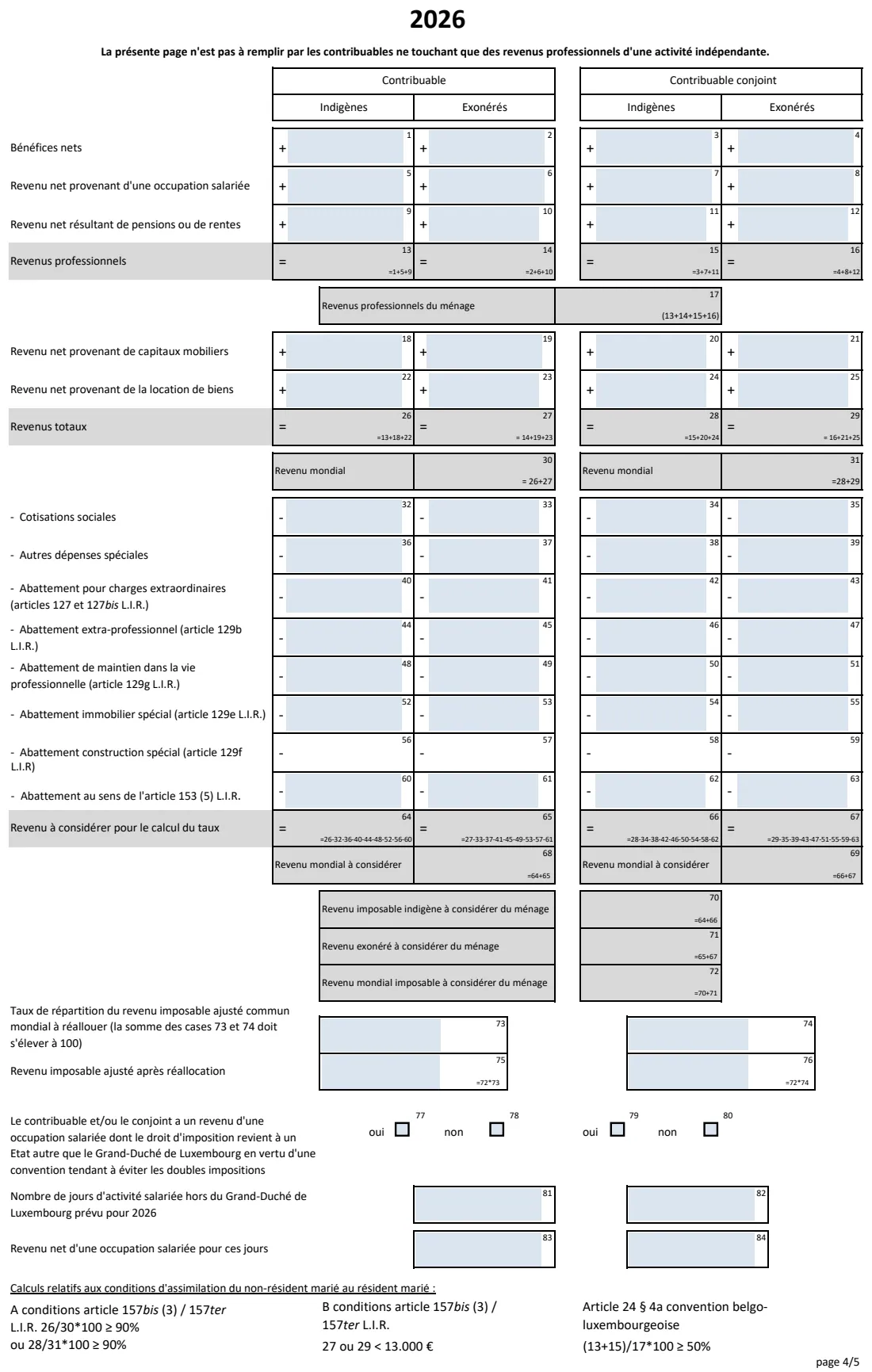
5 Page 4: income for 2026
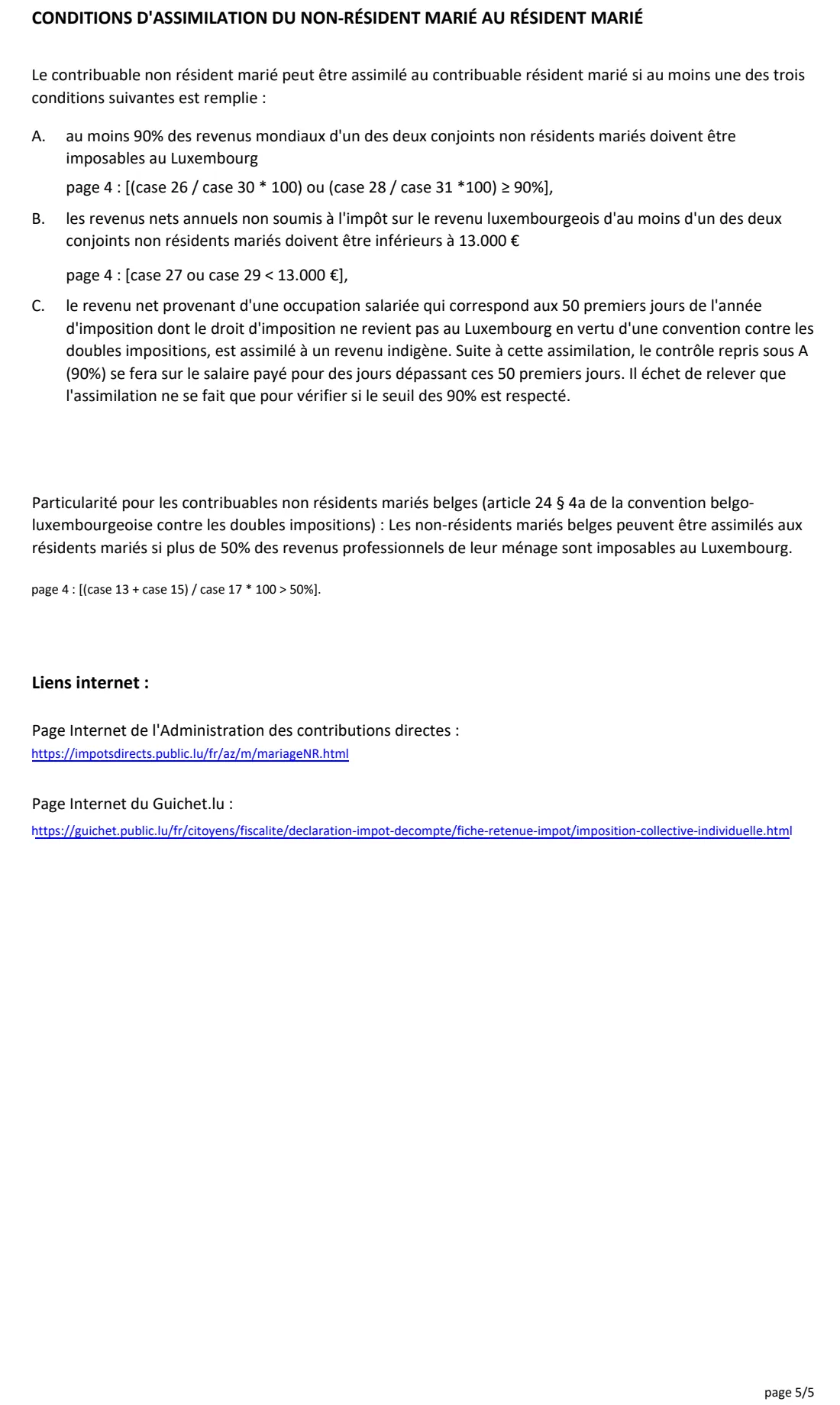
For each spouse, in two columns (Luxembourg and exempt income): net profits, employment income, pensions, investment and rental income, then eight kinds of deductions. The grey boxes are totals: professional income (13 to 17), total income (26 to 29), worldwide income (30, 31), income for the rate (64 to 67) and the household totals (68 to 72). With reallocation, give the split in boxes 73 and 74; boxes 75 and 76 show each spouse's share. Page 5 explains how these boxes show whether non-residents meet the assimilation conditions.
6 Signature (page 3)
Place and date, then both spouses sign. For a revocation, one signature is enough.
Common mistakes to avoid
- Ticking more than one option. Each part lists alternatives: tick one.
- Choosing an option marked 'veuillez remplir la page 4' and leaving page 4 empty.
- Reallocation percentages in boxes 73 and 74 that don't add up to 100.
- Only one spouse signing a first request or change. Options 1 and 2 need both signatures.
- Using the form as registered partners. The footnote says the RTS choices don't apply to partners.
- Missing the 31 December 2026 deadline printed on the form.
After you fill it out
Both spouses sign page 3, then send the form to the ACD. Guichet.lu also describes submitting the request online through MyGuichet.lu.
The chosen tax class or rate appears on your tax cards (fiches de retenue d'impôt), and your employers or pension funds apply it.
The form says every RTS request leads to an assessment after the end of the year with a compulsory tax return (modèle 100), where the choice for the assessment is made.
FileIt keeps the filled PDF in your vault, so you can check later which option you chose.
Fill out 166 — Joint or individual taxation choice 2026 online with FileIt
- Pick the person. Choose someone from People and FileIt fills in their name, date of birth, address and other details it already knows.
- Answer plain-language questions. One part of the form at a time, with the official help text beside each question — 170 fields in all. Your answers save as you go.
- Check the live preview. Watch your answers land on the real Administration des contributions directes (ACD) form, and let FileIt do any worksheet arithmetic.
- Generate the official PDF. FileIt prints your answers into the agency’s own PDF and files it in that person’s folder in your vault. Sign it, or send it for e-signature.
FileIt fills the form — it never files or submits anything for you. Deliver the finished form to whoever asked for it, the way the form’s instructions say.
Start 166 — Joint or individual taxation choice 2026 now — it’s free166 — Joint or individual taxation choice 2026: frequently asked questions
What is the difference between pure individual taxation and reallocation?
With pure individual taxation, each spouse is taxed on their own income in tax class 1. With reallocation, the couple's common adjusted worldwide taxable income is split between the spouses in the percentages you give in boxes 73 and 74, and a withholding rate goes on the tax cards.
When is the deadline?
The form says the deadline for a first request, a change or a revocation of an individual taxation choice is 31 December 2026.
Do we have to file it every year?
No. The form says the choices marked (*) in parts 1 and 2 carry over from year to year until you revoke or change them.
We are both non-resident. Can we be taxed jointly?
Only if you meet at least one assimilation condition on page 5. For example, at least 90% of one spouse's worldwide income is taxable in Luxembourg, or one spouse's income not taxed in Luxembourg is below 13,000 euros. Belgian residents have a special 50% rule under the Belgium-Luxembourg tax treaty.
Does this form replace the tax return?
No. It sets the withholding on wages and pensions. The form says every RTS request leads to a compulsory tax return after the year, where the choice for the assessment is made on modèle 100.
Can registered partners use it?
No. The form's footnote says the RTS choices don't apply to partners.
Official sources
- Blank form (PDF), published by Administration des contributions directes (ACD): https://impotsdirects.public.lu/dam-assets/fr/formulaires/fiches_d_impot/2026/166f-2026.pdf
- Official instructions and guidance: https://guichet.public.lu/fr/citoyens/fiscalite/declaration-impot-decompte/fiche-retenue-impot/imposition-collective-individuelle.html
- Edition shown on this page: Modèle 166 F, 2026 (166F-26-102) (checked 2026-09-28).
FileIt is not affiliated with or endorsed by Administration des contributions directes (ACD) or any government. This page explains the form in general terms and is not legal, tax or immigration advice. Always read the official instructions, and check that you are using the edition the recipient accepts. Page last reviewed 2026-09-28.