What is 163 R — Annual tax adjustment 2025?
In Luxembourg, tax on wages and pensions is withheld at source according to your tax card. Many deductions and credits can't be taken into account there: insurance premiums, loan interest, pension savings, home-savings contributions, gifts, extraordinary charges such as medical or childcare costs, or travel expenses between several workplaces. The décompte annuel, modèle 163 R F, is the request (demande de régularisation) that asks the Administration des contributions directes (ACD) to recalculate your 2025 withholding tax with them, and to refund what was withheld too much.
It is only for resident employees and pensioners who lived in Luxembourg for part or all of 2025 and are not subject to an assessment by tax return. Those who are, for example couples who chose individual taxation, partners asking for joint taxation, or a resident married to a non-resident asking for joint taxation, must file the tax return (modèle 100) instead. Non-residents use modèle 163 NR. The deadline printed on the form, and on the ACD's forms page, is 31 December 2026.
FileIt walks you through all six pages in English, with the French box names alongside. It switches on only the parts you need and prints every amount in the ACD's 1.234,56 style. It adds up the boxes the form's own formulas total (such as 451, 536 and 561) and fills in the ceilings and the minimum lump sum. The finished PDF is saved in your vault. You sign it and hand it in yourself. FileIt never sends it.
- Issued by
- Administration des contributions directes (ACD)
- Who fills it
- Resident employees and pensioners not assessed by tax return
- Tax year
- 2025
- Deadline
- 31 December 2026
- Signatures
- You, and your spouse if you're taxed jointly
- Pages
- 6 (in French)
- Edition
- 163RF-25-101
Who needs to fill out 163 R — Annual tax adjustment 2025?
- Resident employees and pensioners who paid insurance premiums, consumer-loan interest, pension or home-savings contributions, or gifts in 2025 and want them deducted.
- People with extraordinary charges: medical costs, disability, domestic help, care or childcare, or supporting children who don't live with them.
- Parents asking for the child tax reduction as a rebate, the single-parent tax credit (CIM) or the child tax bonus.
- Employees who worked at several workplaces, or moved, and want their travel-expense lump sum recalculated.
- Employees asking for the overtime tax credit (CIHS).
- Not for taxpayers who must file a tax return (modèle 100), and not for non-residents, who use modèle 163 NR.
When to use 163 R — Annual tax adjustment 2025
- After the end of 2025, once you have your annual salary or pension certificates.
- By 31 December 2026, the deadline for a 2025 adjustment printed on the form.
- Once per tax year: the form covers 1 January to 31 December 2025.
What you need before you start
- Your national identification number (matricule), address, and any address you moved from in 2025, with the dates.
- A copy of every 2025 annual salary or pension certificate, to attach.
- Your spouse's details and activities, if you are married and taxed jointly.
- Your children's names and matricules, and any allowances they received.
- Receipts for what you paid in 2025: insurance premiums, loan interest (and any interest subsidy), pension-savings (111bis / 111ter) and home-savings contributions, social security contributions and gifts.
- For extraordinary charges: the amounts and details, the medical certificate for disability, and what you paid for domestic help or childcare.
- For travel expenses: the municipalities where you worked, the periods and how many days a week or month.
What’s on 163 R — Annual tax adjustment 2025
The 2025 edition has 6 pages. FileIt asks for it in 29 parts, and it is signed by Taxpayer (contribuable) and Spouse (contribuable conjoint):
- Tax office (bureau RTS)Taxpayer (contribuable)
- Signalétique — the taxpayer (contribuable)Taxpayer (contribuable)
- Previous address in 2025 (ancien domicile)Taxpayer (contribuable)
- État civil — civil statusTaxpayer (contribuable)
- Activités — salaries, pensions and other periods in 2025 (page 3)Taxpayer (contribuable)
- Contribuable conjoint — your spouse (married, taxed jointly)Spouse (contribuable conjoint)
- Tax identification number abroad (NIF)Taxpayer (contribuable)
- 1. Children in your household (modérations d'impôt pour enfants)Taxpayer (contribuable)
- 3. Single-parent tax credit (crédit d'impôt monoparental — CIM)Taxpayer (contribuable)
- 4. Child tax bonus — child who left the reduction in 2023 or 2024 (231)Taxpayer (contribuable)
- 4. Child tax bonus — children in alternating residence (240)Taxpayer (contribuable)
- 4.a Travel expenses: several workplaces (frais de déplacement — FD)Taxpayer (contribuable)
- 4.a Travel expenses: the spouse's workplacesSpouse (contribuable conjoint)
- 5. Extra-professional allowance (abattement extra-professionnel)Taxpayer (contribuable)
- Special expenses A. Annuities and permanent charges (arrérages de rentes)Taxpayer (contribuable)
- Special expenses B. a) Debit interest on consumer loans (intérêts débiteurs)Taxpayer (contribuable)
- Special expenses B. b) Insurance premiums (primes d'assurance)Taxpayer (contribuable)
- Special expenses C. Personal social security contributionsTaxpayer (contribuable)
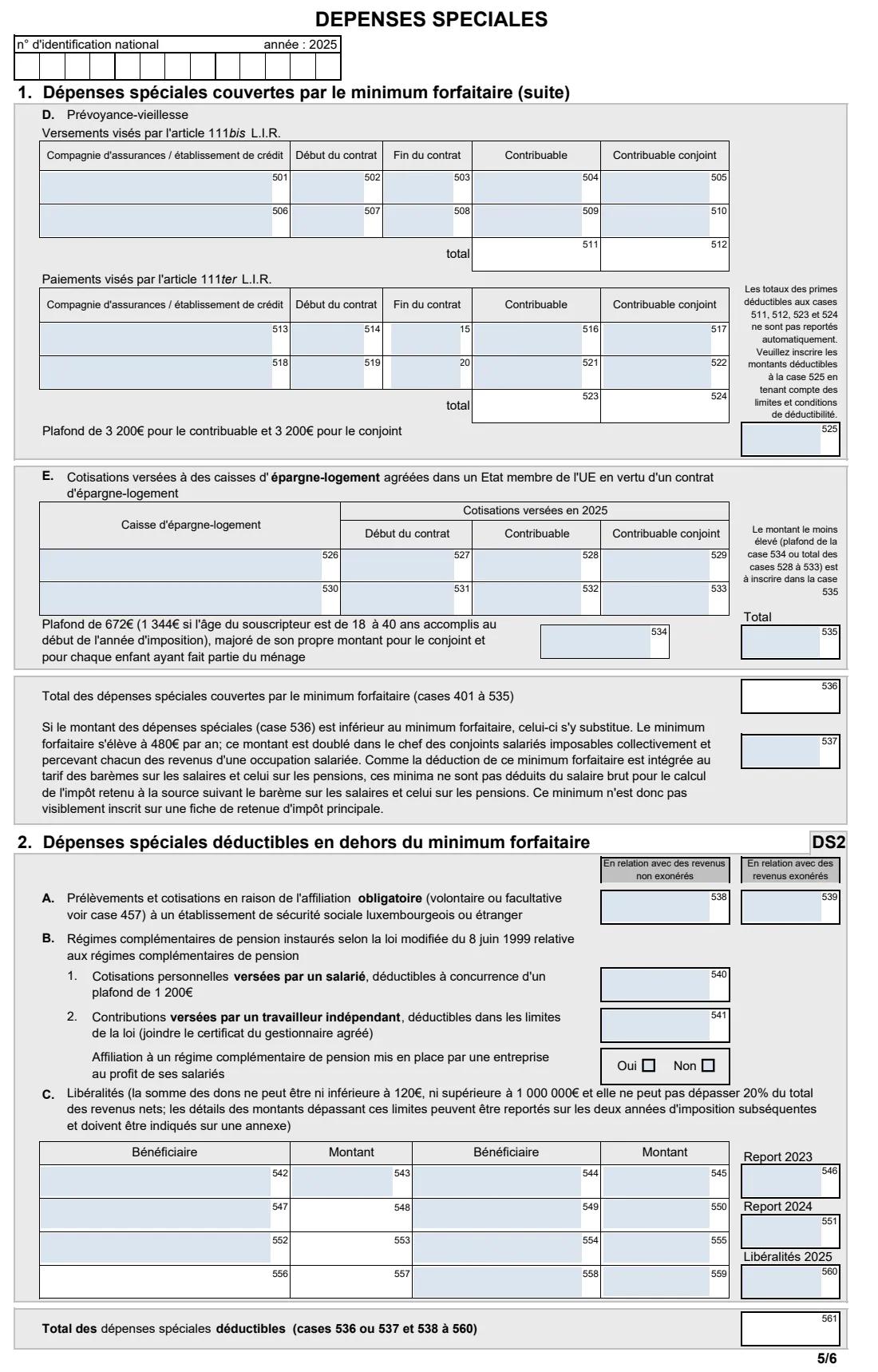
- Special expenses D. Old-age provision (prévoyance-vieillesse)Taxpayer (contribuable)
- Special expenses E. Home-savings contracts (épargne-logement)Taxpayer (contribuable)
- 2. Special expenses outside the lump-sum minimum (DS2)Taxpayer (contribuable)
- C. Gifts (libéralités)Taxpayer (contribuable)
- Special expenses — totals (worked out by FileIt)Taxpayer (contribuable)
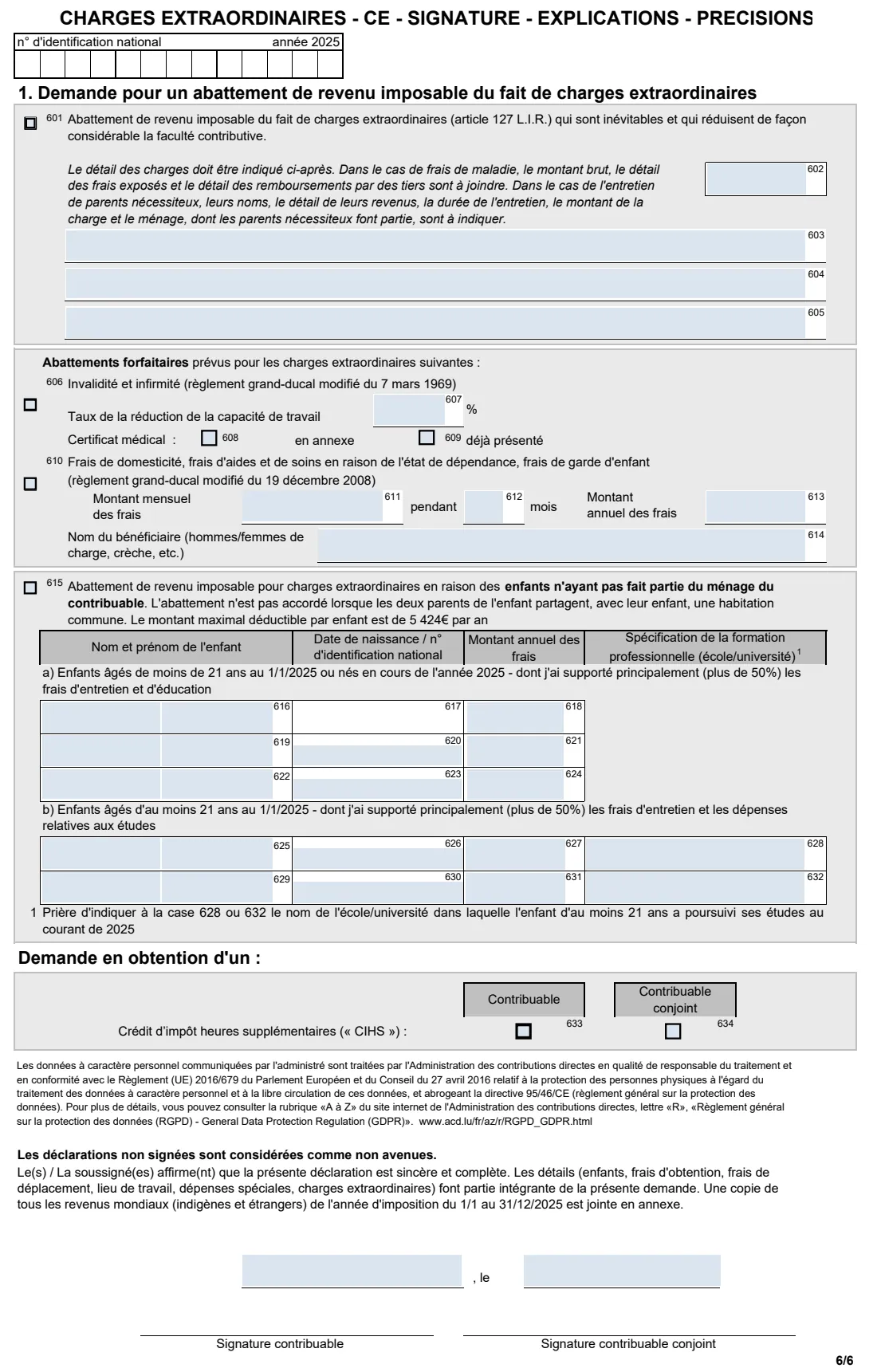
- Extraordinary charges (charges extraordinaires — CE, article 127 L.I.R.)Taxpayer (contribuable)
- Lump-sum allowance: invalidity and infirmity (606)Taxpayer (contribuable)
- Lump-sum allowance: domestic help, care and childcare (610)Taxpayer (contribuable)
- Children not in your household (615)Taxpayer (contribuable)
- Overtime tax credit (crédit d'impôt heures supplémentaires — CIHS)Taxpayer (contribuable)
- Signature(s)Taxpayer (contribuable)
How to fill out 163 R — Annual tax adjustment 2025, step by step
1 Page 1: Signalétique, civil status and NIF
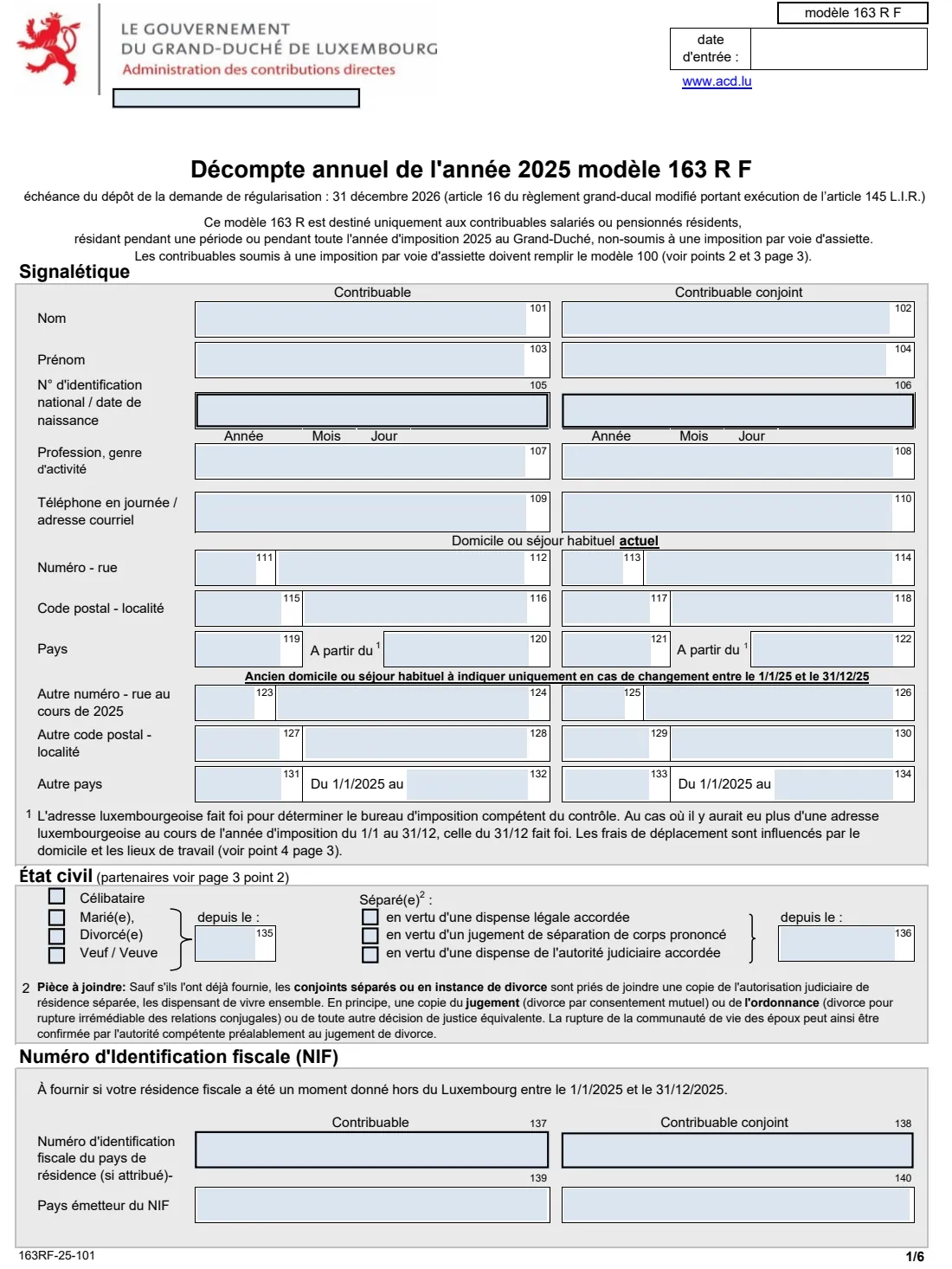
Names, national ID numbers, occupation, contact details and current address for you and your spouse (boxes 101 to 122), any previous address in 2025 (123 to 134), civil status and separation (135, 136), and a foreign tax number if your tax residence was abroad at some point in 2025 (137 to 140).
2 Page 2: Children
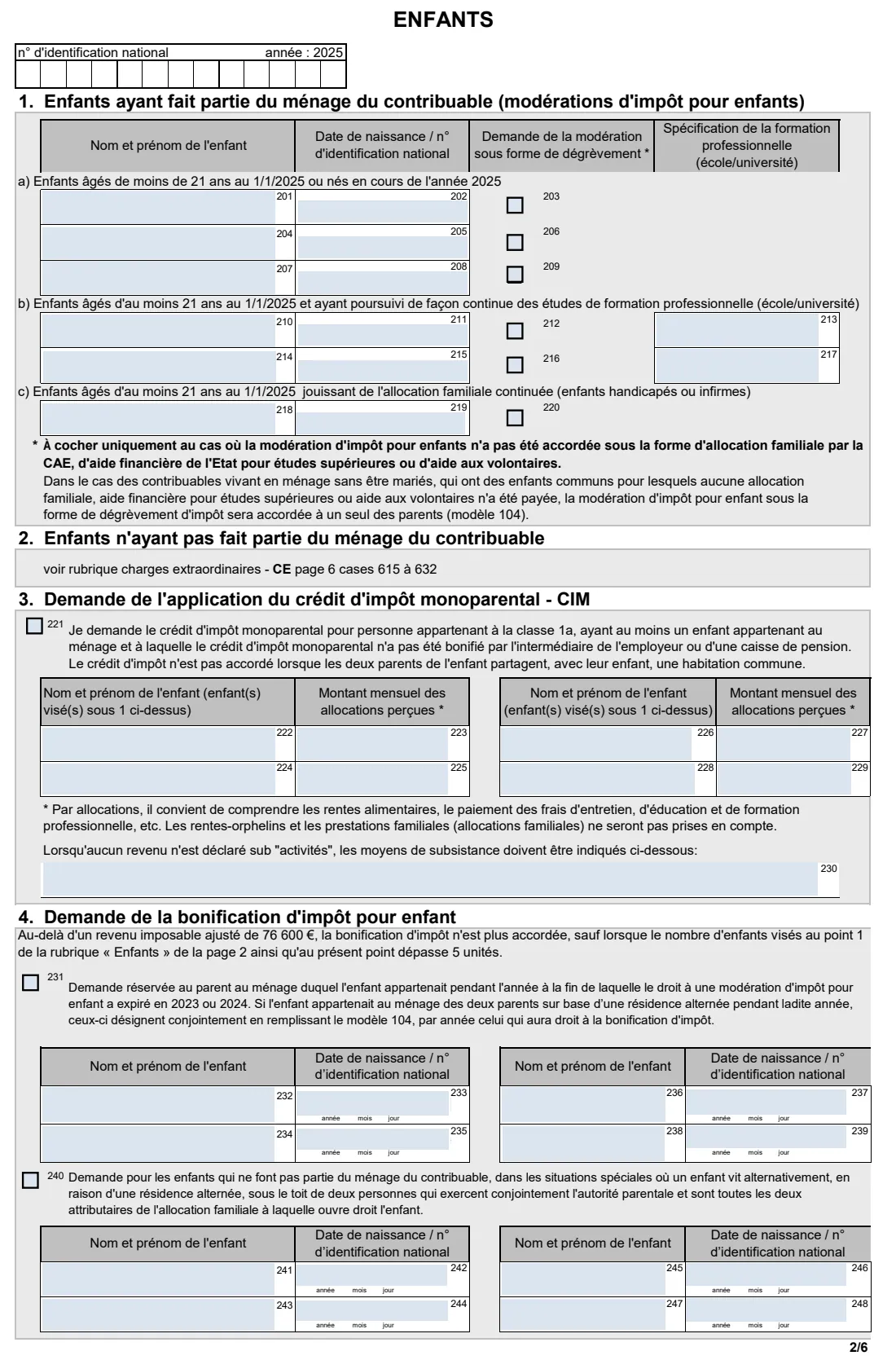
Children in your household (201 to 220), with a box to ask for the child tax reduction as a rebate when it wasn't granted as family allowance. The single-parent tax credit (221 to 230) is for tax class 1a. The child tax bonus (231 to 248) is for children whose entitlement to the child tax reduction ended in 2023 or 2024, and for children in alternating residence.
3 Page 3: Activities, travel and the extra-professional allowance
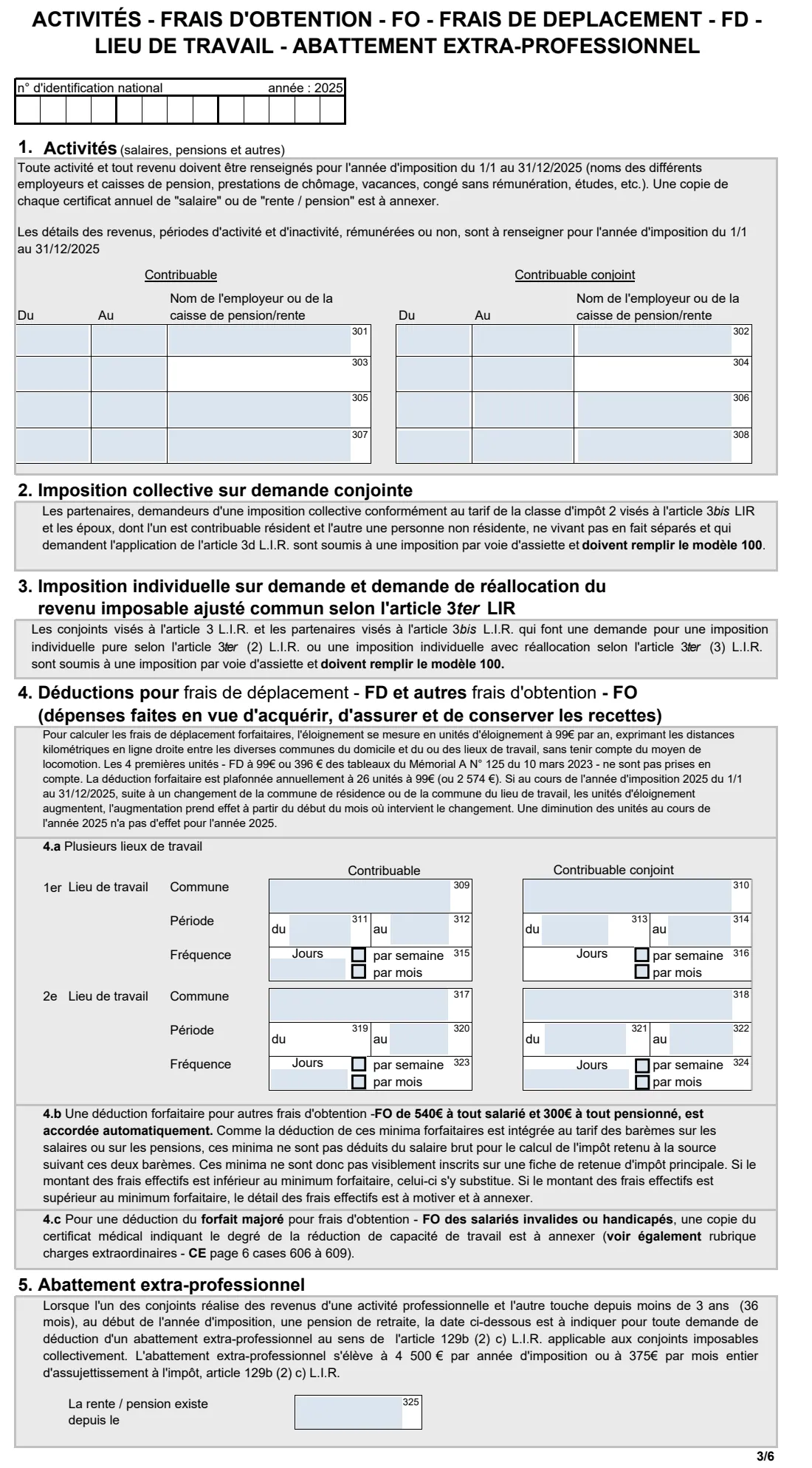
Every employer, pension fund and period in 2025, including unemployment, unpaid leave and studies (301 to 308). Several workplaces for travel expenses (309 to 324). The date a spouse's pension started, for the extra-professional allowance (325).
4 Page 4: Special expenses covered by the minimum
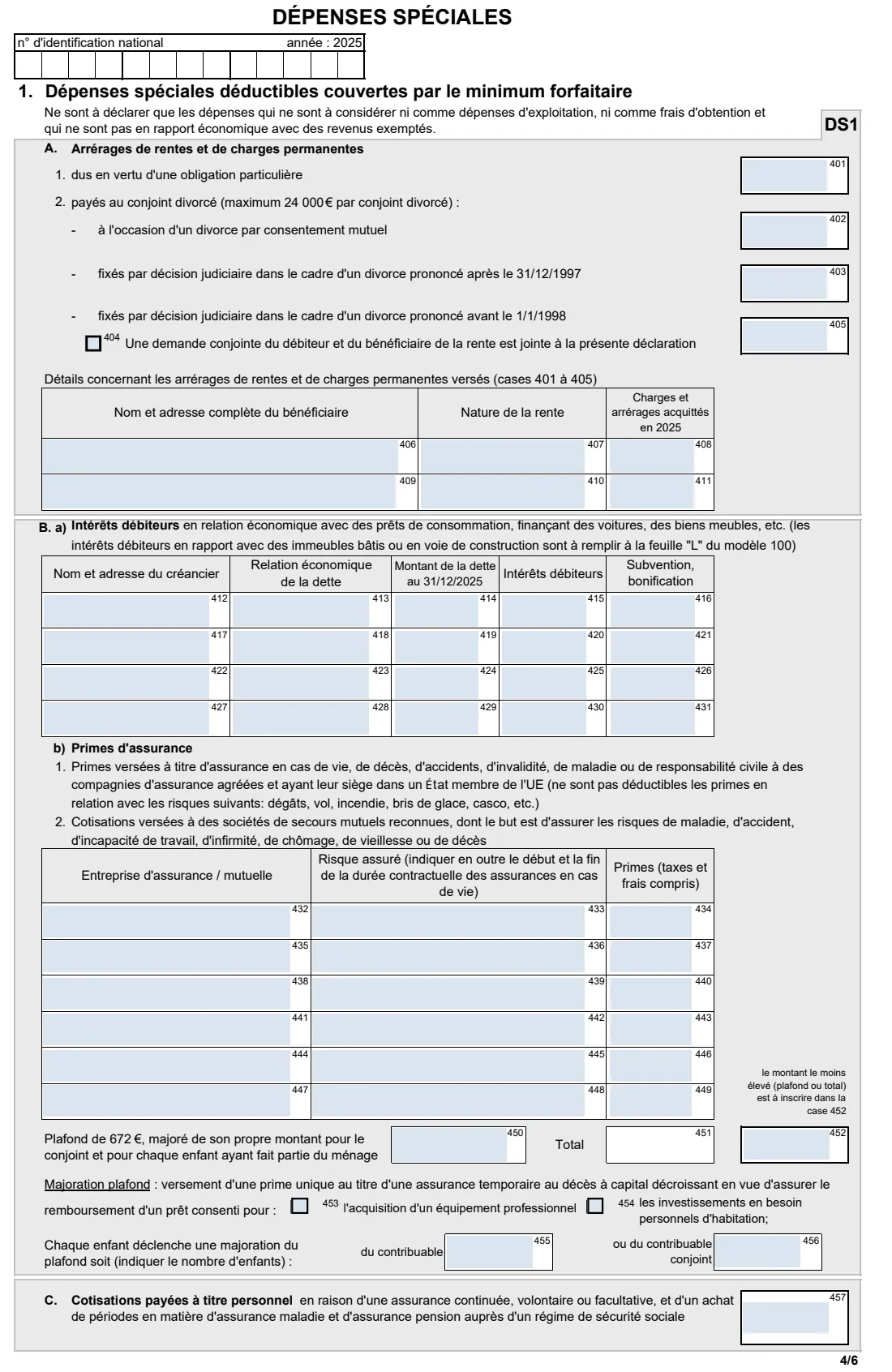
Annuities and permanent charges (401 to 411), consumer-loan interest (412 to 431) and insurance premiums (432 to 449), with the €672 ceiling raised for the spouse and each child (450 to 456), and personal social security contributions (457).
5 Page 5: Pension savings, home savings, DS2 and gifts
Old-age provision under articles 111bis and 111ter (501 to 525), home-savings contracts with their ceiling (526 to 535), the totals and the minimum lump sum (536, 537), compulsory contributions and supplementary pensions (538 to 541), and gifts with the amounts carried over from 2023 and 2024 (542 to 560). Box 561 is the total deductible.
6 Page 6: Extraordinary charges, CIHS and signature
Extraordinary charges (601 to 605), the lump sums for disability (606 to 609) and for domestic help, care and childcare (610 to 614), children not in your household (615 to 632), the overtime tax credit (633, 634), then place, date and signatures.
Common mistakes to avoid
- Using 163 R when you must file a tax return (modèle 100), or when you're not resident (modèle 163 NR).
- Forgetting to attach the annual salary or pension certificates.
- Leaving box 525 empty: the form says the 111bis / 111ter totals are not carried over automatically, so enter the deductible amount yourself.
- Listing a child who was 21 or over on 1 January 2025 under a) instead of b) or c).
- Asking for the single-parent tax credit while married and living with your spouse.
- Gifts that add up to less than €120: the form says the total can't be less than that.
- Not signing. The form says unsigned declarations are considered not filed.
After you fill it out
Sign page 6. If you're taxed jointly, your spouse signs too. Attach your salary and pension certificates and the documents the form asks for.
Hand it in to your tax office by 31 December 2026. The ACD's forms page says forms can be put in the competent office's mailbox and that it does not accept forms sent by email.
The ACD recalculates your 2025 tax and refunds any tax withheld too much.
FileIt keeps the filled PDF in your vault, so you have next year's figures to hand.
Fill out 163 R — Annual tax adjustment 2025 online with FileIt
- Pick the person. Choose someone from People and FileIt fills in their name, date of birth, address and other details it already knows.
- Answer plain-language questions. One part of the form at a time, with the official help text beside each question — 365 fields in all. Your answers save as you go.
- Check the live preview. Watch your answers land on the real Administration des contributions directes (ACD) form, and let FileIt do any worksheet arithmetic.
- Generate the official PDF. FileIt prints your answers into the agency’s own PDF and files it in that person’s folder in your vault. Sign it, or send it for e-signature.
FileIt fills the form — it never files or submits anything for you. Deliver the finished form to whoever asked for it, the way the form’s instructions say.
Start 163 R — Annual tax adjustment 2025 now — it’s free163 R — Annual tax adjustment 2025: frequently asked questions
What is the décompte annuel?
It is the annual adjustment of the tax withheld from wages and pensions. With modèle 163 R, resident employees and pensioners who aren't assessed by tax return ask the ACD to recalculate their withholding tax for the year with deductions and credits the tax card didn't include, and to refund the difference.
What is the deadline for 2025?
31 December 2026, as printed on the form and on the ACD's forms page.
Can I file it if I'm not resident?
No. 163 R is for residents. Non-residents use modèle 163 NR.
What is the minimum lump sum for special expenses?
€480 a year, doubled for spouses taxed jointly who both earn a salary. If your special expenses covered by the minimum (box 536) are lower, the minimum replaces them (box 537). It is already built into the withholding tables.
How is the ceiling for insurance premiums and interest worked out?
The form prints €672, raised by its own amount for the spouse and for each child who was part of the household. FileIt applies that, unless you give a raised ceiling for a single premium repaying a loan (boxes 453 and 454).
Can I send it by email?
No. The ACD's forms page says it doesn't accept forms sent by email for security reasons.
Official sources
- Blank form (PDF), published by Administration des contributions directes (ACD): https://impotsdirects.public.lu/dam-assets/fr/formulaires/decompte_annuel/2025/163rf-2025.pdf
- Official instructions and guidance: https://impotsdirects.public.lu/fr/formulaires/decompte_annuel.html
- Edition shown on this page: Modèle 163 R F, année 2025 (163RF-25-101) (checked 2026-09-28).
FileIt is not affiliated with or endorsed by Administration des contributions directes (ACD) or any government. This page explains the form in general terms and is not legal, tax or immigration advice. Always read the official instructions, and check that you are using the edition the recipient accepts. Page last reviewed 2026-09-28.