What is Italian tax residence certificate request?
When you earn income in another country — dividends, interest, royalties, a pension, fees for services or a salary — that country may tax it at source. If Italy has a double-tax treaty with it, you can often pay less tax there, or get tax back, by proving that you are tax resident in Italy. The proof is a certificate of tax residence (attestato or certificato di residenza fiscale) issued by the Agenzia delle Entrate.
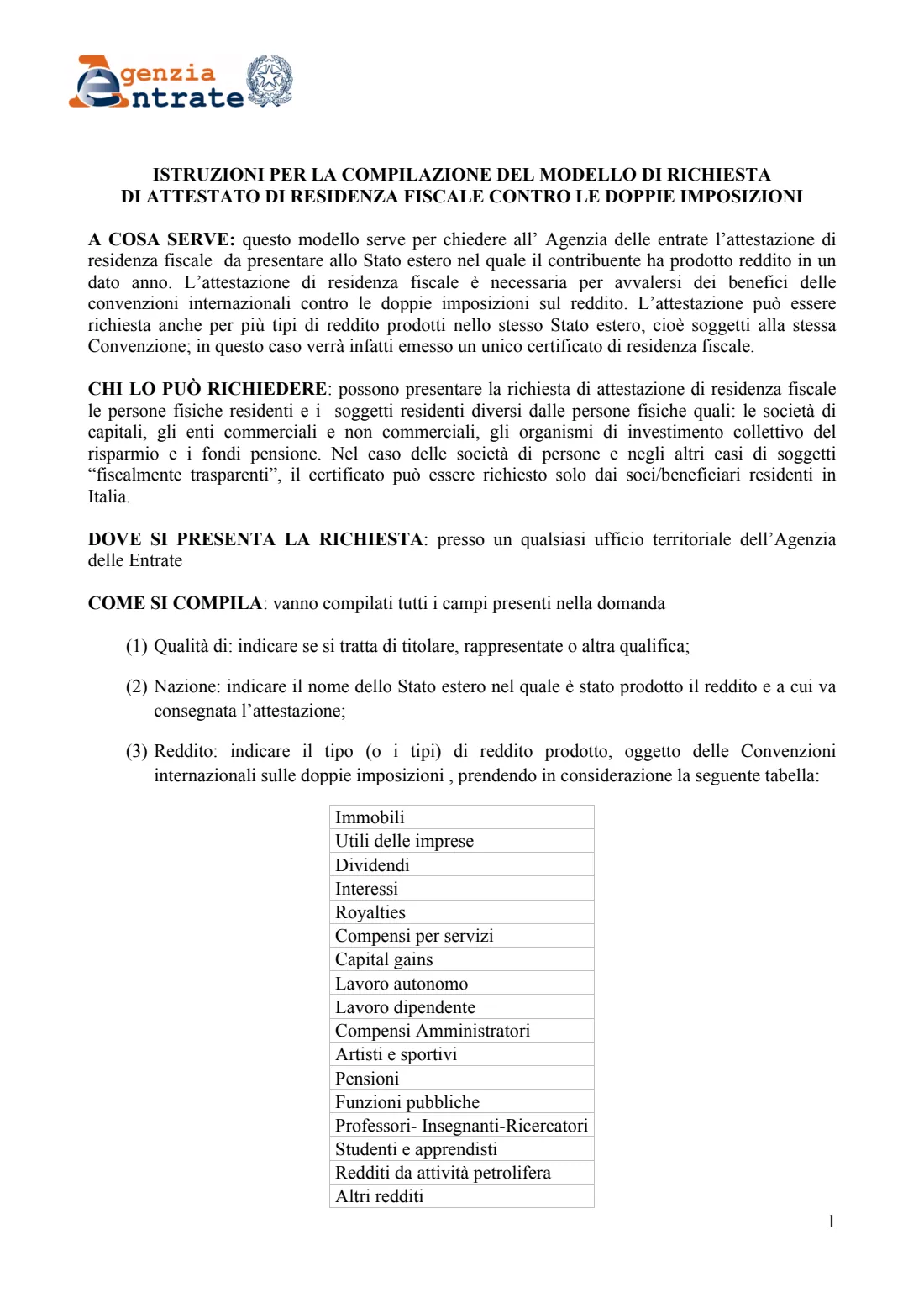
This form is the request for that certificate. According to its instructions, individuals resident in Italy and resident entities other than individuals — companies, commercial and non-commercial bodies, collective investment undertakings and pension funds — can ask for it. For partnerships and other fiscally transparent entities, only the resident partners or beneficiaries can ask, each for themselves. One certificate covers every type of income produced in the same foreign country (under the same treaty).
FileIt explains each line in English, pre-fills your name and date of birth from your People record, and prints your answers into the agency's own Italian PDF, including the optional delegation for someone to collect the certificate for you. You hand it in yourself: FileIt never submits anything to the Agenzia delle Entrate.
- Who fills it
- An Italian-resident individual, or the representative of a resident company or other entity
- Given to
- Any local office (ufficio territoriale) of the Agenzia delle Entrate
- Fee printed on the form
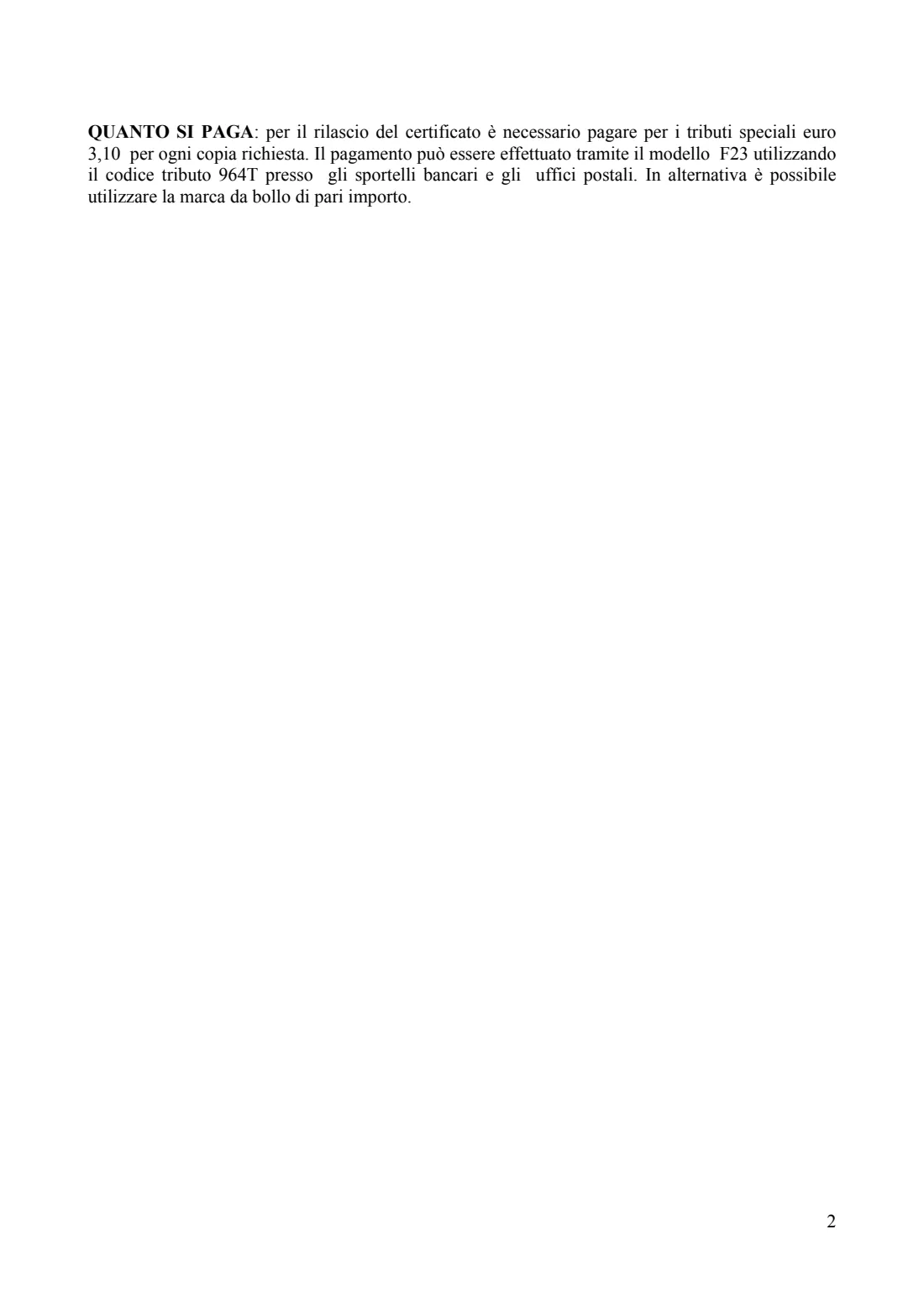
- €3.10 per copy in tributi speciali (form F23, code 964T) or a marca da bollo of the same amount
- Certificate language
- Italian–English or Italian–French
- Signatures
- The applicant signs the delegation when someone else collects the certificate
- Edition
- The agency's current PDF; no edition date printed (file from 2017)
Who needs to fill out Italian tax residence certificate request?
- Italian residents with dividends, interest or royalties from abroad who want the foreign country's reduced treaty rate or a refund of tax withheld there.
- Pensioners resident in Italy who receive a foreign pension and need to prove Italian residence to the paying country.
- Freelancers, consultants, artists and athletes resident in Italy who are paid by foreign clients for services.
- Employees resident in Italy who worked abroad and need the treaty's rules applied to their salary.
- Italian companies, commercial and non-commercial bodies, investment funds and pension funds receiving foreign income, through their legal representative.
When to use Italian tax residence certificate request
- When a foreign payer, tax authority, bank or fund asks you for a certificate of Italian tax residence before applying a treaty rate.
- When you claim back tax withheld abroad for a past year — the request names the year the income relates to.
- When you need several copies for different payers in the same country: give the number of copies on the form.
- Use a separate request for each foreign country, since each certificate refers to one treaty.
What you need before you start
- Your codice fiscale, date and place of birth.
- A valid identity document: its type, number, issuing authority and date of issue.
- For a company or entity: its name, codice fiscale or partita IVA, city and address, and your role (for example legal representative).
- The year, the foreign country and the types of income (the instructions list them: Immobili, Utili delle imprese, Dividendi, Interessi, Royalties, Compensi per servizi, Capital gains, Lavoro autonomo, Lavoro dipendente, Compensi Amministratori, Artisti e sportivi, Pensioni, Funzioni pubbliche, Professori-Insegnanti-Ricercatori, Studenti e apprendisti, Redditi da attività petrolifera, Altri redditi).
- Proof of payment of the fee printed on the form for each copy (F23 with code 964T, or a marca da bollo) — check the current amount with the agency.
- If someone else will collect the certificate: their name and identity document details, and a photocopy of their document if you choose to attach one.
What’s on Italian tax residence certificate request
The 2017 edition has 4 pages. FileIt asks for it in 5 parts, and it is signed by Applicant:
- Which Agenzia delle Entrate officeApplicant
- You (io sottoscritto/a)Applicant
- Asking for a company or other entityApplicant
- What you are asking for (chiedo)Applicant
- Someone else will collect the certificate (delego)Applicant
How to fill out Italian tax residence certificate request, step by step
1 Office
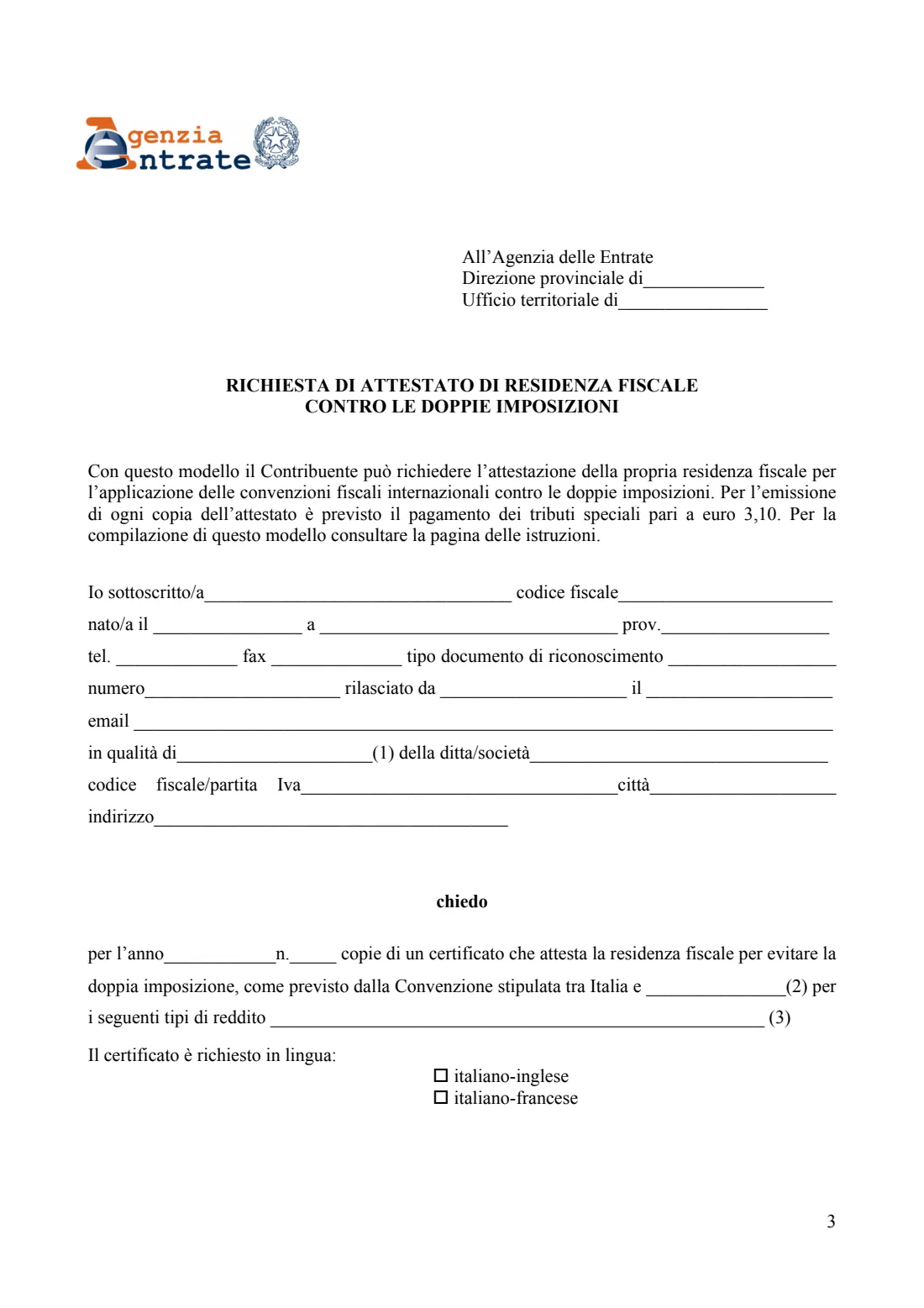
At the top, name the provincial directorate (Direzione provinciale) and the local office (Ufficio territoriale) where you will hand in the request. The instructions say it can go to any local office of the agency.
2 Io sottoscritto/a — your details
Your full name, codice fiscale, date and place of birth with the province, phone, fax and email, and the identity document you will show at the office.
If you are asking for a company or other entity, the next lines give your role (in qualità di), the firm's name, its codice fiscale or partita IVA, city and address.
3 Chiedo — the request
The year and the number of copies, the foreign country whose treaty with Italy applies, and the types of income produced there, chosen from the list in the instructions. Several types of income in the same country go on one certificate.
4 Language
Tick whether you want the certificate in Italian and English or in Italian and French.
5 Delego — delegation (optional)
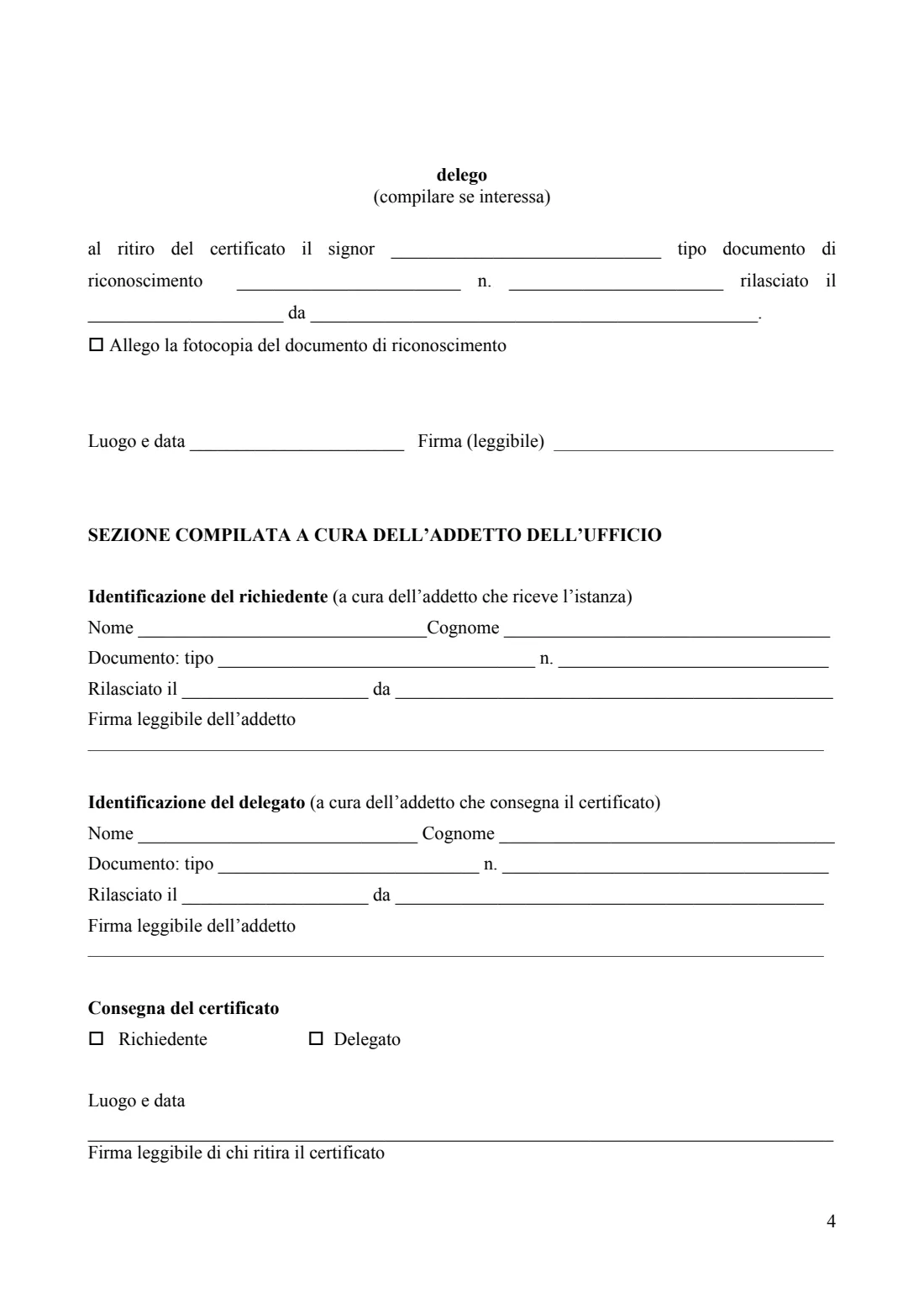
Page 4 lets you authorise someone else to collect the certificate: their name, identity document, issuing authority and date, whether you attach a copy of the document, then place, date and your legible signature. The rest of page 4 is filled in by agency staff when the request is received and the certificate handed over.
Common mistakes to avoid
- Asking for one certificate per type of income in the same country — one certificate covers them all.
- Using this form for a fiscally transparent partnership: the instructions say only its resident partners or beneficiaries can ask.
- Forgetting to pay the fee for each copy, or paying for fewer copies than you request.
- Leaving the foreign country or the income types blank — the instructions say every field must be filled in.
- A codice fiscale with a wrong check letter; FileIt checks it.
- Signing a delegation without naming the delegate.
After you fill it out
Download the completed form from your FileIt vault and check every page. If a delegate will collect the certificate, sign the delegation on page 4.
Pay the fee for each copy as the form describes and take the request, your identity document and the proof of payment to an Agenzia delle Entrate office.
Once you receive the certificate, send it to the foreign payer or tax authority that asked for it, and keep a copy — FileIt's vault is a good place for it.
Fill out Italian tax residence certificate request online with FileIt
- Pick the person. Choose someone from People and FileIt fills in their name, date of birth, address and other details it already knows.
- Answer plain-language questions. One part of the form at a time, with the official help text beside each question — 33 fields in all. Your answers save as you go.
- Check the live preview. Watch your answers land on the real Agenzia delle Entrate (AdE) form, and let FileIt do any worksheet arithmetic.
- Generate the official PDF. FileIt prints your answers into the agency’s own PDF and files it in that person’s folder in your vault. Sign it, or send it for e-signature.
FileIt fills the form — it never files or submits anything for you. Deliver the finished form to whoever asked for it, the way the form’s instructions say.
Start Italian tax residence certificate request now — it’s freeItalian tax residence certificate request: frequently asked questions
What is a certificate of Italian tax residence for?
It proves to another country that you are resident in Italy for tax purposes, so that country can apply its double-tax treaty with Italy — typically a reduced withholding rate or a refund on income such as dividends, interest, royalties, pensions or fees.
Where do I hand in the request?
The instructions say at any local office (ufficio territoriale) of the Agenzia delle Entrate. FileIt doesn't send it for you.
How much does it cost?
The form states €3.10 in tributi speciali for each copy, paid with form F23 (tax code 964T) at a bank or post office, or with a marca da bollo of the same amount. Check the current amount with the agency before paying.
Can I get the certificate in English?
Yes — tick italiano-inglese. The alternative is italiano-francese.
Can a company ask for one?
Yes. The instructions list companies, commercial and non-commercial bodies, collective investment undertakings and pension funds resident in Italy. The legal representative fills in their own details and the entity's.
Can someone else collect it for me?
Yes. Fill in the delegation on page 4 with the delegate's details and sign it. The office identifies the delegate when handing over the certificate.
Does the foreign country accept this certificate instead of its own form?
That depends on the country. Some tax authorities have their own residence form that the Italian agency stamps instead; check with the foreign payer or tax authority what they need.
Official sources
- Blank form (PDF), published by Agenzia delle Entrate (AdE): https://www.agenziaentrate.gov.it/portale/documents/20143/449236/Richiesta+di+attestato+di+residenza_richiesta_attestato_residenza_fiscale.pdf/ce107695-9e03-b121-1c8b-f7eabe6b11b8?t=1555069171950
- Official instructions and guidance: https://www.agenziaentrate.gov.it/portale/documents/20143/449236/Richiesta+di+attestato+di+residenza_richiesta_attestato_residenza_fiscale.pdf/ce107695-9e03-b121-1c8b-f7eabe6b11b8?t=1555069171950
- Edition shown on this page: No edition printed; the agency's current PDF, last modified March 2017 (checked 2026-09-28).
FileIt is not affiliated with or endorsed by Agenzia delle Entrate (AdE) or any government. This page explains the form in general terms and is not legal, tax or immigration advice. Always read the official instructions, and check that you are using the edition the recipient accepts. Page last reviewed 2026-09-28.