What is Withholding declaration?
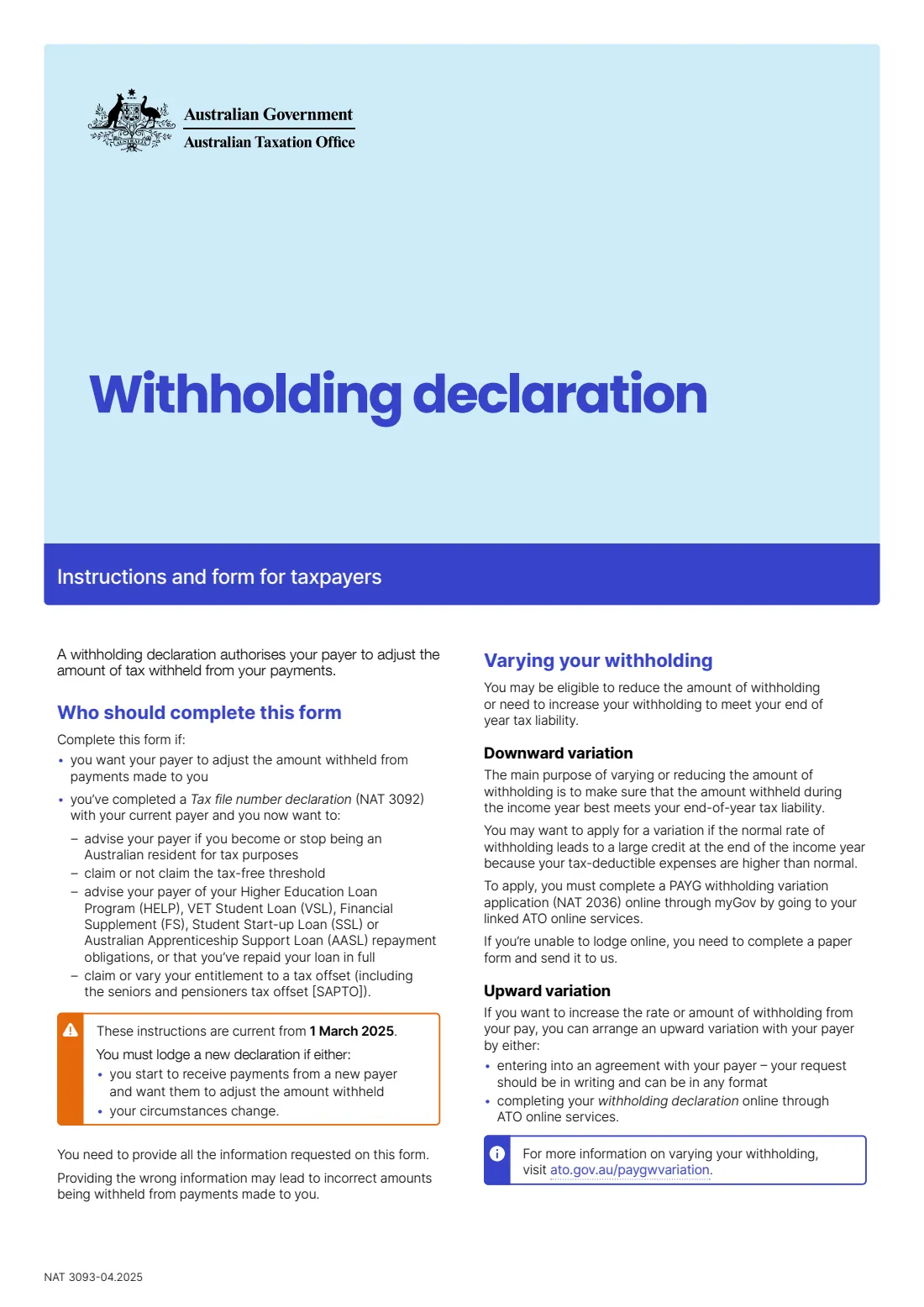
The Withholding declaration, NAT 3093, authorises your payer — usually your employer — to adjust the amount of tax withheld from your payments. It's the follow-up to the Tax file number declaration (NAT 3092): you can only make a withholding declaration with a payer you've already given a TFN declaration to, either quoting your TFN or claiming an exemption.
You'd use it when something that affects your withholding changes: you want to start or stop claiming the tax-free threshold from this payer, you become or stop being an Australian resident for tax purposes, you take on a study or training support loan (such as HELP) or pay it off, or you want to claim or vary a tax offset, including the seniors and pensioners tax offset (SAPTO). Wrong answers can mean too much or too little tax is withheld during the year.
FileIt helps you fill in the current edition (NAT 3093-04.2025) through guided questions. Your answers are printed into the ATO's own PDF, your name and date of birth can be pre-filled from your People records, and the completed form is saved to your FileIt vault. You can sign it by hand or with FileIt's optional e-signature, and then you give it to your payer yourself — FileIt never sends it to the ATO or anyone else.
- Who fills it
- The payee (you) completes Section A; the payer completes Section B
- Given to
- Your payer (employer) — not the ATO
- When
- Whenever your circumstances change, or when you start with a new payer and want them to adjust withholding
- Signatures
- Payee signs Section A; payer signs Section B
- Before you start
- You must already have given this payer a Tax file number declaration (NAT 3092)
- Edition
- NAT 3093-04.2025 (instructions current from 1 March 2025)
Who needs to fill out Withholding declaration?
- Employees who want to start or stop claiming the tax-free threshold from a particular employer — for example when taking on or leaving a second job.
- People who have become, or stopped being, Australian residents for tax purposes since they gave their payer a TFN declaration.
- Anyone who now has a HELP, VET Student Loan, Financial Supplement, Student Start-up Loan or Australian Apprenticeship Support Loan debt — or who has just repaid it in full.
- People entitled to the invalid or invalid carer tax offset, or the zone or overseas forces tax offset, who want it reflected in their withholding.
- Eligible seniors and pensioners who want to claim or vary SAPTO through one payer.
- Employers and other payers, who complete Section B and keep the form on file.
When to use Withholding declaration
- When you start receiving payments from a new payer and want them to adjust the amount withheld — the form says you must lodge a new declaration in that case.
- Whenever your circumstances change in a way the form asks about, such as residency, the tax-free threshold, a study loan or a tax offset.
- When you finish paying off a HELP or other study loan, so compulsory repayment amounts stop being withheld.
- A new declaration overrides any previous one you gave the same payer, and it applies to payments made after the payer receives it.
- If you want to reduce withholding because your deductions are unusually high, this isn't the right form — the ATO says to apply for a PAYG withholding variation (NAT 2036) instead.
What you need before you start
- Your full name, title and date of birth.
- Your tax file number (TFN), or the reason you haven't provided it.
- Your residency status for tax purposes — Australian resident, foreign resident or working holiday maker.
- Whether you're claiming the tax-free threshold from any other payer, and a rough idea of your total income for the year.
- Whether you have a HELP, VSL, FS, SSL or AASL debt.
- Your estimated total tax offset amount in whole dollars, if you're claiming the invalid, invalid carer, zone or overseas forces offset.
- Your relationship status (single, member of a couple, or member of an illness-separated couple) if you're claiming SAPTO.
- For the payer: their ABN (or withholding payer number) and registered business, trading or individual name.
What’s on Withholding declaration
The 2025 edition has 7 pages. FileIt asks for it in 4 parts, and it is signed by Employee and Employer:
- Section A: Payee's declaration — your detailsEmployee
- Section A: Questions 4–8Employee
- Section A: Declaration by payeeEmployee
- Section B: Payer's declarationEmployer
How to fill out Withholding declaration, step by step
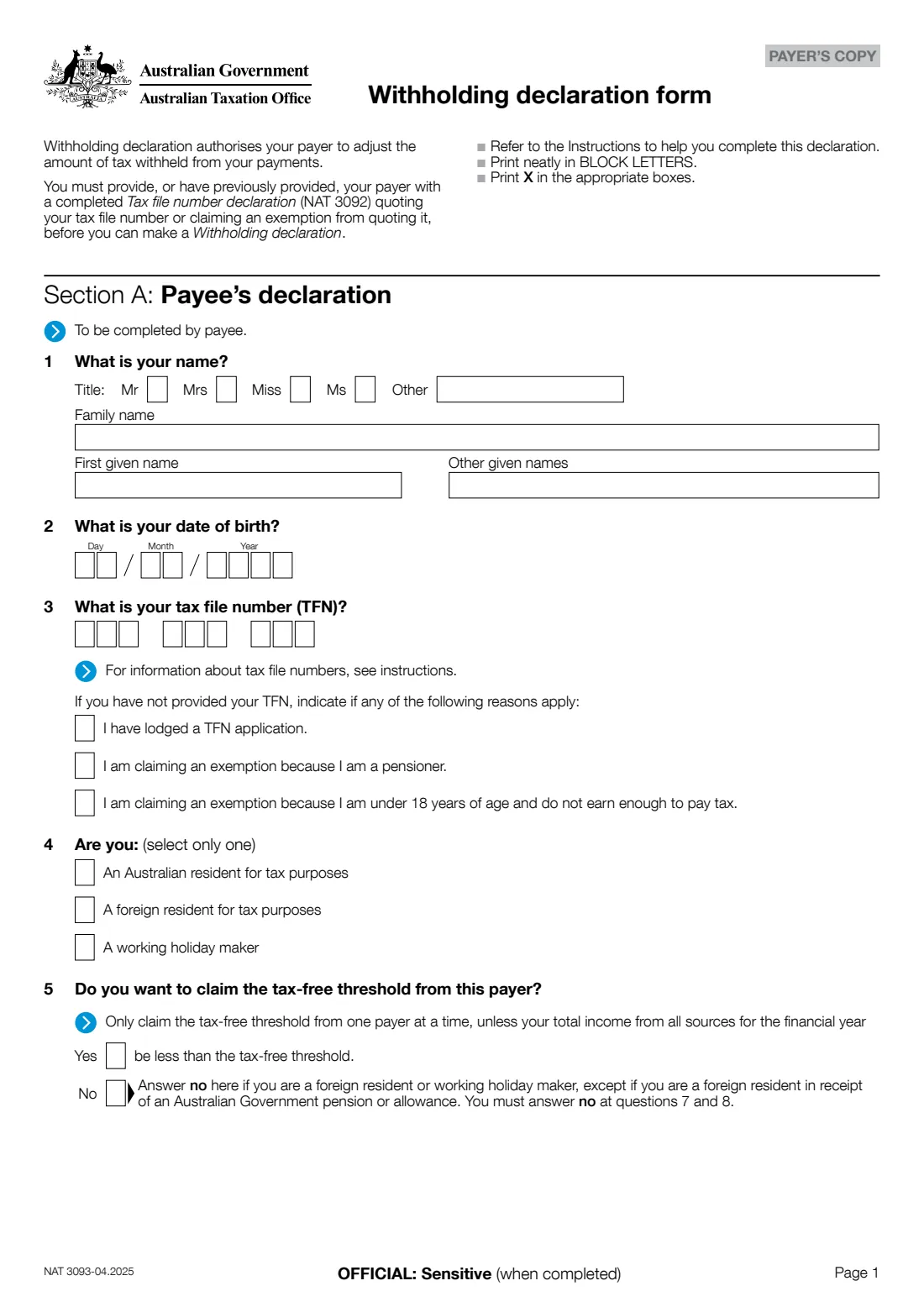
1 Section A, questions 1 and 2: Your name and date of birth
Tick your title and enter your family name, first given name, other given names and date of birth. Use the same name your payer and the ATO have on record.
The form asks for BLOCK LETTERS and an X in the boxes; FileIt prints your typed answers into the correct boxes of the official PDF.
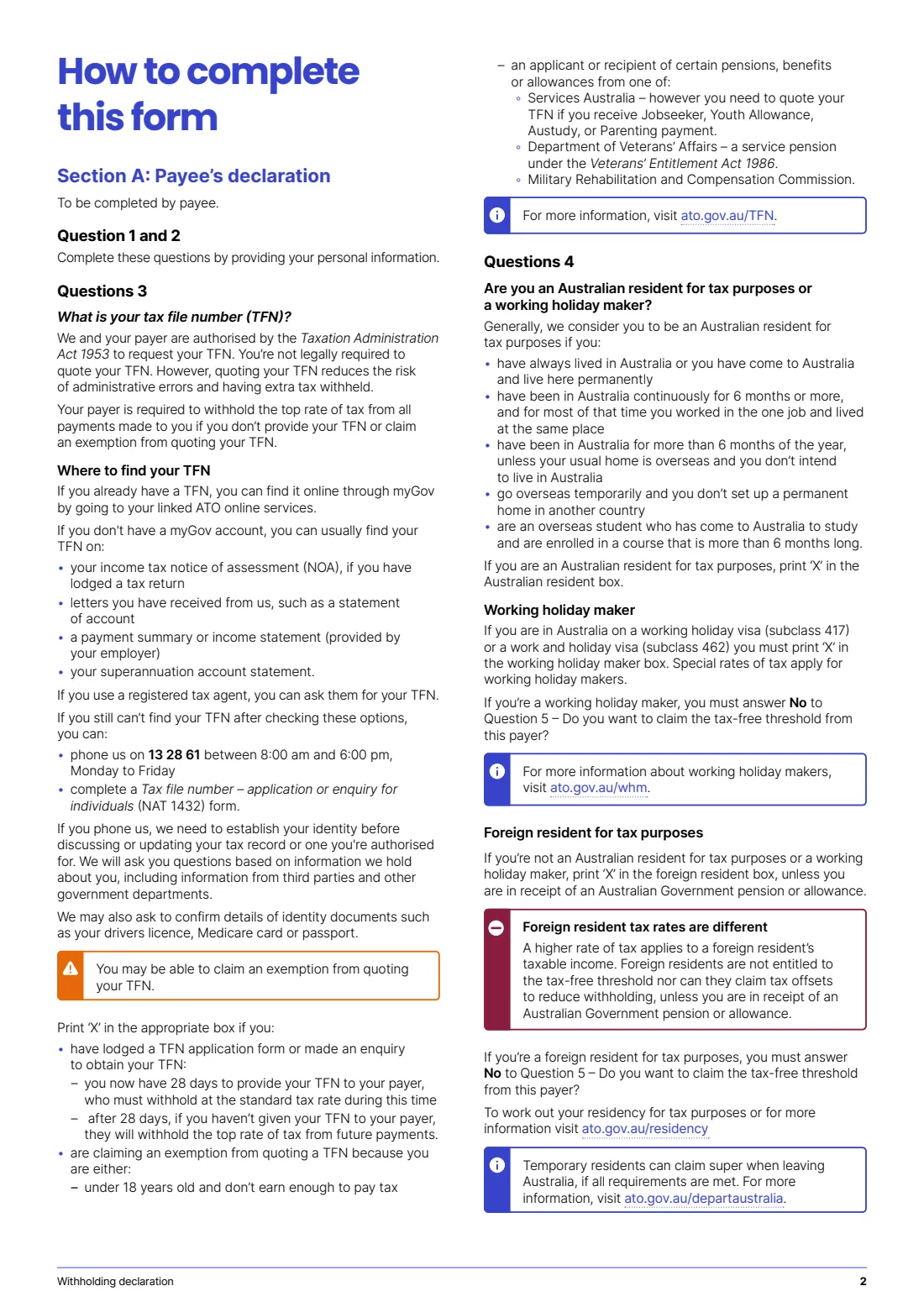
2 Question 3: What is your tax file number (TFN)?
You're not legally required to quote your TFN, but if you don't provide it or claim an exemption, your payer must withhold the top rate of tax. You can find it in ATO online services through myGov, on a notice of assessment, an income statement or your super statement.
If you haven't provided a TFN, tick the reason that applies: you've lodged a TFN application (you then have 28 days to give your TFN to your payer before the top rate applies), you're claiming an exemption as an eligible pensioner, or you're under 18 and don't earn enough to pay tax. The instructions note that people receiving JobSeeker, Youth Allowance, Austudy or Parenting Payment must still quote their TFN.
3 Question 4: Are you an Australian resident, a foreign resident or a working holiday maker?
Select only one. Generally you're an Australian resident for tax purposes if you've always lived here or live here permanently, have been here continuously for 6 months or more mostly in one job and one place, or are an overseas student on a course longer than 6 months. See the instructions for the full list.
If you're in Australia on a working holiday visa (subclass 417) or work and holiday visa (subclass 462), you must tick working holiday maker. Otherwise, if you're not a resident, tick foreign resident.
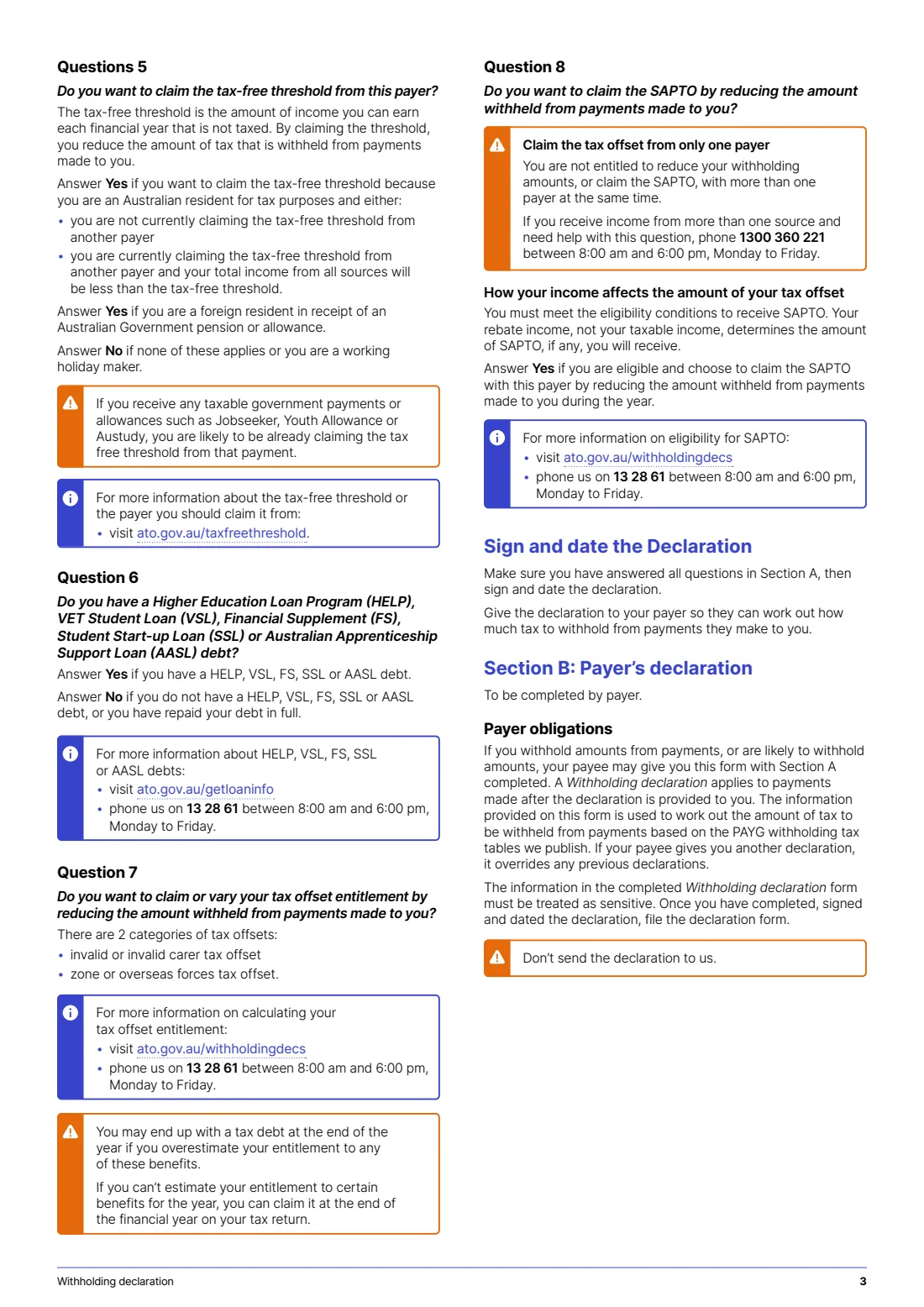
4 Question 5: Do you want to claim the tax-free threshold from this payer?
The tax-free threshold is the amount you can earn each financial year without paying tax, and claiming it reduces the tax withheld. Answer Yes if you're an Australian resident and you're not claiming it from another payer — or you are, but your total income from all sources will be below the threshold. A foreign resident receiving an Australian Government pension or allowance also answers Yes.
Foreign residents (without such a pension) and working holiday makers must answer No. If you get JobSeeker, Youth Allowance or Austudy, you're probably already claiming the threshold from that payment.
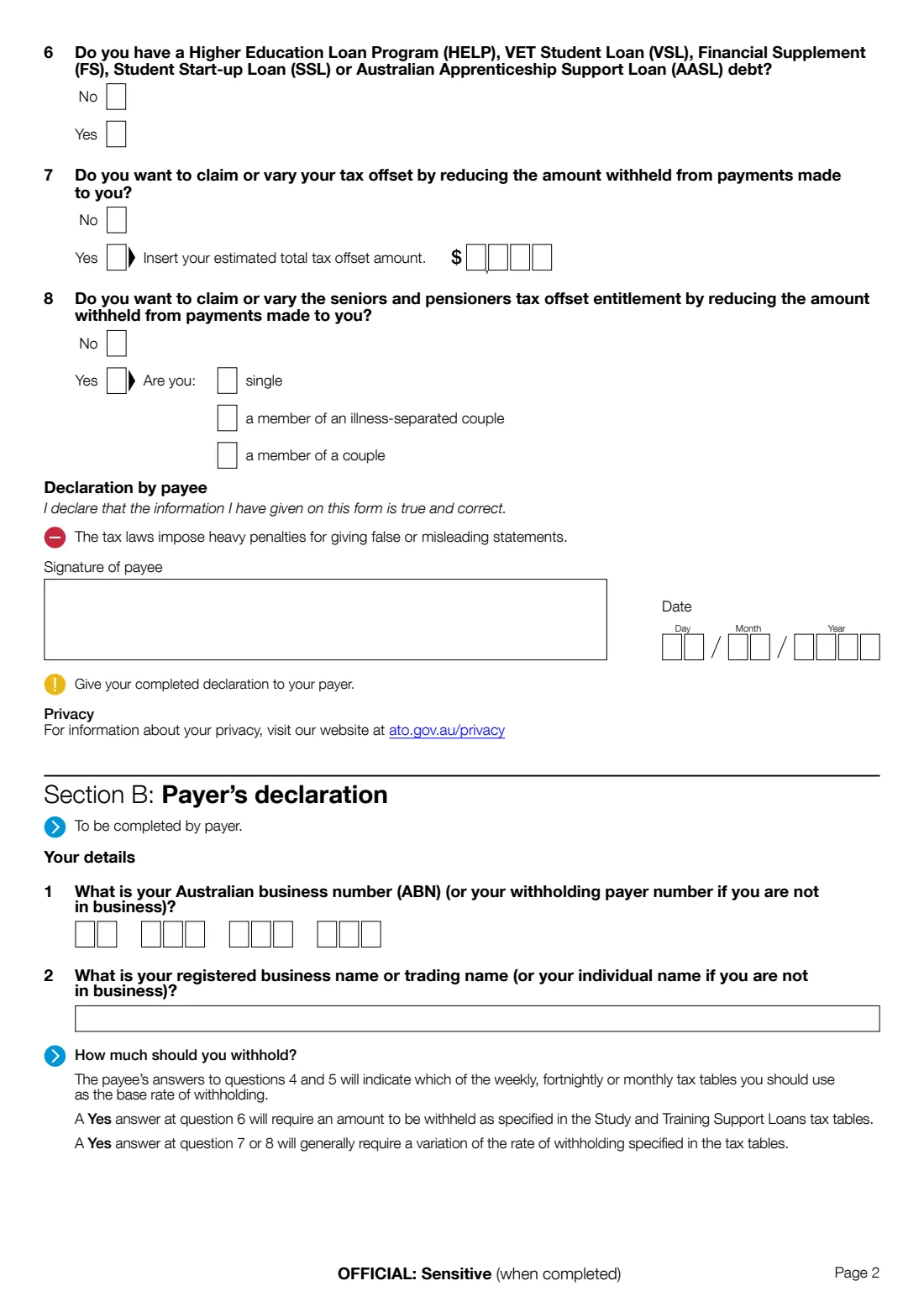
5 Question 6: Do you have a HELP, VSL, FS, SSL or AASL debt?
Answer Yes if you have any of these study and training support loans. Your payer then withholds an extra amount using the Study and Training Support Loans tax tables, which goes towards your compulsory repayment.
Answer No if you don't have one, or if you've repaid the debt in full — a new declaration with No here is how you tell your payer to stop.
6 Question 7: Do you want to claim or vary your tax offset?
This covers two categories: the invalid or invalid carer tax offset, and the zone or overseas forces tax offset. If you answer Yes, enter your estimated total tax offset amount in whole dollars.
The form warns you may end up with a tax debt at year end if you overestimate. If you can't estimate your entitlement, you can claim it in your tax return instead. Foreign residents without an Australian Government pension or allowance, and working holiday makers, must answer No.
7 Question 8: Do you want to claim or vary the seniors and pensioners tax offset (SAPTO)?
Answer Yes only if you're eligible and choose to claim SAPTO through this payer. If Yes, tick whether you're single, a member of an illness-separated couple, or a member of a couple.
You can't reduce withholding or claim SAPTO with more than one payer at the same time. The amount of SAPTO depends on your rebate income, not your taxable income.
8 Declaration by payee
Check you've answered every question in Section A, then sign and date the declaration that the information is true and correct. The form notes that the tax laws impose heavy penalties for false or misleading statements.
9 Section B: Payer's declaration
The payer enters their ABN (or withholding payer number if not in business) and their registered business, trading or individual name, then signs and dates.
The payee's answers at questions 4 and 5 decide which tax table the payer uses; a Yes at question 6 brings in the study loan tables; a Yes at 7 or 8 generally varies the withholding rate. The payer files the form, treats it as sensitive, and does not send it to the ATO.
Common mistakes to avoid
- Making a withholding declaration with a payer you haven't yet given a Tax file number declaration (NAT 3092) to.
- Claiming the tax-free threshold from two payers at once when your total income will be above the threshold — this can leave you with a tax bill.
- Working holiday makers or foreign residents answering Yes to question 5, 7 or 8 when the form says they must answer No.
- Forgetting to lodge a new declaration after paying off a HELP debt, so extra repayments keep being withheld.
- Overestimating a tax offset at question 7 — if in doubt, claim it in your tax return.
- Claiming SAPTO through more than one payer at the same time.
- Sending the form to the ATO instead of giving it to your payer.
After you fill it out
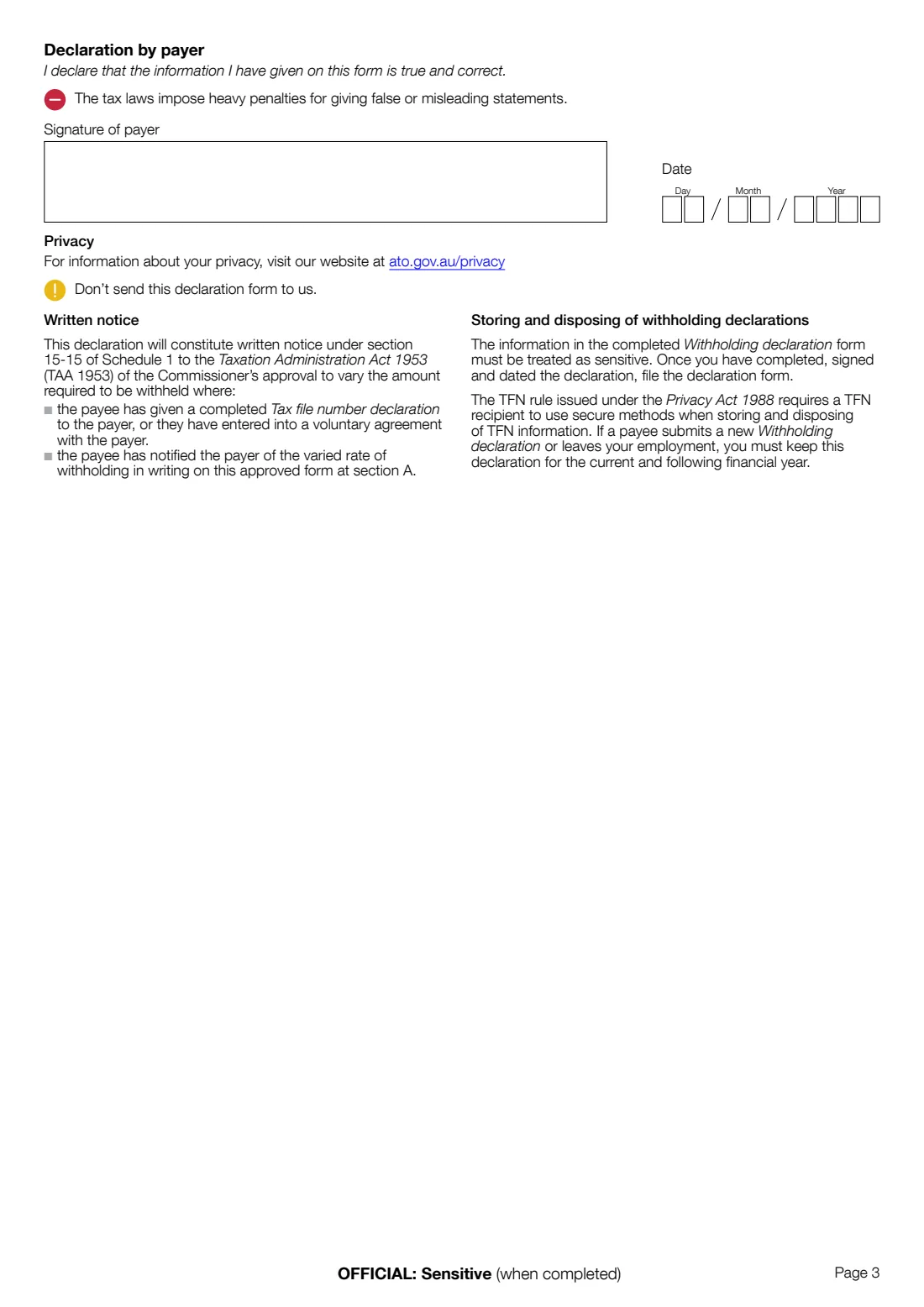
Sign and date the payee declaration in Section A, by hand or with FileIt's optional e-signature, then give the completed form to your payer. The payer completes and signs Section B. Don't send the declaration to the ATO.
The declaration applies to payments made after your payer receives it and overrides any earlier one. The payer must store it securely and keep it for the current and following financial year after you give a new declaration or leave.
Keep your own copy — FileIt saves the finished PDF in your vault under your name. Check your payslips over the next pay cycles to confirm the change, and fill in a new declaration whenever your circumstances change again.
Fill out Withholding declaration online with FileIt
- Pick the person. Choose someone from People and FileIt fills in their name, date of birth, address and other details it already knows.
- Answer plain-language questions. One part of the form at a time, with the official help text beside each question — 19 fields in all. Your answers save as you go.
- Check the live preview. Watch your answers land on the real Australian Taxation Office (ATO) form, and let FileIt do any worksheet arithmetic.
- Generate the official PDF. FileIt prints your answers into the agency’s own PDF and files it in that person’s folder in your vault. Sign it, or send it for e-signature.
FileIt fills the form — it never files or submits anything for you. Deliver the finished form to whoever asked for it, the way the form’s instructions say.
Start Withholding declaration now — it’s freeWithholding declaration: frequently asked questions
What is the difference between the TFN declaration and the withholding declaration?
The Tax file number declaration (NAT 3092) is what you give a payer when you start, quoting your TFN. The Withholding declaration (NAT 3093) is used afterwards to change things that affect withholding, such as the tax-free threshold, residency, study loans or tax offsets. You must have given the TFN declaration first.
Where do I send the withholding declaration?
Give it to your payer, usually your employer. The ATO's instructions say not to send it to the ATO — your payer files it.
Can I fill in the NAT 3093 withholding declaration online?
Yes. FileIt guides you through each question and prints your answers into the ATO's official NAT 3093 PDF, which you can sign by hand or with FileIt's optional e-signature. It's available on every FileIt account, including the free plan. The ATO also lets you complete employment forms through ATO online services in myGov.
How do I tell my employer I've paid off my HELP debt?
Give them a new withholding declaration answering No at question 6. The form says to answer No if you don't have one of these debts or have repaid it in full.
Can I claim the tax-free threshold from two jobs?
Generally only from one payer at a time. The exception printed on the form is when your total income from all sources for the financial year will be less than the tax-free threshold.
Can a working holiday maker claim the tax-free threshold?
No. The form says working holiday makers must answer No at question 5 and must also answer No at questions 7 and 8.
How do I reduce my withholding because of large deductions?
Not with this form. The ATO says to apply for a PAYG withholding variation (NAT 2036), online through myGov where possible. To increase withholding, you can make a written agreement with your payer.
How long does my employer keep my withholding declaration?
The form says the payer must keep it for the current and following financial year if you submit a new declaration or leave their employment, and must store and dispose of TFN information securely.
Official sources
- Blank form (PDF), published by Australian Taxation Office (ATO): https://www.ato.gov.au/api/public/content/fbcafb1f-944b-45d1-bf46-9376da50282c_895748f7_9e80_43fc_8090_46e8d3f9995c_pdf
- Official instructions and guidance: https://www.ato.gov.au/forms-and-instructions/withholding-declaration
- Edition shown on this page: NAT 3093-04.2025 (checked 2026-09-25).
FileIt is not affiliated with or endorsed by Australian Taxation Office (ATO) or any government. This page explains the form in general terms and is not legal, tax or immigration advice. Always read the official instructions, and check that you are using the edition the recipient accepts. Page last reviewed 2026-09-25.