What is a director indemnification agreement?
Serving on a board brings personal legal risk: claims from shareholders, creditors, regulators or employees can name directors personally. Experienced directors increasingly ask for a written indemnity and directors' and officers' (D&O) insurance before they join. An indemnification agreement gives them a direct contractual promise, separate from the company's articles or bylaws, which can be changed.
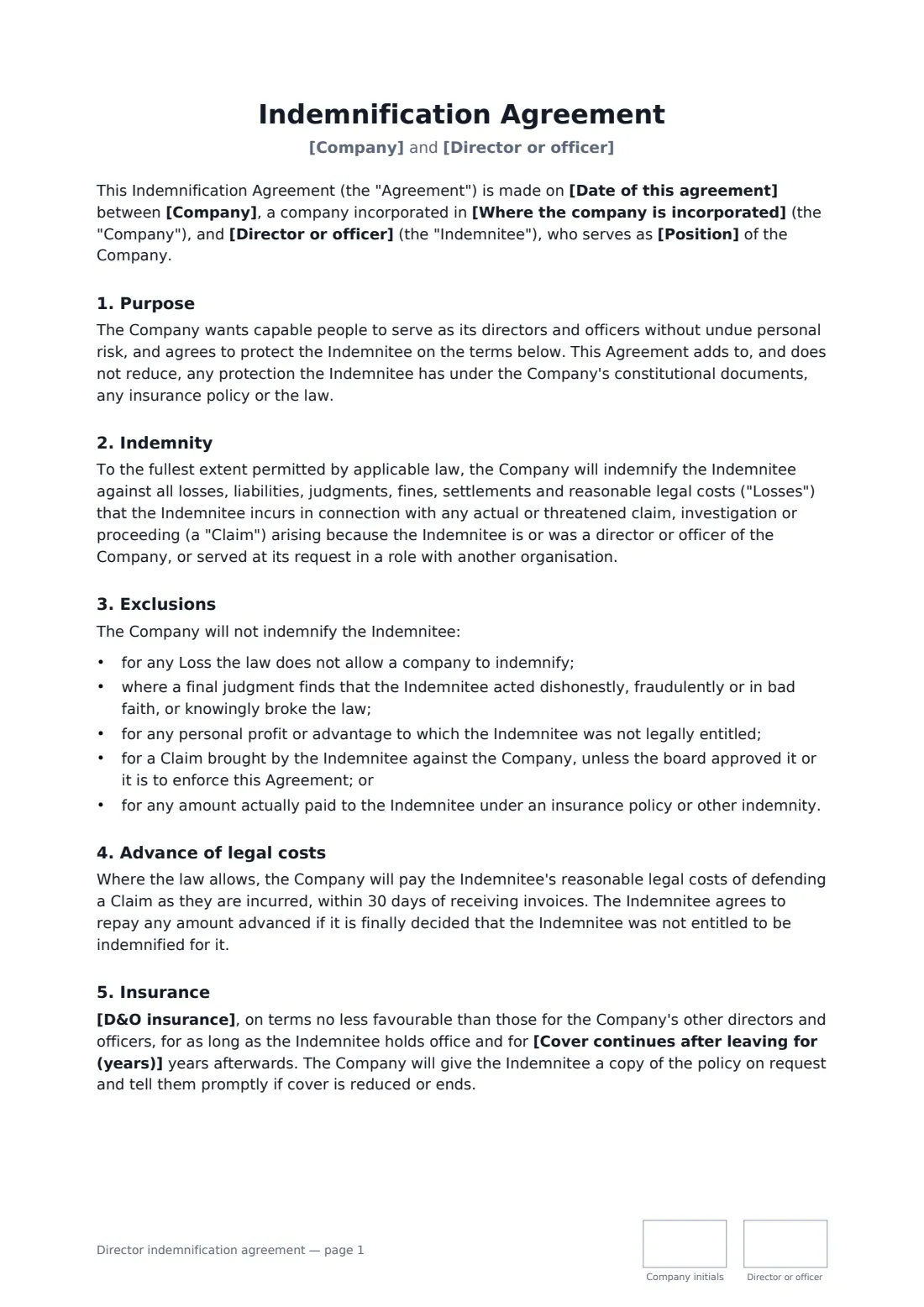
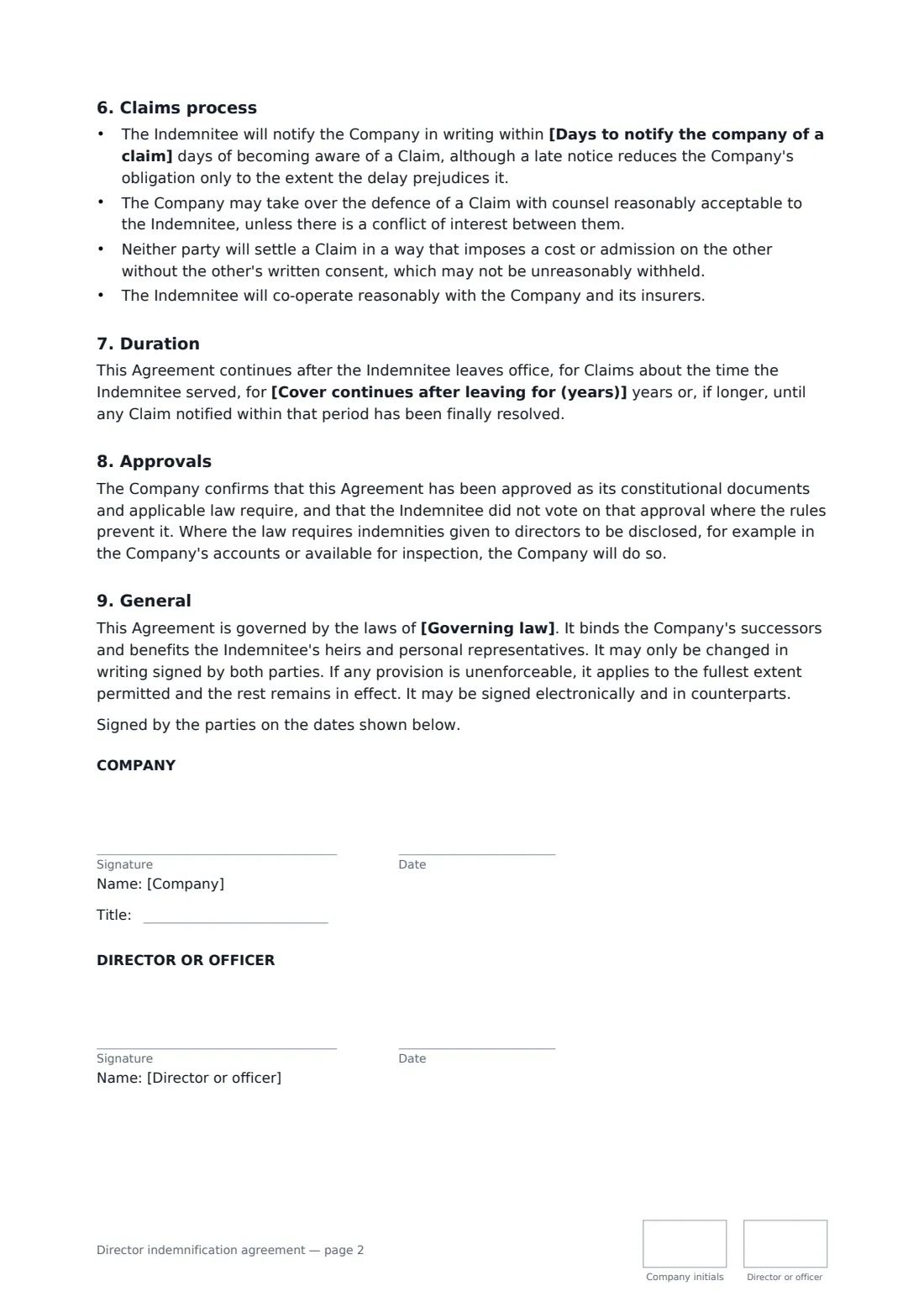
This template indemnifies the director or officer to the fullest extent the law allows, lists the usual exclusions (dishonesty, improper personal profit, claims the law does not allow to be indemnified), provides for advancing legal costs subject to repayment, commits the company to D&O insurance during office and a run-off period, sets out a claims process, and records that the agreement was properly approved and will be disclosed where the law requires.
- Best for
- Directors and officers of private companies and non-profits
- Signed by
- The company and the director or officer
- Covers
- Indemnity, advance of costs, D&O insurance, run-off
- Length
- About 2 pages, initialled on every page
When to use a director indemnification agreement
- Recruiting an experienced non-executive director
- An investor's nominee joining the board
- Protecting officers such as the CEO or CFO
- Non-profit trustees and board members
- Directors of subsidiaries appointed by a parent company
What you fill in
9 blanks, then the name and email of each person who signs: company, director or officer.
1 The parties
- Date of this agreement*
- Company*
- Where the company is incorporated*
- Director or officer*
- Position*
2 Cover
- D&O insurance* The Company will maintain directors' and officers' liability insurance covering the Indemnitee · The Company will use reasonable efforts to obtain directors' and officers' liability insurance covering the Indemnitee
- Cover continues after leaving for (years)*
- Days to notify the company of a claim*
- Governing law*
3 Who signs
- Company signature and date, job title, initials on every page · A director other than the indemnified person should sign for the company.
- Director or officer signature and date, initials on every page
What the director indemnification agreement covers
- Purpose
- Indemnity
- Exclusions
- Advance of legal costs
- Insurance
- Claims process
- Duration
- Approvals
- General
Using the director indemnification agreement, step by step
1 Enter the company and the person
Name the company, where it is incorporated, and the director or officer with their position.
2 Choose insurance commitment
Decide whether the company will maintain D&O insurance or use reasonable efforts to obtain it, and how long cover continues after the person leaves.
3 Set the claims process
Choose how quickly the person must notify a claim and the governing law.
4 Approve and sign
Approve it by board resolution, then have a director other than the indemnitee sign for the company. The signed copy is filed in your vault.
Tips before you send it
- Company law in many places limits what a company may indemnify; the agreement applies only to the extent the law allows.
- Indemnity is only as good as the company's balance sheet; D&O insurance matters if the company is in trouble.
- Make sure the board approval is minuted and that the interested director does not vote where the rules forbid it.
- Some places require indemnities given to directors to be disclosed in accounts or kept available for inspection.
Sign it online in minutes
- Fill in the blanks. Names, dates and amounts go straight into the agreement — the preview shows exactly where.
- Name who signs. Tick “This is me” for your own part. FileIt builds the PDF with every signature, date and initials box on the right line, and you can check or move anything before sending.
- Send it. Each signer gets a secure link and signs from any device — no account needed. The signed PDF, with an audit trail and a Certificate of Completion, is filed in your vault and emailed to everyone.
Director indemnification agreement: frequently asked questions
Why do I need this if the articles already indemnify directors?
Articles and bylaws can be changed by shareholders. A contract gives the director a direct right that cannot be taken away without their consent.
Does it cover fines and penalties?
Only where the law allows. Many places forbid indemnifying criminal fines or certain regulatory penalties.
What is advancement of costs?
The company pays legal costs as they arise rather than after the case ends, so the director is not out of pocket. The director must repay if it turns out they were not entitled.
Is D&O insurance required?
Not by this template, but it is strongly recommended and many directors insist on it.