What is Form IRED 63A (estate duty statement in lieu of affidavit)?
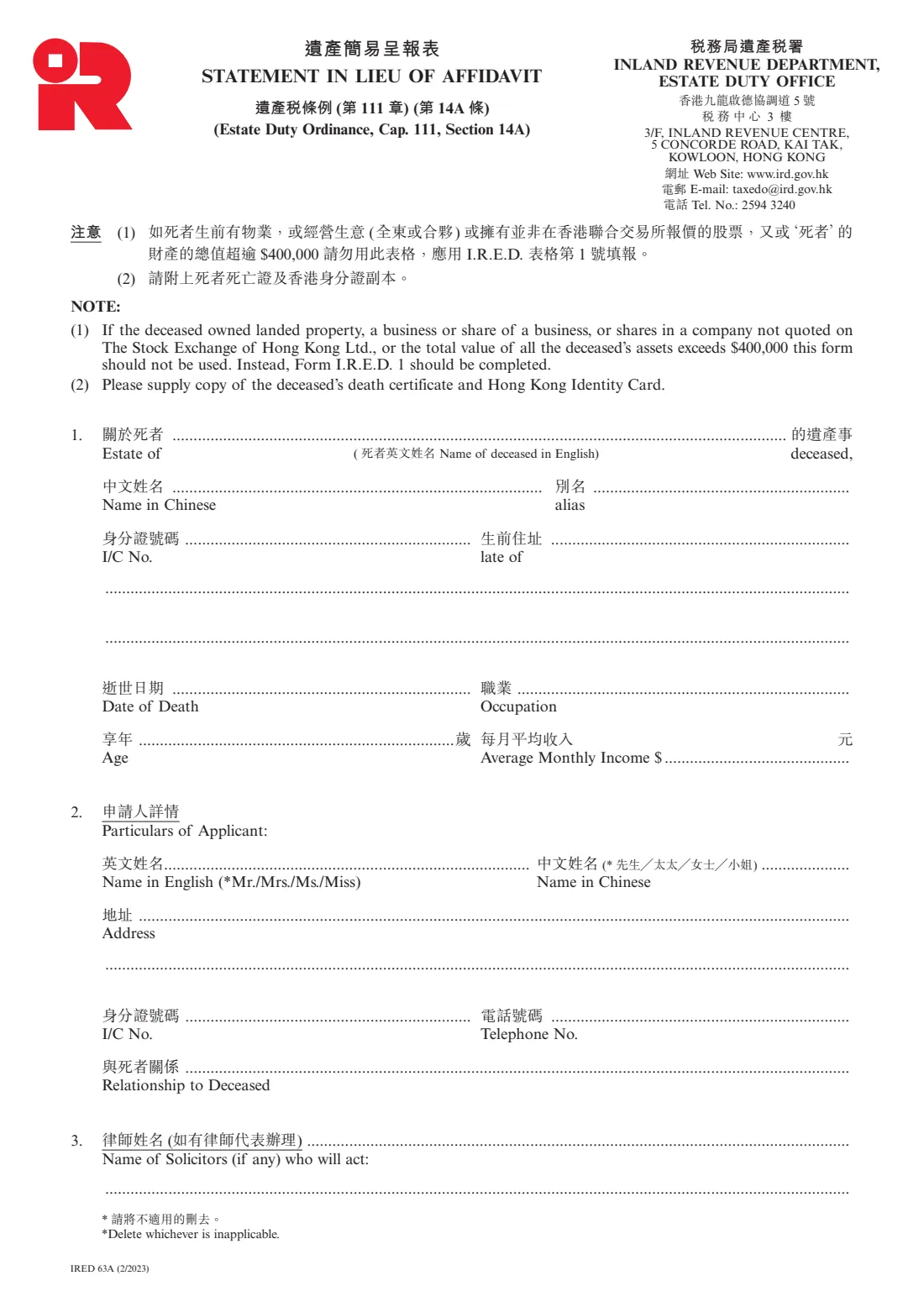
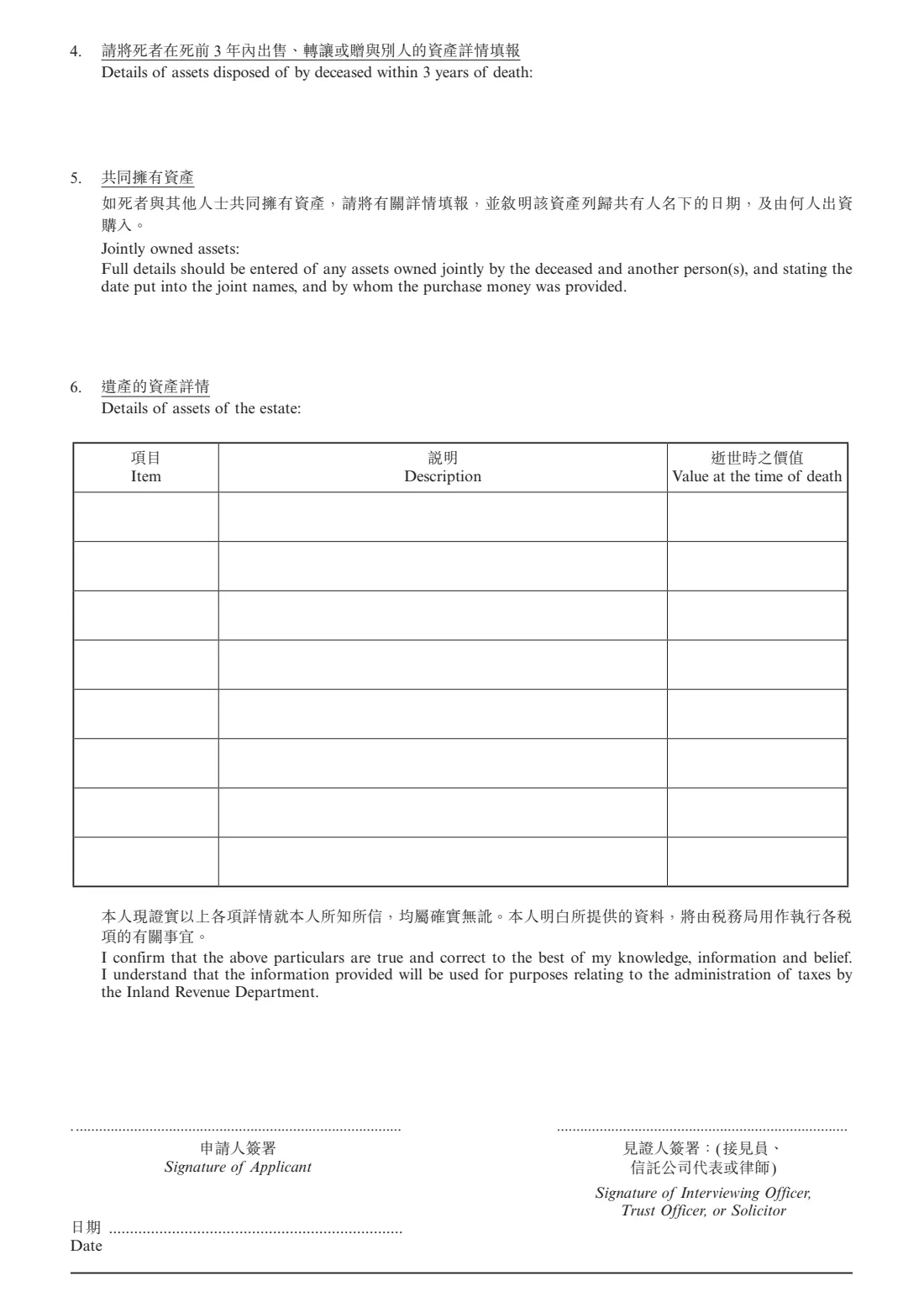
Form IRED 63A is the simplified estate duty statement under section 14A of the Estate Duty Ordinance (Cap. 111). It is used for small estates instead of the full affidavit and account: the applicant, usually a close relative, lists the deceased's details, any assets given away in the 3 years before death, jointly owned assets and the assets of the estate with their values at the date of death.
Estate duty was abolished in Hong Kong for deaths on or after 11 February 2006. For those deaths no estate duty affidavits or clearance papers are needed, so this form matters only for estates of people who died before that date that still need to be dealt with, for example an old estate that was never administered. The form itself says it can't be used if the deceased owned landed property, a business or a share of one, or shares in a company not quoted on the Stock Exchange of Hong Kong, or if the total assets exceed $400,000; Form I.R.E.D. 1 is used instead.
FileIt guides you through each item, checks the date of death and the $400,000 limit, adds up the values, strikes out the titles that don't apply, and prints everything into IRD's bilingual PDF. You then sign it by hand in front of the witness.
- Who fills it
- The applicant dealing with the estate, usually a close relative of the deceased.
- Only for
- Deaths before 11 February 2006, estates of $400,000 or less, with no land, business or unlisted shares.
- Attach
- A copy of the deceased's death certificate and Hong Kong Identity Card (the form's Note 2).
- Sent to
- Estate Duty Office, Inland Revenue Department, 3/F Inland Revenue Centre, 5 Concorde Road, Kai Tak, Kowloon (printed on the form). Not by fax or electronically.
- Edition
- IRED 63A (2/2023).
Who needs to fill out Form IRED 63A (estate duty statement in lieu of affidavit)?
- A relative dealing with the small estate of someone who died in Hong Kong before 11 February 2006.
- Families who find an old bank account, cash or listed shares of a relative who died before estate duty was abolished and need to deal with the estate now.
- Solicitors or trust officers assisting with such an estate.
When to use Form IRED 63A (estate duty statement in lieu of affidavit)
- Only when the date of death was before 11 February 2006. For later deaths, IRD's estate duty page says no estate duty papers are needed.
- Only when the estate is small: total assets of $400,000 or less, and no landed property, business interests or shares in unlisted companies.
- Before applying for a grant of representation for such an estate, since the Court needs the Commissioner's certificate first.
What you need before you start
- The deceased's name, any alias, identity card number, last address, date of death, occupation, age and average monthly income.
- Your own name, address, identity card number, telephone number and relationship to the deceased.
- The name of the solicitors acting, if any.
- Details of anything the deceased sold, transferred or gave away in the 3 years before death.
- Details of any jointly owned assets, when they were put into joint names and who provided the money.
- A list of the estate's assets (bank accounts, cash, listed shares, personal effects) with their values at the date of death.
- A copy of the death certificate and of the deceased's Hong Kong Identity Card.
What’s on Form IRED 63A (estate duty statement in lieu of affidavit)
The 2023 edition has 2 pages. FileIt asks for it in 6 parts:
- 1. The deceasedApplicant
- 2. You, the applicantApplicant
- 3. Solicitors (if any)Applicant
- 4-5. Assets given away and jointly ownedApplicant
- 6. Assets of the estateApplicant
- Confirmation and dateApplicant
How to fill out Form IRED 63A (estate duty statement in lieu of affidavit), step by step
1 1. The deceased
The deceased's name in English (and in Chinese, written by hand if any), alias, identity card number, last address ('late of'), date of death, occupation, age and average monthly income. FileIt stops you if the date of death is on or after 11 February 2006, since estate duty no longer applies.
2 2. Particulars of applicant
Your name with title (Mr./Mrs./Ms./Miss; the form says to delete the others, which FileIt does in English and Chinese), address, identity card number, telephone number and relationship to the deceased.
3 3. Solicitors
The name of the solicitors who will act, if any. Leave it blank if you are dealing with the estate yourself.
4 4 and 5. Assets given away and jointly owned
Item 4 lists assets the deceased disposed of within 3 years of death. Item 5 gives full details of jointly owned assets, the date they were put into joint names and who provided the purchase money. Write 'Nil' where there is nothing.
5 6. Assets of the estate
A table of up to 8 lines: item, description and value at the time of death. FileIt adds up the values and warns you if they pass $400,000, when Form I.R.E.D. 1 has to be used instead.
6 Confirmation
You confirm the particulars are true and correct to the best of your knowledge, information and belief, and sign and date the form. A witness (an interviewing officer, trust officer or solicitor) signs beside you.
Common mistakes to avoid
- Using this form for a death on or after 11 February 2006, when no estate duty papers are needed.
- Using it for an estate that includes landed property, a business or unlisted shares, or is worth more than $400,000.
- Forgetting the copies of the death certificate and the deceased's identity card.
- Leaving out gifts made in the 3 years before death or jointly held accounts.
- Trying to fax or e-mail it: IRD's estate duty page says fax and electronic filing aren't accepted.
After you fill it out
Print the form from FileIt and check every item. Sign it by hand with the witness's signature beside yours; FileIt leaves both signature lines blank.
Send or take it, with the copies of the death certificate and identity card, to the Estate Duty Office at the address printed on the form. IRD's estate duty page says that in the great majority of cases a Certificate of Exemption is issued within six weeks.
Keep the certificate with the estate papers in your FileIt vault: the Court won't issue a grant of representation for such an estate until the Commissioner has certified the estate duty position.
Fill out Form IRED 63A (estate duty statement in lieu of affidavit) online with FileIt
- Pick the person. Choose someone from People and FileIt fills in their name, date of birth, address and other details it already knows.
- Answer plain-language questions. One part of the form at a time, with the official help text beside each question — 55 fields in all. Your answers save as you go.
- Check the live preview. Watch your answers land on the real Inland Revenue Department, Estate Duty Office, the Government of the Hong Kong Special Administrative Region (IRD) form, and let FileIt do any worksheet arithmetic.
- Generate the official PDF. FileIt prints your answers into the agency’s own PDF and files it in that person’s folder in your vault.
FileIt fills the form — it never files or submits anything for you. Deliver the finished form to whoever asked for it, the way the form’s instructions say.
Start Form IRED 63A (estate duty statement in lieu of affidavit) now — it’s freeForm IRED 63A (estate duty statement in lieu of affidavit): frequently asked questions
Is estate duty still payable in Hong Kong?
No, not for deaths on or after 11 February 2006. IRD's estate duty page says no estate duty affidavits and accounts need to be filed and no clearance papers are needed for those deaths. This form is for earlier deaths only.
When can't I use IRED 63A?
When the deceased owned landed property, a business or a share of a business, or shares in a company not quoted on the Stock Exchange of Hong Kong, or when the total value of all the assets exceeds $400,000. Form I.R.E.D. 1 is used instead.
What do I attach?
A copy of the deceased's death certificate and Hong Kong Identity Card, as Note 2 on the form asks.
Can I send it by fax or e-mail?
No. IRD says submission by fax is not acceptable and filing by electronic means is not accepted for estate duty papers.
Who is the witness?
The form has a second signature line for an interviewing officer, trust officer or solicitor, who signs as witness to your signature.
How long does it take?
IRD's estate duty page says that in the great majority of cases a Certificate of Exemption is issued within six weeks.
Official sources
- Blank form (PDF), published by Inland Revenue Department, Estate Duty Office, the Government of the Hong Kong Special Administrative Region (IRD): https://www.ird.gov.hk/eng/pdf/ired63a.pdf
- Official instructions and guidance: https://www.ird.gov.hk/eng/tax/edu.htm
- Edition shown on this page: IRED 63A (2/2023) (checked 2026-09-28).
FileIt is not affiliated with or endorsed by Inland Revenue Department, Estate Duty Office, the Government of the Hong Kong Special Administrative Region (IRD) or any government. This page explains the form in general terms and is not legal, tax or immigration advice. Always read the official instructions, and check that you are using the edition the recipient accepts. Page last reviewed 2026-09-28.