What is L 1 (2025) — employee tax assessment?
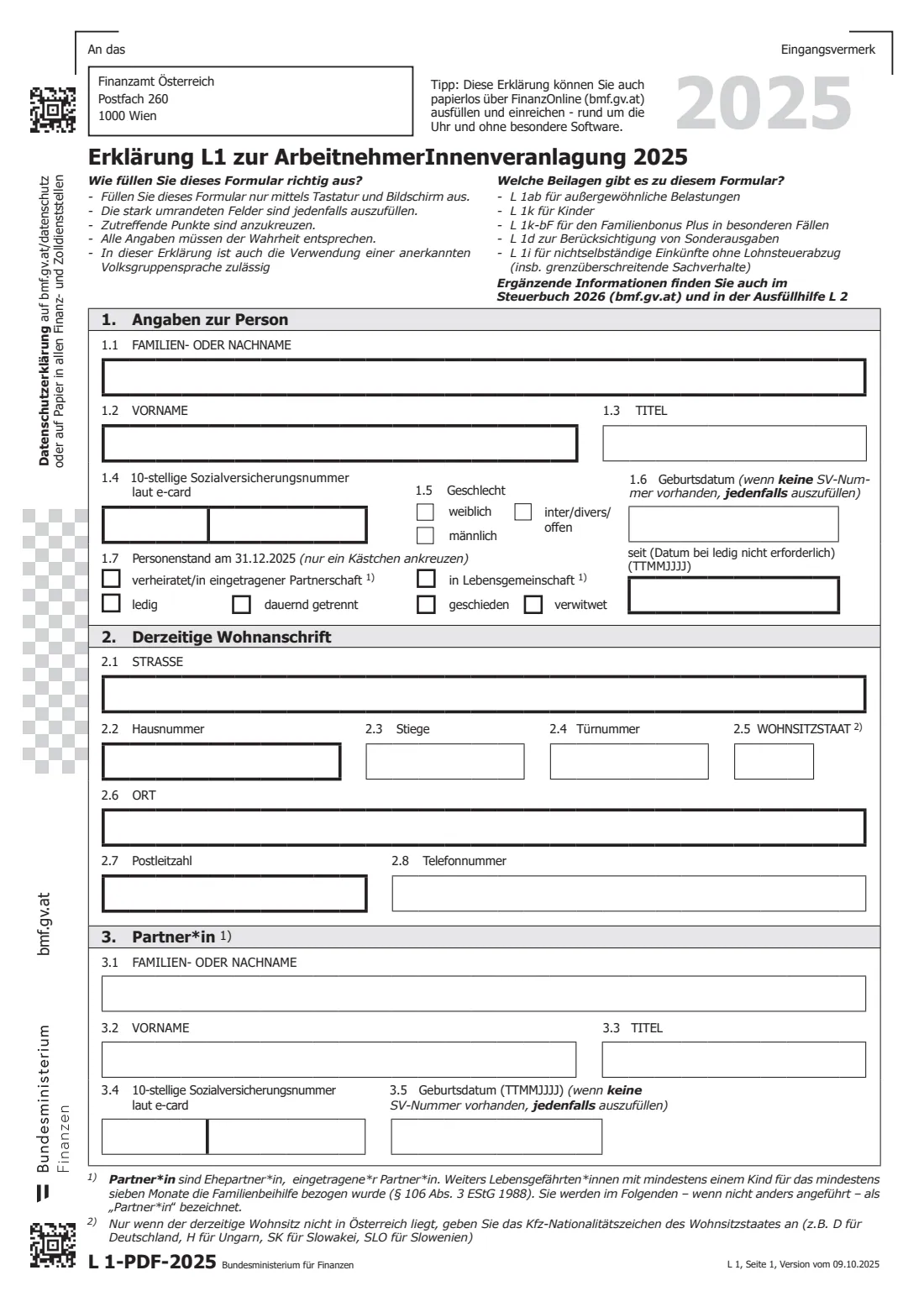
Form L 1, the Erklärung zur ArbeitnehmerInnenveranlagung, is the return employees and pensioners in Austria use to settle their income tax for a year. It is published by the Federal Ministry of Finance (Bundesministerium für Finanzen, BMF) and goes to the Finanzamt Österreich. The edition covered here is L 1-PDF-2025, Version vom 09.10.2025, for the 2025 tax year.
The L 1 is where you claim work-related expenses (Werbungskosten), the commuter allowance and commuter euro, the sole earner's or single parent's credit, the child supplement (Kindermehrbetrag), the increased pensioner's credit and the large-family supplement, and where you give the bank account for any refund. Children are claimed separately on one supplement L 1k per child, and other items have their own supplements: L 1ab for extraordinary burdens, L 1d for special expenses and L 1i for employment income without wage tax deducted.
FileIt explains every box in English, with the German terms alongside, and prints your answers into the official BMF PDF the way its boxes expect: capitals one character per box, dates as TTMMJJJJ, and amounts right-aligned with a decimal comma. The finished PDF is saved in your FileIt vault. FileIt doesn't send anything to the tax office. You print, sign and post the L 1 yourself, or you file the same return online in FinanzOnline, which the form itself suggests.
- Who fills it
- Employees and pensioners taxed in Austria, for the 2025 tax year
- Given to
- Finanzamt Österreich, Postfach 260, 1000 Wien (or filed online in FinanzOnline)
- Supplements
- L 1k per child; L 1ab, L 1d, L 1i and L 1k-bF where they apply
- Signatures
- You sign and date page 4 by hand
- Edition
- L 1-PDF-2025, Version vom 09.10.2025
Who needs to fill out L 1 (2025) — employee tax assessment?
- Employees in Austria who want back wage tax, for example because of work expenses, a commuter allowance their employer didn't apply, or income that changed during the year.
- Pensioners claiming the increased pensioner's credit (erhöhter Pensionistenabsetzbetrag).
- Sole earners and single parents claiming the Alleinverdiener- or Alleinerzieherabsetzbetrag and, where it applies, the child supplement.
- Families with at least three children claiming the large-family supplement (Mehrkindzuschlag) for 2026.
- Anyone who wants an exemption notice (Freibetragsbescheid) so that their employer takes expenses into account in payroll.
- People who had more than one Austrian employer or pension payer in 2025.
When to use L 1 (2025) — employee tax assessment
- After the end of 2025, to file your employee tax assessment for the 2025 tax year on paper.
- When you claim the sole earner's or single parent's credit, or the increased pensioner's credit, even if your employer or pension payer already applied it. The form's notes say you must claim it again here to avoid a back-payment.
- When your employer didn't take the right commuter allowance or trade union fees into account in payroll.
- When you prefer paper to FinanzOnline. The online route is the same return.
What you need before you start
- Your 10-digit social security number from your e-card (or your date of birth if you have none), your address and phone number.
- Your marital status on 31 December 2025, and your partner's name and social security number if you claim partner-related credits.
- The number of Austrian employers and pension payers that paid you in 2025.
- The number of children for whom you or your partner received family allowance for at least seven months.
- For the commuter allowance: the annual Pendlerpauschale and Pendlereuro from the BMF's Pendlerrechner.
- Annual totals of your work expenses, such as union fees, work equipment, specialist literature, training, travel, double household or home office, less any tax-free reimbursements.
- Your IBAN (and BIC for a non-SEPA foreign bank) if the tax office doesn't have your account yet or it has changed.
- The supplements you enclose: one L 1k per child, and L 1ab, L 1d or L 1i if you need them.
What’s on L 1 (2025) — employee tax assessment
The 2025 edition has 4 pages. FileIt asks for it in 15 parts, and it is signed by Taxpayer (steuerpflichtige*r):
- 1. About you (Angaben zur Person)Taxpayer (steuerpflichtige*r)
- 2. Your current address (Derzeitige Wohnanschrift)Taxpayer (steuerpflichtige*r)
- 3. Your partner (Partner*in)Taxpayer (steuerpflichtige*r)
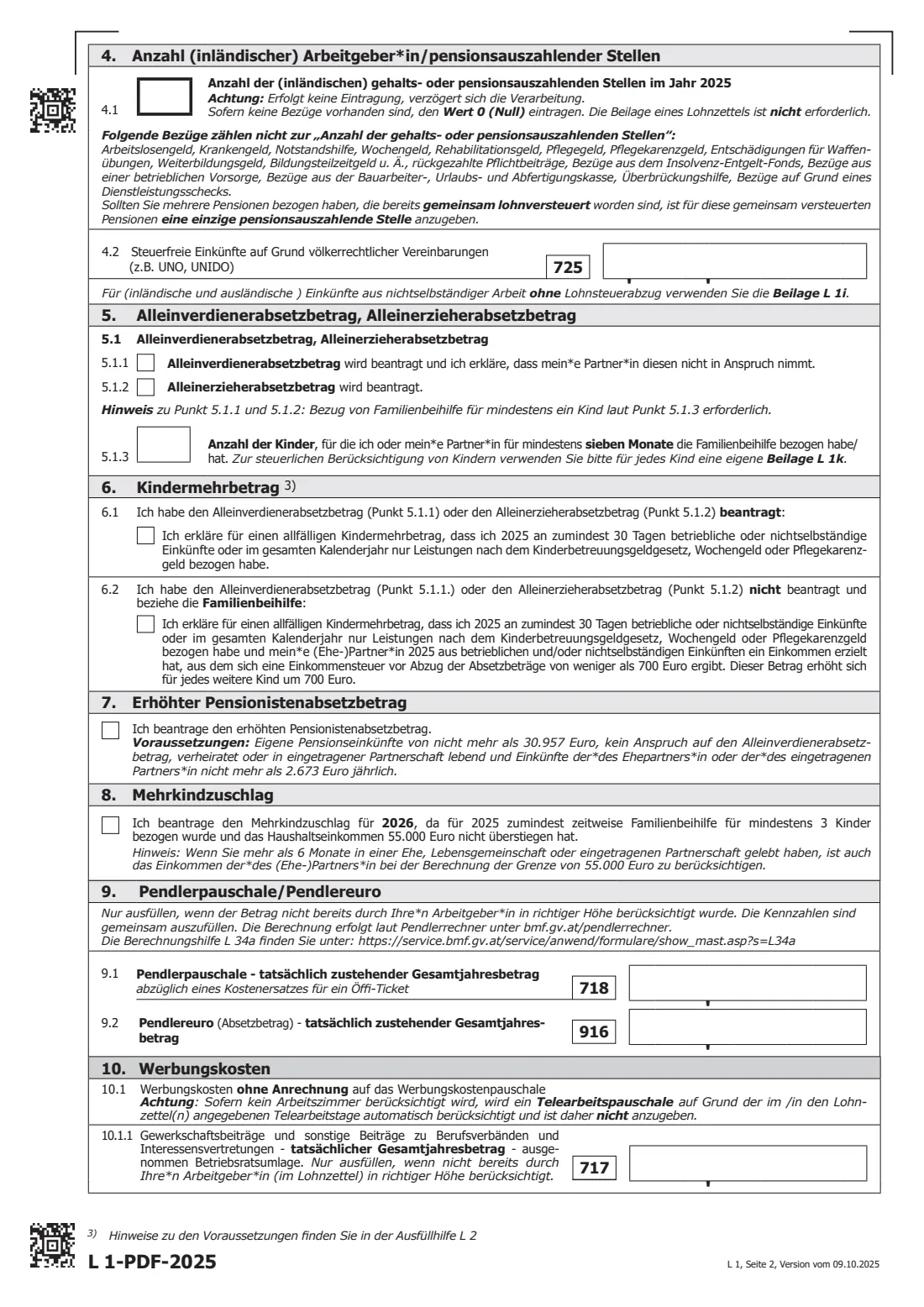
- 4. Number of Austrian employers and pension payers (Anzahl der Arbeitgeber*innen/pensionsauszahlenden Stellen)Taxpayer (steuerpflichtige*r)
- 5.–6. Sole earner / single parent credit and child supplement (Alleinverdiener-/Alleinerzieherabsetzbetrag, Kindermehrbetrag)Taxpayer (steuerpflichtige*r)
- 7.–8. Increased pensioner credit, large-family supplement (Erhöhter Pensionistenabsetzbetrag, Mehrkindzuschlag)Taxpayer (steuerpflichtige*r)
- 9. Commuter allowance and commuter euro (Pendlerpauschale/Pendlereuro)Taxpayer (steuerpflichtige*r)
- 10.1 Work expenses not set against the lump sum (Werbungskosten ohne Anrechnung auf das Pauschale)Taxpayer (steuerpflichtige*r)
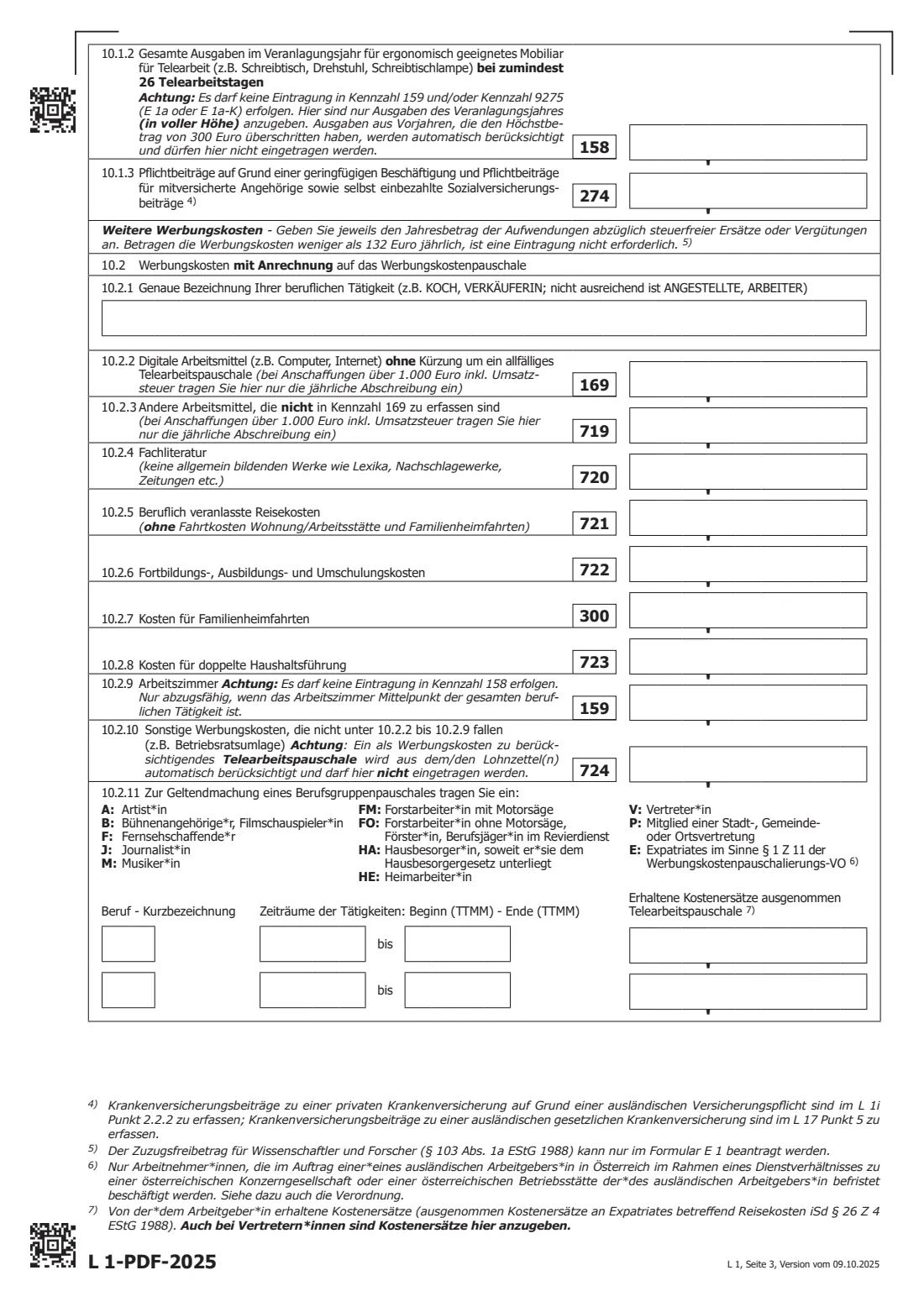
- 10.2 Work expenses set against the lump sum (Werbungskosten mit Anrechnung auf das Werbungskostenpauschale)Taxpayer (steuerpflichtige*r)
- 10.2.11 Occupational group lump sum (Berufsgruppenpauschale)Taxpayer (steuerpflichtige*r)
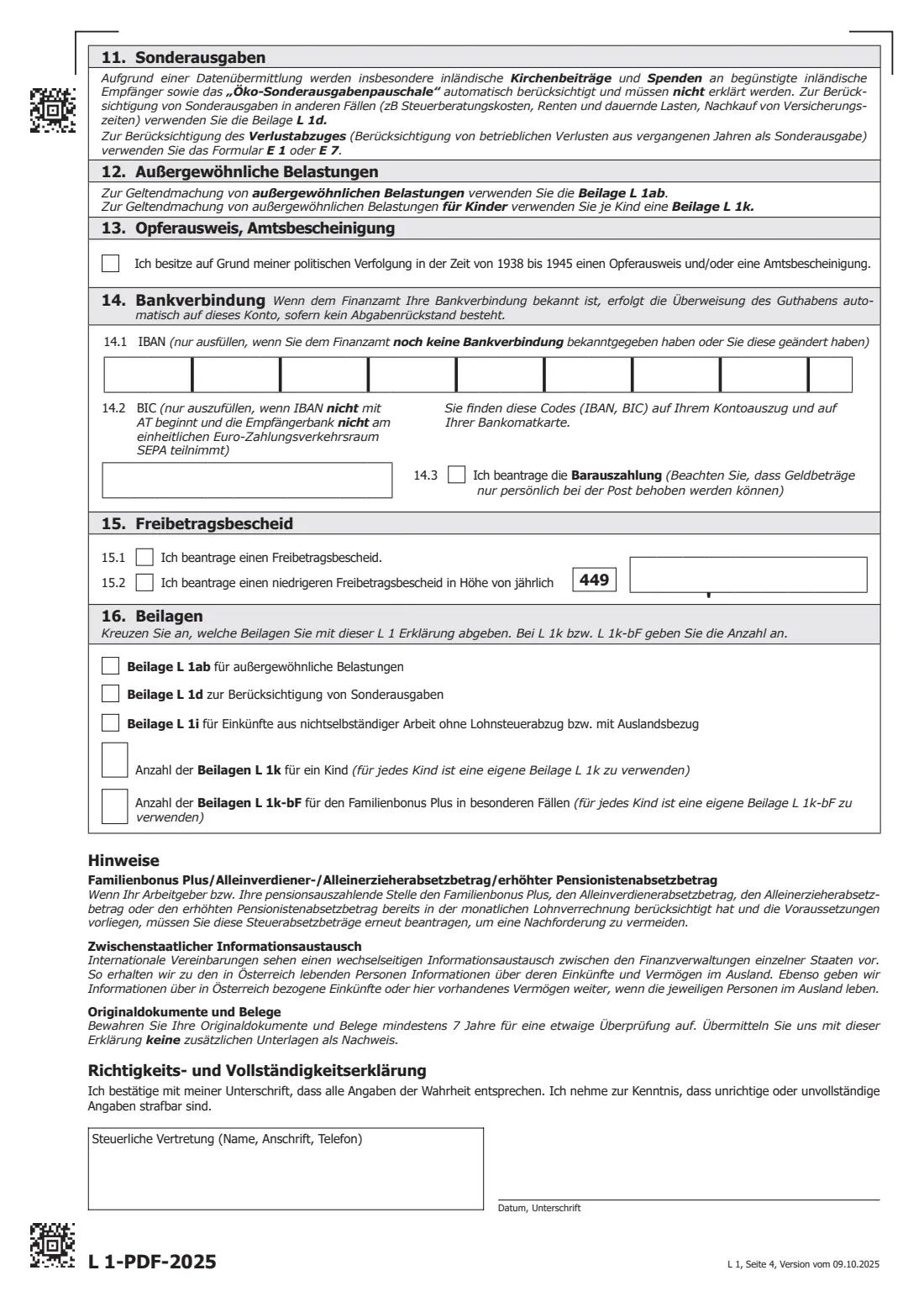
- 11.–13. Special expenses, extraordinary burdens, victim's card (Sonderausgaben, außergewöhnliche Belastungen, Opferausweis)Taxpayer (steuerpflichtige*r)
- 14. Bank account (Bankverbindung)Taxpayer (steuerpflichtige*r)
- 15. Exemption notice (Freibetragsbescheid)Taxpayer (steuerpflichtige*r)
- 16. Supplements you enclose (Beilagen)Taxpayer (steuerpflichtige*r)
- Declaration and signature (Richtigkeits- und Vollständigkeitserklärung)Taxpayer (steuerpflichtige*r)
How to fill out L 1 (2025) — employee tax assessment, step by step
1 1. Angaben zur Person (about you)
Surname, first name and title, your 10-digit social security number from your e-card, sex, and your date of birth if you have no social security number. Then your marital status on 31 December 2025, ticking only one box, and the date it began (not needed if single).
2 2. Derzeitige Wohnanschrift (address)
Street, house number, staircase, door, town, postcode and phone number. If you don't live in Austria, give your country of residence as a car nationality code, such as D for Germany or H for Hungary.
3 3. Partner*in
Your spouse or registered partner, or a cohabiting partner with whom you have at least one child for whom family allowance was received for at least seven months. Give their name and social security number, or their date of birth if they have none.
4 4. Arbeitgeber*innen (employers and pension payers)
The number of Austrian employers or pension payers that paid you in 2025. The form warns that leaving it empty delays processing: enter 0 if there were none. Unemployment benefit, sickness benefit, maternity benefit and similar payments don't count. Kennzahl 725 is for tax-free income under international agreements, such as from the UN or UNIDO.
5 5.–8. Credits and supplements
Tick the sole earner's credit (5.1.1) or the single parent's credit (5.1.2), and give the number of children with family allowance for at least seven months (5.1.3). Part 6 is the child supplement, with 6.1 if you claimed 5.1.1 or 5.1.2 and 6.2 if you didn't. Part 7 is the increased pensioner's credit and part 8 the large-family supplement for 2026. The conditions are printed next to each box.
6 9. Pendlerpauschale/Pendlereuro
Only if your employer didn't already apply the right amount. Enter the annual commuter allowance (Kennzahl 718) and commuter euro (Kennzahl 916) together, as calculated by the BMF's Pendlerrechner.
7 10. Werbungskosten (work expenses)
10.1 covers expenses not set against the lump sum: union fees, ergonomic furniture for telework, and certain insurance contributions. 10.2 covers expenses that are set against it. Give your exact occupation, then the annual amounts for work equipment, specialist literature, travel, training, trips home, double household, home office and other expenses. 10.2.11 is for occupations with a lump sum, such as journalists, musicians or sales representatives.
8 13.–16. Victim's card, bank, exemption notice, supplements
Tick part 13 if you hold an Opferausweis or Amtsbescheinigung. Give an IBAN only if it's new to the tax office, or ask for cash payment. Part 15 asks for an exemption notice (Freibetragsbescheid), or a lower one. Part 16 lists the supplements you enclose, with the number of L 1k and L 1k-bF forms.
9 Declaration and signature
By signing you confirm that everything is true; the form notes that incorrect or incomplete information is punishable. If a tax adviser represents you, give their details. FileIt prints the date and you sign beside it.
Common mistakes to avoid
- Leaving 4.1 empty. The form says this delays processing, so enter 0 if you had no Austrian employer or pension payer.
- Not claiming credits your employer already applied. The form's notes say to claim them again here to avoid a back-payment.
- Claiming both the sole earner's and the single parent's credit, or claiming either without a child in 5.1.3.
- Ticking 6.1 without having claimed 5.1.1 or 5.1.2, or 6.2 when you did.
- Filling in only one of Kennzahl 718 and 916. The form says both go together.
- Entering the telework lump sum yourself. It comes from your pay slip automatically.
- Claiming ergonomic furniture (158) and a home office (159) together.
- Writing ANGESTELLTE or ARBEITER as your occupation. The form asks for something specific, like KOCH or VERKÄUFERIN.
- Sending receipts. The form asks you to keep originals for at least seven years instead.
After you fill it out
Print the L 1 from FileIt, sign page 4 and post it with any supplements to the address printed on the form: Finanzamt Österreich, Postfach 260, 1000 Wien. The form also points out that the same return can be filed paperless in FinanzOnline.
Don't attach receipts or pay slips. Keep your original documents for at least seven years in case the tax office asks, and keep the filled L 1 in your FileIt vault with that year's paperwork.
Any refund is paid to the bank account the tax office has on file, unless you owe tax. Next year needs a new L 1, because each edition is tied to its tax year.
Fill out L 1 (2025) — employee tax assessment online with FileIt
- Pick the person. Choose someone from People and FileIt fills in their name, date of birth, address and other details it already knows.
- Answer plain-language questions. One part of the form at a time, with the official help text beside each question — 88 fields in all. Your answers save as you go.
- Check the live preview. Watch your answers land on the real Bundesministerium für Finanzen (BMF) — Finanzamt Österreich form, and let FileIt do any worksheet arithmetic.
- Generate the official PDF. FileIt prints your answers into the agency’s own PDF and files it in that person’s folder in your vault. Sign it, or send it for e-signature.
FileIt fills the form — it never files or submits anything for you. Deliver the finished form to whoever asked for it, the way the form’s instructions say.
Start L 1 (2025) — employee tax assessment now — it’s freeL 1 (2025) — employee tax assessment: frequently asked questions
What is the L 1?
It is the Austrian employee tax assessment (Arbeitnehmerveranlagung) return, used by employees and pensioners to settle a year's income tax and claim deductions and credits. This edition is for 2025.
Can I file the L 1 online?
Yes. FinanzOnline accepts the same return. With FileIt you answer in English and get the official BMF PDF filled in, ready to print, sign and post.
Where do I send the paper L 1?
To the address printed on it: Finanzamt Österreich, Postfach 260, 1000 Wien. FileIt doesn't submit it for you.
How do I claim my children?
With a separate supplement L 1k for each child, attached to the L 1. FileIt has the L 1k too. Give the number of L 1k forms in part 16.
Do I need to attach receipts?
No. The form asks you not to send extra documents but to keep originals and receipts for at least seven years.
My employer already applied the Alleinverdienerabsetzbetrag. Do I claim it again?
Yes. The form's notes say that credits already applied in payroll must be claimed again in the assessment to avoid a back-payment.
Where do the commuter allowance amounts come from?
From the BMF's Pendlerrechner at bmf.gv.at/pendlerrechner. Enter the annual Pendlerpauschale (718) and Pendlereuro (916) only if your employer didn't already apply the right amount.
Official sources
- Blank form (PDF), published by Bundesministerium für Finanzen (BMF) — Finanzamt Österreich: https://formulare.bmf.gv.at/service/formulare/inter-Steuern/pdfs/2025/L1.pdf?open=download
- Official instructions and guidance: https://formulare.bmf.gv.at/service/formulare/inter-Steuern/L1.html
- Edition shown on this page: L 1-PDF-2025, Version vom 09.10.2025 (checked 2026-09-28).
FileIt is not affiliated with or endorsed by Bundesministerium für Finanzen (BMF) — Finanzamt Österreich or any government. This page explains the form in general terms and is not legal, tax or immigration advice. Always read the official instructions, and check that you are using the edition the recipient accepts. Page last reviewed 2026-09-28.