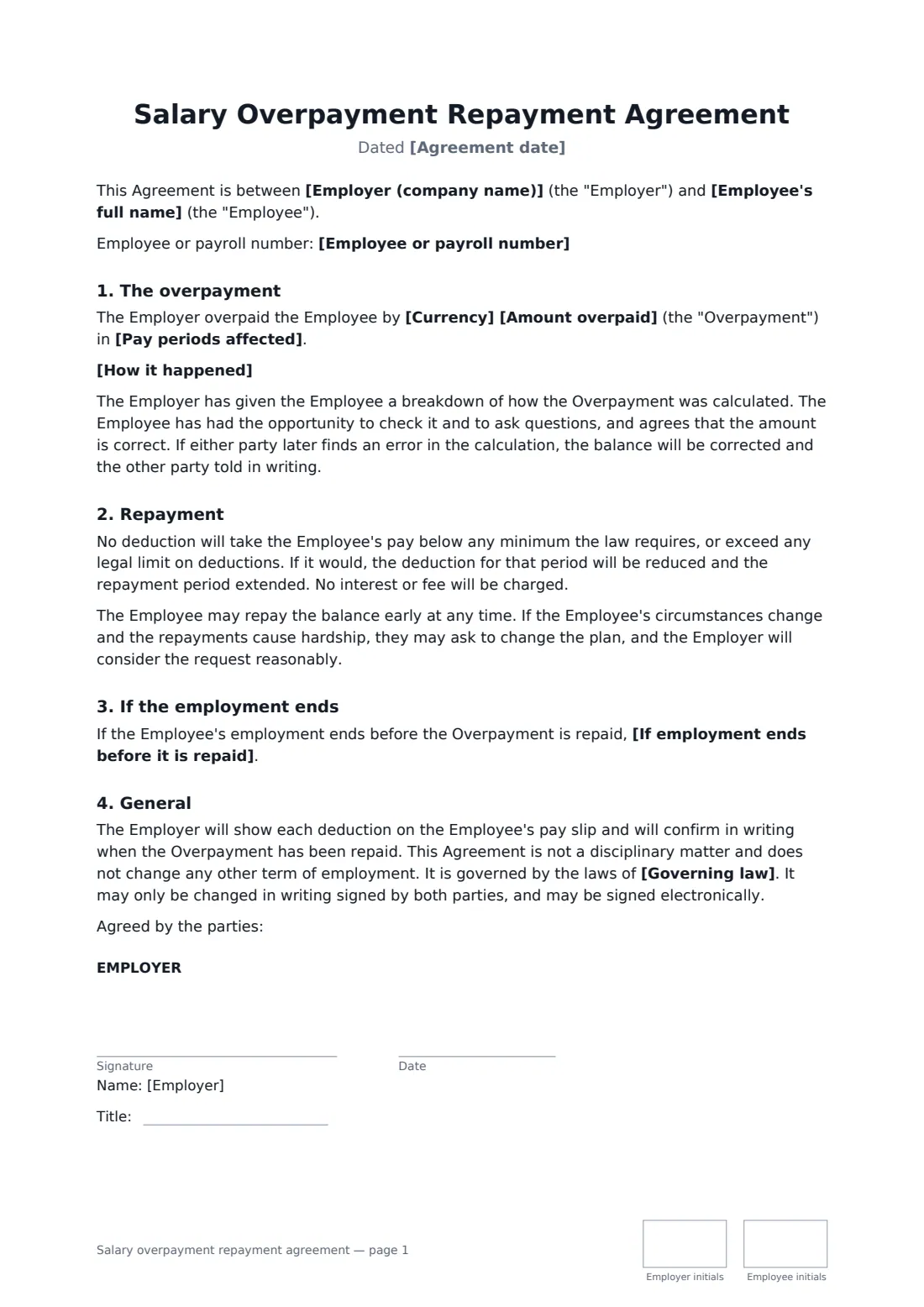

What is a salary overpayment repayment agreement?
Payroll mistakes happen: a pay rise applied twice, hours that weren't updated, a leaver paid for an extra month. Recovering the money is usually fair, but taking it back without warning — or without consent — can cause hardship and, in many places, breach wage rules.
This agreement records the amount overpaid, the pay periods affected and how it happened, and confirms the employee has seen the calculation and agrees it. You choose deductions from pay in instalments, a single deduction, or payments by the employee. The plan never takes pay below the legal minimum, charges no interest, allows early repayment, and lets the employee ask to change it if it causes hardship. It covers what happens if employment ends before the balance is repaid, and confirms this isn't a disciplinary matter.
- Best for
- Recovering wage overpayments by agreement
- Signed by
- The employer and the employee
- Repayment
- Instalments from pay, one deduction, or payments by the employee
- Length
- About 2 pages, initialled on every page
When to use a salary overpayment repayment agreement
- Hours were reduced but payroll kept paying the old hours
- A one-off payment was processed twice
- An employee on unpaid leave was paid in error
- A leaver received an extra month's salary
- A pay rise was backdated to the wrong date
What you fill in
15 blanks, then the name and email of each person who signs: employer, employee.
1 The parties
- Agreement date*
- Employer (company name)*
- Employee's full name*
- Employee or payroll number
2 The overpayment
- Currency*
- Amount overpaid*
- Pay periods affected*
- How it happened*
3 Repayment
- How it will be repaid* Deductions from pay · Payments by the Employee · A single deduction from the next pay
- Instalment amount
- Instalments* each pay period · each month
- First repayment on*
- Where to send payments (if paid by the employee)
- If employment ends before it is repaid* the balance may be deducted from final pay, as far as the law allows, and any amount left will be repaid on a schedule agreed at that time · the Employee will continue to repay the balance at the same rate by payments to the Employer
- Governing law*
4 Who signs
- Employer signature and date, job title, initials on every page · The payroll, finance or HR person agreeing the plan.
- Employee signature and date, initials on every page
What the salary overpayment repayment agreement covers
- The overpayment
- Repayment
- If the employment ends
- General
Using the salary overpayment repayment agreement, step by step
1 Explain the overpayment
Enter the amount, the pay periods affected and a plain explanation of what went wrong. Give the employee the detailed calculation separately.
2 Agree the repayment method
Choose deductions from pay, a single deduction or payments by the employee, and set the instalment, frequency and first repayment date. Talk to the employee about what's affordable first.
3 Decide what happens if they leave
Choose whether any balance is taken from final pay as far as the law allows, or repaid at the same rate after they leave.
4 Send for signature
Both parties initial and sign. Show each deduction on the pay slip and confirm when the balance is cleared.
Tips before you send it
- Tell the employee as soon as you spot the mistake, and apologise — it was your error.
- Agree an instalment the employee can afford, especially for larger amounts.
- Ask your payroll provider how tax already deducted on the overpayment is handled where you are.
- Check whether written consent, limits or a time limit apply to recovering overpaid wages where the employee works.
Sign it online in minutes
- Fill in the blanks. Names, dates and amounts go straight into the agreement — the preview shows exactly where.
- Name who signs. Tick “This is me” for your own part. FileIt builds the PDF with every signature, date and initials box on the right line, and you can check or move anything before sending.
- Send it. Each signer gets a secure link and signs from any device — no account needed. The signed PDF, with an audit trail and a Certificate of Completion, is filed in your vault and emailed to everyone.
Salary overpayment repayment agreement: frequently asked questions
Can I just deduct an overpayment from the next pay?
Rules differ. In many places you need the employee's written consent, and deductions may be limited. This agreement records consent and a plan; check the local rules before deducting.
Is interest charged?
No. The agreement says no interest or fee is charged, and the employee can repay early at any time.
What if the repayments cause hardship?
The employee can ask to change the plan, and the employer agrees to consider the request reasonably.
Is this the same as a payroll deduction authorization?
It's related but specific: it explains an overpayment and sets a repayment plan. A payroll deduction authorization covers ongoing deductions such as benefits or loans.