What is a employment arbitration agreement?
Some employers ask employees to agree that workplace disputes will be decided by a private arbitrator rather than a court. Whether that's allowed, and on what terms, varies a great deal from place to place and changes often. This template is a careful starting point, not a finished agreement — have an employment lawyer check it for your location before anyone signs.
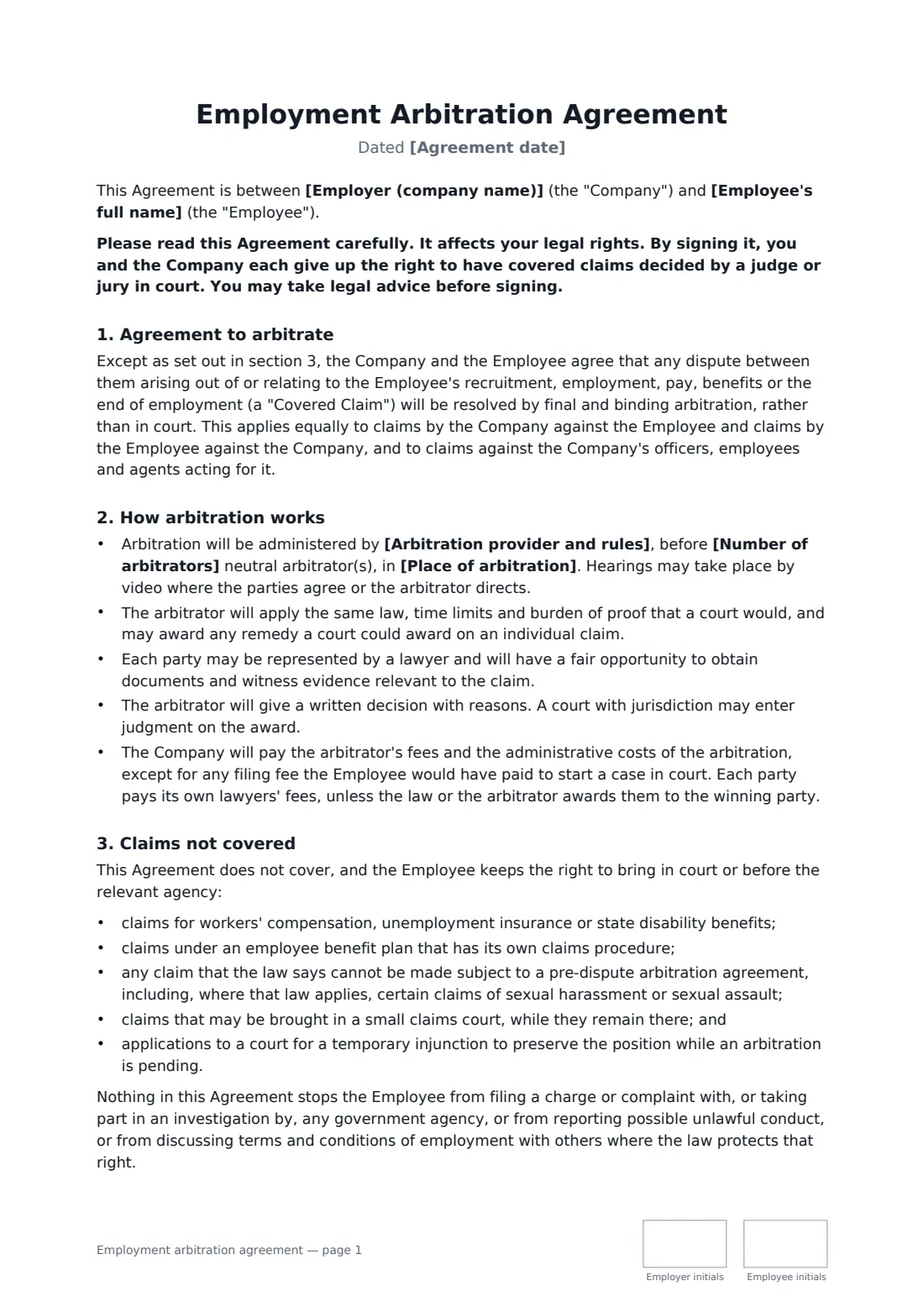
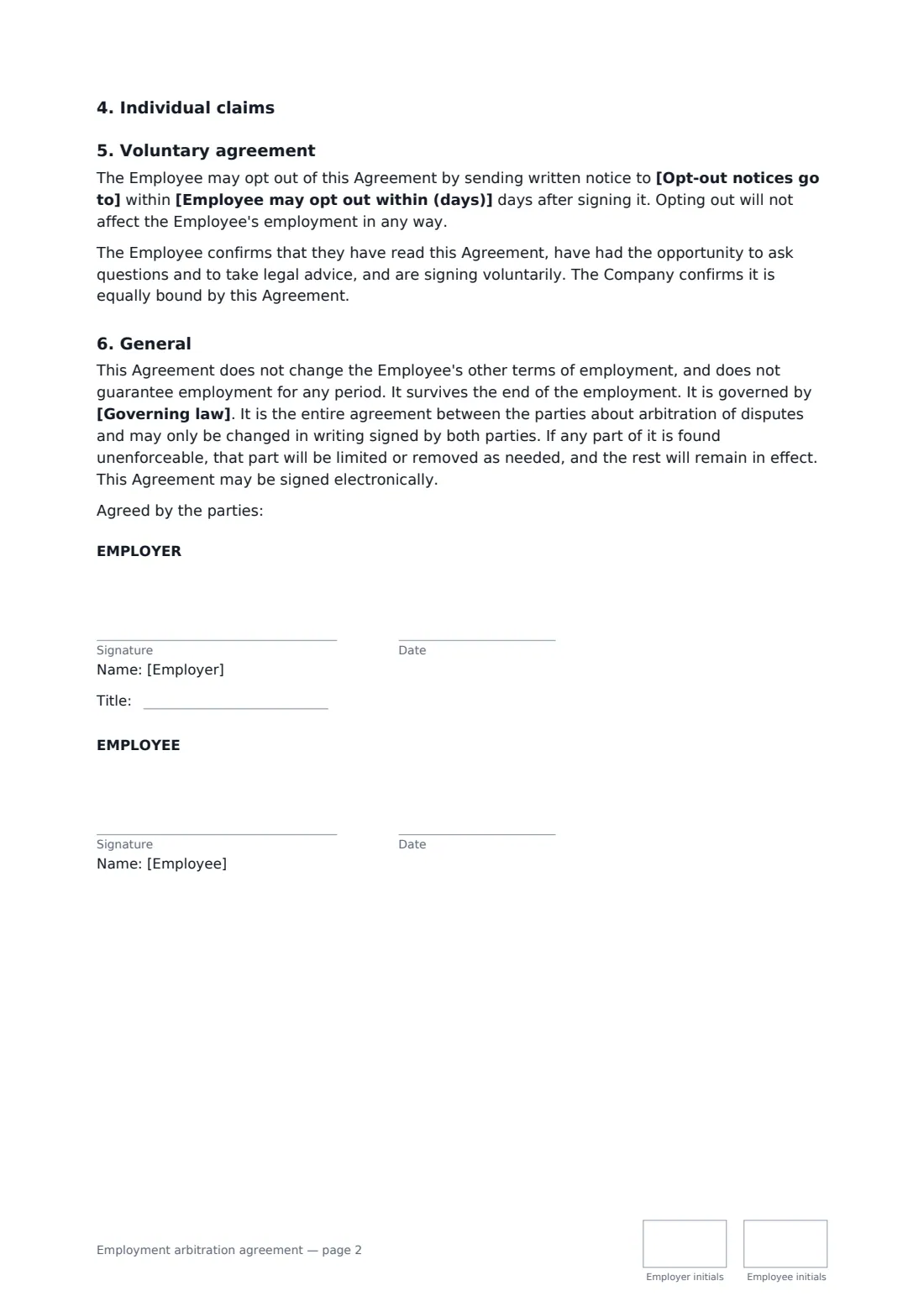
The agreement is mutual: it binds the company as much as the employee. It opens with a plain warning that it affects legal rights, names the arbitration provider and place, has the company pay the arbitrator's fees, and requires the arbitrator to apply the same law and remedies as a court. It excludes claims that can't be arbitrated by law, small claims and benefit claims, and keeps the employee's right to go to government agencies, report unlawful conduct and discuss pay. A class action waiver is off by default, and you can give the employee a window to opt out.
- Best for
- Employers whose lawyer has recommended an arbitration programme
- Signed by
- The employer and the employee
- Costs
- Arbitrator and administration fees paid by the employer
- Legal review
- Strongly recommended before use
- Length
- About 3 pages, initialled on every page
When to use a employment arbitration agreement
- Rolling out an arbitration programme your lawyer has approved
- Adding a stand-alone arbitration agreement for new hires
- Replacing a one-sided arbitration clause with a mutual one
- Offering arbitration with an opt-out window to keep it voluntary
- A starting draft for your lawyer to adapt
What you fill in
10 blanks, then the name and email of each person who signs: employer, employee.
1 The parties
- Agreement date*
- Employer (company name)*
- Employee's full name*
2 Arbitration
- Arbitration provider and rules*
- Place of arbitration*
- Number of arbitrators* one · three
- Class or collective action waiver* Not included · Included, to the extent the law allows
3 Opt-out
- Employee may opt out within (days)
- Opt-out notices go to
4 General
- Governing law*
5 Who signs
- Employer signature and date, job title, initials on every page · Someone authorised to bind the Company.
- Employee signature and date, initials on every page
What the employment arbitration agreement covers
- Agreement to arbitrate
- How arbitration works
- Claims not covered
- Individual claims
- Voluntary agreement
- General
Using the employment arbitration agreement, step by step
1 Talk to a lawyer first
Arbitration rules for employment differ widely, and some claims can't be arbitrated at all. Confirm the approach is allowed and appropriate where you operate.
2 Name the provider and place
Enter the arbitration body and rules your lawyer recommends, the place of arbitration and the number of arbitrators.
3 Decide on class waiver and opt-out
Leave the class action waiver off unless your lawyer advises otherwise. Add an opt-out period and contact if you want to give the employee a clear choice.
4 Send with time to read
Send it separately from other onboarding documents, give the employee time to read it and take advice, and have both parties initial and sign.
Tips before you send it
- Don't bury arbitration in an offer letter or handbook. A separate, clearly titled agreement is easier to defend.
- Make sure the company is bound too — one-sided arbitration agreements are vulnerable.
- Some places ban arbitration as a condition of employment, or for particular claims. Check before you send.
- Review the agreement whenever the law changes; it moves often in this area.
Sign it online in minutes
- Fill in the blanks. Names, dates and amounts go straight into the agreement — the preview shows exactly where.
- Name who signs. Tick “This is me” for your own part. FileIt builds the PDF with every signature, date and initials box on the right line, and you can check or move anything before sending.
- Send it. Each signer gets a secure link and signs from any device — no account needed. The signed PDF, with an audit trail and a Certificate of Completion, is filed in your vault and emailed to everyone.
Employment arbitration agreement: frequently asked questions
Is an employment arbitration agreement enforceable?
It depends heavily on where you are, the type of claim, and how the agreement was presented and signed. FileIt makes no promise about enforceability. Have an employment lawyer review this template before use.
Does the employee give up the right to complain to a government agency?
No. The agreement keeps the employee's right to file charges with or take part in investigations by government agencies, to report unlawful conduct, and to discuss pay where the law protects it.
Who pays for arbitration?
The company pays the arbitrator's fees and administration costs, apart from any filing fee the employee would have paid in court. Each side pays its own lawyers unless the law or arbitrator says otherwise.
Can the employee say no?
If you add an opt-out period, the employee can opt out by written notice within that time without any effect on their job. Whether arbitration can be required as a condition of employment depends on local law.