What is Form DR1 (Dependent Relative Tax Credit)?
The Dependent Relative Tax Credit is an Irish income tax credit for people who support a relative. Revenue's page gives it as EUR 305 for 2025 and 2026, and EUR 245 for 2022 to 2024. No credit is due if the relative's own income is over the limit, which Revenue gives as EUR 18,028 for 2025 and EUR 18,548 for 2026. All of the relative's income counts, including social welfare payments, pensions and deposit interest.
You can claim for a relative of yours or of your spouse or civil partner who can't maintain themselves because of old age or infirmity and whom you maintain at your own expense. You can also claim for a widowed father or mother, or a parent who is a surviving civil partner, of yourself, your spouse or civil partner, whether they are incapacitated or not. The relative doesn't have to live in Ireland. Revenue's main route is myAccount, and Form DR1 is the paper claim. A claim for a child on whose services you depend uses Form DR2.
FileIt fills Revenue's own PDF for you, one capital letter per box as the form is laid out, with the euro amounts right-aligned in their cells. It checks the IBAN and the dates, and files the result in your vault. You sign the declaration and send it to Revenue yourself. FileIt never submits anything.
- Issued by
- Office of the Revenue Commissioners (Revenue)
- Credit (Revenue's page)
- EUR 305 for 2025 and 2026; EUR 245 for 2022 to 2024
- Relative's income limit
- EUR 18,028 for 2025; EUR 18,548 for 2026
- Online alternative
- myAccount: Claim tax credits, Dependent Relative Tax Credit
- Edition
- RPC019295_EN_WB_L_1 (February 2025 PDF), 2 pages
Who needs to fill out Form DR1 (Dependent Relative Tax Credit)?
- People who support an elderly or infirm relative, or one of their spouse's or civil partner's, who can't maintain themselves.
- People whose father or mother, or whose spouse's or civil partner's parent, is widowed or a surviving civil partner, whether or not that parent is incapacitated.
- Claimants who can't use myAccount and need the paper claim.
When to use Form DR1 (Dependent Relative Tax Credit)
- When you start maintaining a dependent relative, to have the credit added to your tax credits.
- For an earlier year, within the four-year time limit for repayment claims printed on the form.
- Not for a child on whose services you depend. That claim is on Form DR2.
What you need before you start
- Your name, address with Eircode, and PPSN.
- The relative's name and address, and their PPSN if you know it.
- How they are related to you.
- The sources and annual amount of their income, and what others contribute each year.
- Unless the claim is for a widowed parent: their date of birth and the nature of their infirmity.
- Your IBAN and BIC if you want any refund paid into your bank account.
What’s on Form DR1 (Dependent Relative Tax Credit)
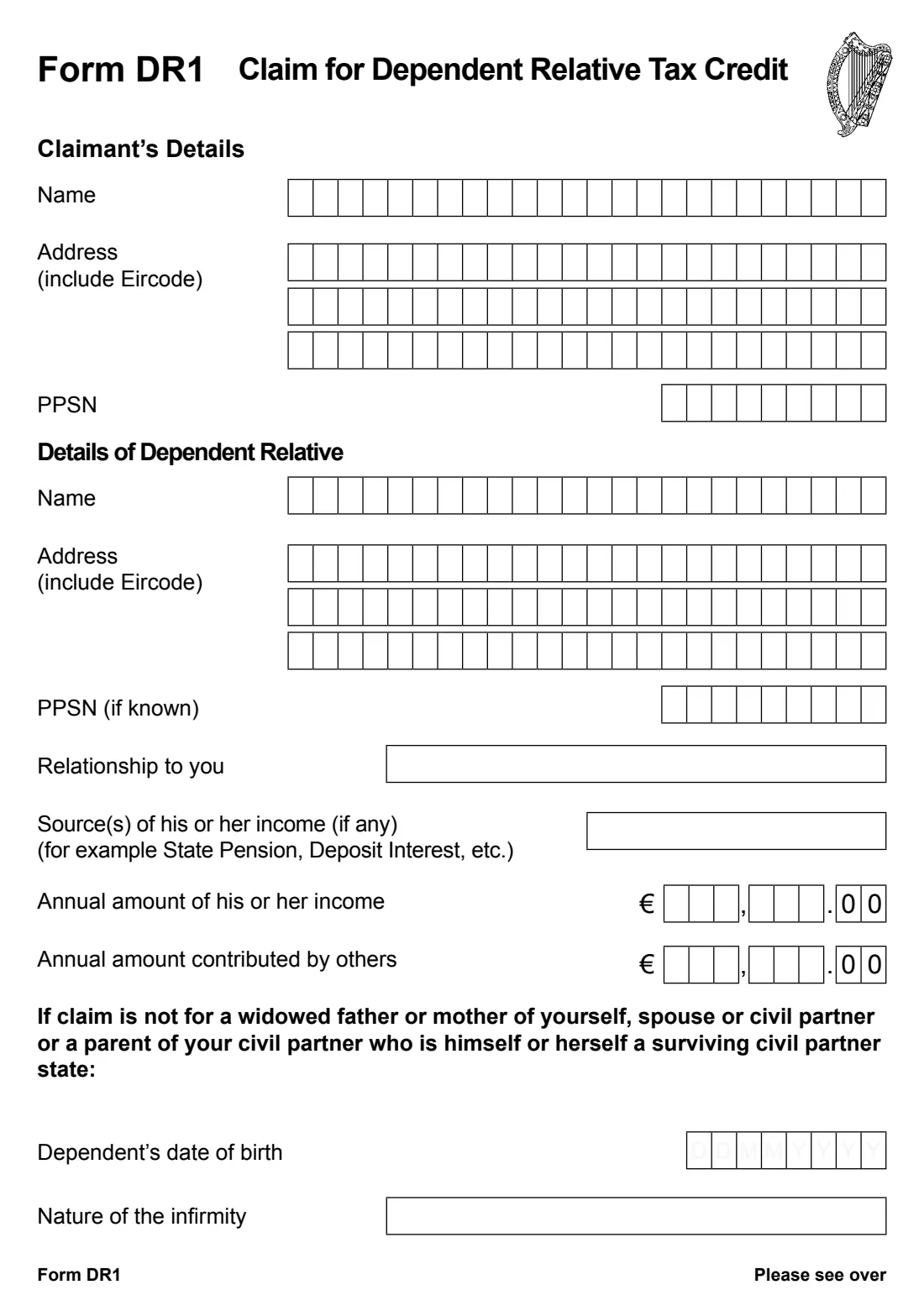
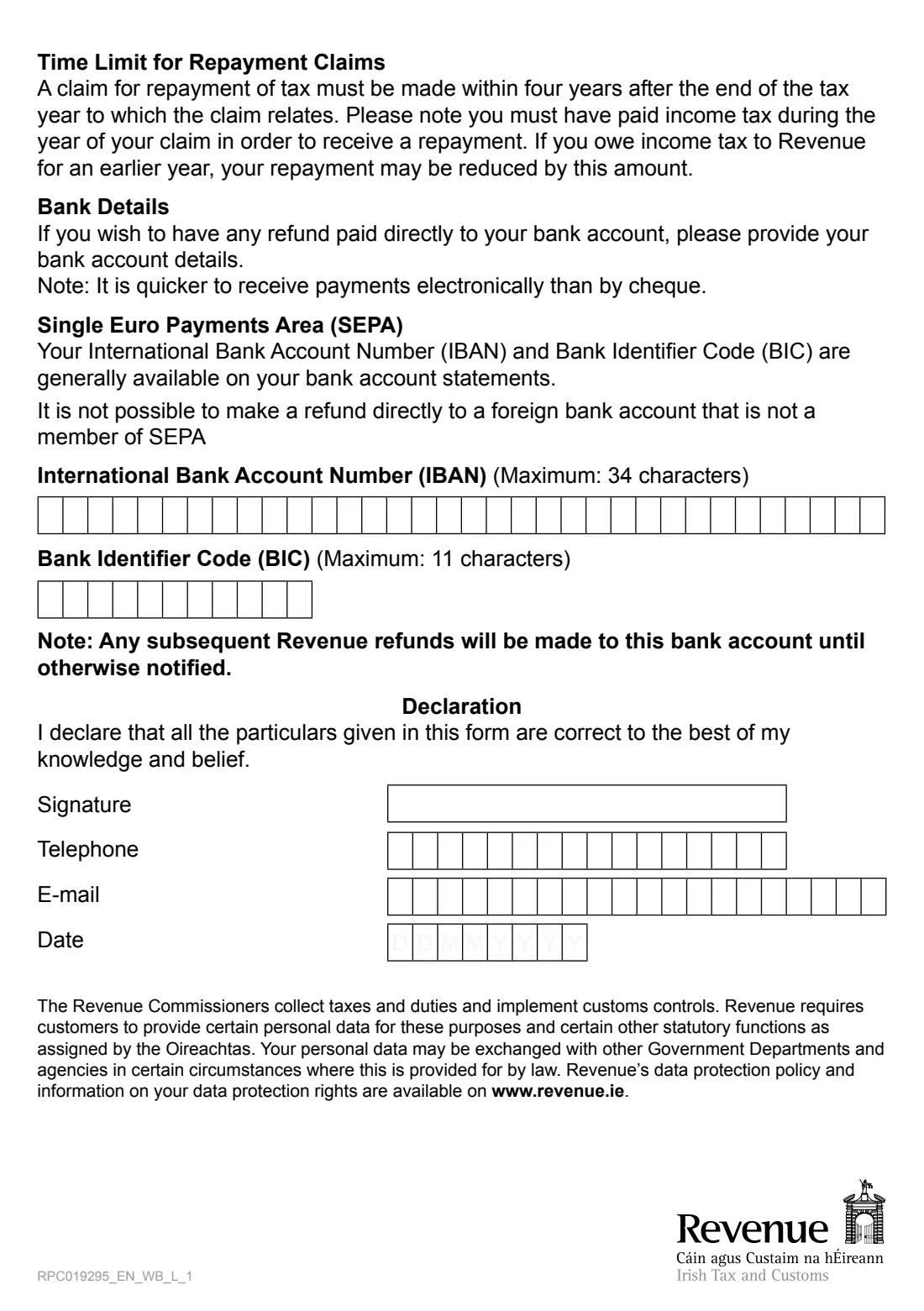
The 2025 edition has 2 pages. FileIt asks for it in 4 parts, and it is signed by Claimant:
- Claimant's detailsClaimant
- Details of dependent relativeClaimant
- Bank details (SEPA)Claimant
- DeclarationClaimant
How to fill out Form DR1 (Dependent Relative Tax Credit), step by step
1 Claimant's details
Your name, a three-line address ending with your Eircode, and your PPSN, one character per box.
2 Details of dependent relative
The relative's name, address and PPSN (if known), your relationship, the sources of their income, the annual amount of their income and the annual amount others contribute. Amounts are whole euro: the form prints the '.00'.
3 Date of birth and infirmity
Only if the claim is not for a widowed father or mother (or a parent who is a surviving civil partner): give the dependent's date of birth and the nature of the infirmity.
4 Bank details
Optional. An IBAN and BIC for any refund. Revenue can't pay into an account outside the Single Euro Payments Area (SEPA).
5 Declaration
Sign and date the declaration that the particulars are correct, and add a telephone number and email if you like. The email box has 20 character cells.
Common mistakes to avoid
- Leaving out part of the relative's income. Revenue says all of it counts, including social welfare payments, pensions and deposit interest.
- Skipping the date of birth and infirmity for a relative who isn't a widowed parent.
- Using DR1 for a child you depend on. That is Form DR2.
- Writing more than fits: each name and address line has 24 boxes.
- Mistyping the IBAN. FileIt checks its check digits.
After you fill it out
Sign the declaration and send the form to your Revenue office. FileIt does not send it for you.
Keep the filled PDF in your FileIt vault, with any evidence that you maintain the relative.
Check that the credit shows on your next Tax Credit Certificate or in myAccount.
Fill out Form DR1 (Dependent Relative Tax Credit) online with FileIt
- Pick the person. Choose someone from People and FileIt fills in their name, date of birth, address and other details it already knows.
- Answer plain-language questions. One part of the form at a time, with the official help text beside each question — 22 fields in all. Your answers save as you go.
- Check the live preview. Watch your answers land on the real Office of the Revenue Commissioners (Revenue) form, and let FileIt do any worksheet arithmetic.
- Generate the official PDF. FileIt prints your answers into the agency’s own PDF and files it in that person’s folder in your vault. Sign it, or send it for e-signature.
FileIt fills the form — it never files or submits anything for you. Deliver the finished form to whoever asked for it, the way the form’s instructions say.
Start Form DR1 (Dependent Relative Tax Credit) now — it’s freeForm DR1 (Dependent Relative Tax Credit): frequently asked questions
What is Form DR1?
It is Revenue's paper claim for the Dependent Relative Tax Credit, for someone who maintains an incapacitated relative or has a widowed parent.
How much is the Dependent Relative Tax Credit?
Revenue's page gives EUR 305 for 2025 and 2026, and EUR 245 for 2022 to 2024. Figures can change in each Budget, so check Revenue's page for the year you claim.
Is there an income limit for the relative?
Yes. Revenue says no credit is due if the relative's income exceeds EUR 18,028 for 2025 or EUR 18,548 for 2026, and all their income counts.
Does my relative need to live in Ireland?
No, according to Revenue's page, except for a dependent child, who must live in Ireland with you.
Can I claim online instead?
Yes. Revenue's main route is myAccount: 'Manage your tax for the current year', 'Claim tax credits', then 'Dependent Relative Tax Credit'. Self-assessed taxpayers claim in their income tax return.
Can I fill in Form DR1 online with FileIt?
Yes. FileIt fills Revenue's own PDF box by box, checks your answers and files it in your vault. You can sign it by hand or e-sign it in FileIt, then send it to Revenue yourself.
Official sources
- Blank form (PDF), published by Office of the Revenue Commissioners (Revenue): https://www.revenue.ie/en/personal-tax-credits-reliefs-and-exemptions/documents/formdr1.pdf
- Official instructions and guidance: https://www.revenue.ie/en/personal-tax-credits-reliefs-and-exemptions/health-and-age/dependant-relative-tax-credit/index.aspx
- Edition shown on this page: RPC019295_EN_WB_L_1 (PDF of February 2025) (checked 2026-10-01).
FileIt is not affiliated with or endorsed by Office of the Revenue Commissioners (Revenue) or any government. This page explains the form in general terms and is not legal, tax or immigration advice. Always read the official instructions, and check that you are using the edition the recipient accepts. Page last reviewed 2026-10-01.